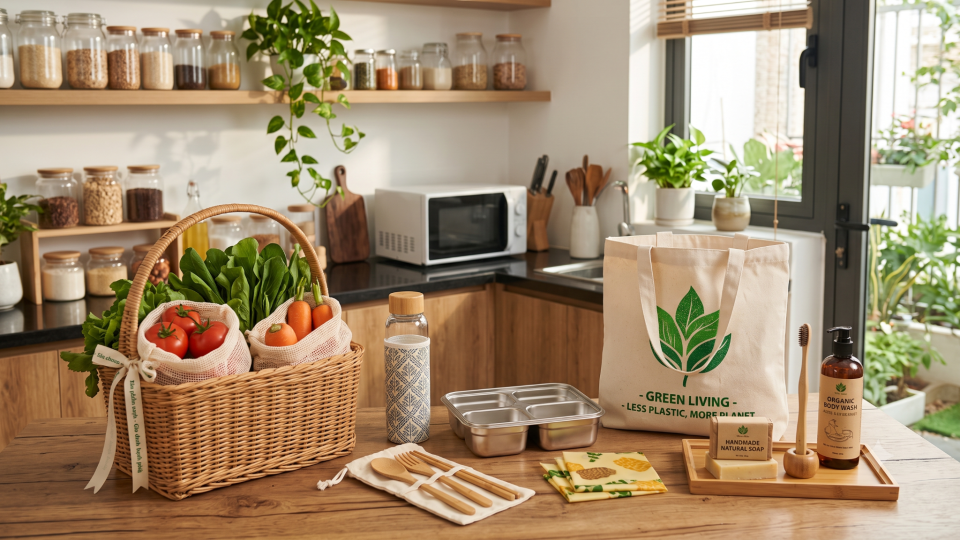
Think about everything you might use before lunchtime: a takeaway coffee cup, a food wrapper, a bottle of hand soap, a delivery package, and perhaps a shopping bag. Each item may seem too small to matter. Some will stay in use for months or years. Others will become waste within minutes.
That difference is why eco-friendly products deserve attention. The choices we make about what to buy, how often to replace it, and how long to use it affect demand for materials and the amount of waste we create. Yet “eco-friendly” can also be a vague marketing promise. Buying more products simply because they look green may miss the point.
This article explains why everyday products matter, where better choices can make a difference, and how to avoid turning sustainable living into another shopping trend.
The Short Answer
Eco-friendly products matter because the items we use every day require materials to produce and eventually become waste. Durable, reusable, repairable, and thoughtfully packaged products can help reduce the need for repeated purchases when they fit our needs and are used as intended. The most effective starting point is to buy less of what you do not need, make good use of what you already own, and choose replacements carefully.
Why Should We Care About the Products We Buy?
A product’s impact begins before it reaches our hands and continues after we throw it away.
Consider a disposable bottle. By the time you purchase it, materials have already been obtained, turned into a container, packaged or filled, and transported. Once you are finished, the bottle needs to be collected and handled. A product used for only a short time can therefore have a much longer story than its time in your home suggests.
This is the idea behind a life cycle approach. Instead of asking only what an item is made from, we consider its production, distribution, use, and end of life. The US Environmental Protection Agency (EPA) uses this approach to identify opportunities to conserve resources and reduce environmental impacts.
The scale of the issue becomes clearer when we look beyond a single bottle or bag. According to the OECD’s Global Plastics Outlook, the world generated 353 million tonnes of plastic waste in 2019. After accounting for losses during recycling, only 9% was ultimately recycled. These figures describe global plastic waste in that year; they do not mean that every plastic item follows the same path. They do show why relying on recycling alone cannot answer every question about the products we use.
Our purchases are part of a much larger system shaped by product design, business practices, collection services, and public policy. Individual choices cannot replace those systems. They can, however, help us reduce avoidable waste in our own routines and support products and services designed for longer use.
How Can Eco-Friendly Products Reduce Waste?
They can reduce waste when they prevent disposable items from being used repeatedly or keep an existing product in service for longer.
A reusable water bottle is an easy example. If you carry it regularly, it may replace bottles you would otherwise purchase while away from home. A washable cloth can take the place of some disposable cleaning wipes. A refillable dispenser may let you keep using the same container.
The key phrase is “when you use it.” A reusable product does not deliver its intended benefit while sitting untouched in a cupboard. It needs to be convenient enough to become part of your routine.
Waste prevention also includes choices that are less visible than buying a new reusable item:
- Repairing a bag instead of replacing it.
- Replacing a worn component rather than the entire product.
- Choosing a durable item that stays useful for years.
- Borrowing something needed only occasionally.
- Using up what you have before purchasing another version.
The EPA’s waste management hierarchy places source reduction and reuse ahead of recycling. Source reduction means preventing waste from being created in the first place. Recycling remains valuable, but it addresses material after an item has already been made and used.
This explains why the most meaningful “eco-friendly product” may sometimes be one you already own.
Does Choosing Better Products Help Conserve Resources?
It can, especially when a product lasts longer or replaces repeated purchases.
Every new item requires inputs. Depending on the product, these may include raw materials, water, energy, packaging, and transport. Keeping an item in use can delay the need to make a replacement. Repair and refill options may extend that useful life further.
Picture two kitchen products that do the same job. One breaks after several months and cannot be repaired. The other lasts for years and has a replaceable part. The second product may be a more practical choice because you can keep using the main item. That conclusion still depends on the products’ actual design and your use of them, but durability is a sensible question to ask before buying.
The same thinking applies to clothing, storage containers, cleaning tools, and small household goods. An attractive environmental claim is less useful if the item fails quickly.
A longer useful life is not the only consideration. Some products require electricity, water, or replacement supplies during use. Others are difficult to clean or maintain. Looking at the full life cycle helps you avoid declaring a product “better” based on just one feature.
Can Everyday Product Choices Make a Difference to Climate Change?
They are one part of a broader response, but a green label is not proof of a lower carbon footprint.
Making, transporting, using, and disposing of products can involve energy and greenhouse gas emissions. A product designed to last longer or reduce unnecessary material use may address some of those demands. The outcome depends on the product and how it is used; it cannot be assumed from its color, packaging, or material alone.
The Intergovernmental Panel on Climate Change (IPCC) has found substantial potential in demand-side measures, which include changes in how services are provided and used across buildings, transport, and food. Its findings cover large sectors and many types of action. They should not be read as a claim that switching to a particular shopping bag or bottle will produce a specific emissions reduction.
For an individual shopper, a more honest approach is to ask whether a purchase reduces a real pattern of waste. If you replace a disposable product you use every day with an alternative you will use for years, there is a clear reason to investigate that option. If you buy another item you do not need, the environmental benefit is much harder to justify.
Businesses and governments also matter. Product design determines whether an item can be repaired or refilled. Collection services determine what can be handled locally. Better individual choices work best alongside better systems.
Why Is Reuse Often More Important Than Recycling?
Reuse keeps an item serving its original purpose. Recycling processes its materials after that use has ended. Both can be helpful, but they act at different points in a product’s life.
Take a sturdy food container. Each time you wash and use it again, you continue to benefit from the container as a finished product. If it eventually becomes unusable, recycling may be an option if the material and local system allow it. Recycling cannot substitute for the months or years of use the container could have provided.
That is why product design matters. Items that are easy to clean, refill, maintain, and repair have a better chance of remaining useful. UNEP’s work on single-use products encourages approaches that keep resources in use for longer, including reusable systems, while assessing impacts across the life cycle.
At the same time, “reusable” is a description of a product’s potential. It does not guarantee that the item will be used often enough to be a good choice for every household. Choose products that solve problems you encounter regularly.
How Do Eco-Friendly Products Affect Our Daily Lives?
The best options often make a routine simpler, more reliable, or less wasteful.
Environmental benefits are easier to maintain when a product also works well for the person using it. A shopping bag with comfortable handles is more likely to be carried again. A bottle that is easy to wash is more likely to stay in use. A refill sold nearby is more useful than a refill system you cannot access.
This is why there is no universal shopping list for sustainable living. One person may benefit most from a durable lunch container because they buy takeaway food every workday. Another may already bring lunch from home and have no need for another container.
Cost can matter too. A durable product may have a higher purchase price but a lower cost per use if it replaces frequent purchases. For example, you can divide an item’s price by the number of times you realistically expect to use it. That is a budgeting tool, not a calculation of its environmental impact. A cheap product you use for years may be a better fit than an expensive one you seldom touch.
Convenience matters just as much as intention. If a sustainable option is awkward to store, carry, or maintain, it is worth looking for a design that better fits your life instead of blaming yourself for not using it.
Quick Comparison
There are several ways a product can support a less wasteful routine. Each one addresses a different question:
- A durable product aims to stay useful for longer. Ask how it holds up and whether worn parts can be replaced.
- A reusable product is designed for repeated use. Ask how often you will actually use and clean it.
- A refillable product lets you retain a container or device. Ask whether compatible refills are available and affordable.
- A product with recycled content uses recovered material. Ask what percentage it contains and which part of the product the claim covers.
- A recyclable product may be processed after use. Ask whether your local collection service accepts that specific item.
- A compostable product requires appropriate composting conditions. Ask whether it is suitable for home composting or needs an industrial facility.
These features can overlap, but none of them alone proves that a product is the best choice. For example, an item made with recycled material could still break quickly; a recyclable package might not be accepted where you live. Specific details are more useful than a broad label.
How to Choose
Begin with a habit, not a product category. Notice what you throw away or replace most often. Which of those purchases could be avoided? Which products are frustrating because they wear out too quickly?
Use what you already have. You do not need to replace a working item to make a better choice. The EPA recommends asking whether a purchase is necessary and whether an existing item can be repaired, reused, borrowed, or purchased secondhand.
Choose for real use. Imagine an ordinary week, including busy days. Will you remember to bring the item? Is it comfortable? Can you clean it without difficulty? A product that fits your routine has a better chance of replacing repeated purchases.
Look beyond the main material. Check the product’s construction, expected lifespan, care instructions, and replacement parts. A material described as natural does not tell you how long the finished item will last.
Read environmental claims precisely. “Eco-friendly” does not explain what has improved. Look for a clear statement about a particular feature, such as recycled content or a refillable design. EPA consumer guidance cautions that vague claims can be difficult to interpret.
Think about the end of the product’s life. Can it be passed on, repaired, or recycled locally? If it is compostable, which kind of composting does it require? Do not rely on the label without checking the conditions.
Start small and observe. Try one change for a few weeks. Did it reduce the disposable items you use? Was it easy to maintain? Your own experience will tell you whether that choice deserves a permanent place in your routine.
Important Safety Considerations
Eco-friendly does not mean safe for every use. Environmental marketing describes a claimed environmental attribute; it does not replace care instructions or product safety information.
Check whether a food container is suitable for the temperatures and cleaning methods you plan to use. Follow the directions for cleaning products. Do not assume that an item is safe for skin contact, hot food, or microwave use because it is made from a “natural” material.
Be careful with disposal claims as well. The EPA notes that plastic labeled compostable is generally intended for industrial or commercial composting unless it is specifically identified as suitable for home composting. Likewise, a recyclable label does not tell you whether your local program accepts the item.
Finally, avoid throwing away usable possessions simply to replace them with products advertised as green. A lower-waste routine is built through thoughtful use as well as thoughtful buying.
Frequently Asked Questions
Do individual purchases really matter when companies produce so much waste?
Individual purchases matter, but they are only part of the solution. Your habits can reduce waste in your household and determine which products you continue to buy. Larger changes also depend on businesses designing durable products and on effective collection and reuse systems. UNEP describes plastic pollution as a life cycle issue involving production, use, reuse, and waste management.
Are eco-friendly products always more expensive?
No, although purchase prices vary. Some durable items cost more upfront but may replace repeated purchases. Other useful choices—using what you own, repairing an item, or buying secondhand—may require little or no new spending. Compare total cost over the time you expect to use a product, rather than assuming the cheapest or most expensive option is best.
Is a paper or bamboo product automatically better than a plastic one?
No. Compare products that perform the same job, including how they are made, how long they last, and what happens after use. Research into alternatives to single-use bags uses life cycle assessment for this reason.
Can I rely on recycling instead of changing what I buy?
Recycling helps, but waste prevention and reuse address an earlier part of the problem. The EPA’s hierarchy prioritizes reducing and reusing before recycling. The OECD’s estimate that 9% of global plastic waste was ultimately recycled in 2019 also illustrates why a recyclable label should not be your only buying criterion.
What if I cannot find a perfect eco-friendly alternative?
You do not need a perfect product to make a sensible improvement. Identify the problem you want to solve, compare the options available to you, and choose something you can use consistently. Keeping a functional item longer may be more practical than searching for a replacement with an impressive label.
What is one good place to start?
Look at what you repeatedly buy and throw away. Choose one item or routine you encounter often—such as a daily drink, takeaway lunch, or household refill. Check whether something you already own can meet the need. If you buy a replacement, select one that is durable and convenient enough to keep using.
The Bottom Line
Eco-friendly products matter because everyday items have a life before we buy them and a destination after we finish with them. Choosing well can help prevent avoidable waste and keep useful materials in service longer.
The strongest habit is simple: buy what you need, use it fully, and check whether a product’s environmental promise will hold up in your real life. A well-used item can tell a more convincing story than an “eco-friendly” label ever could.