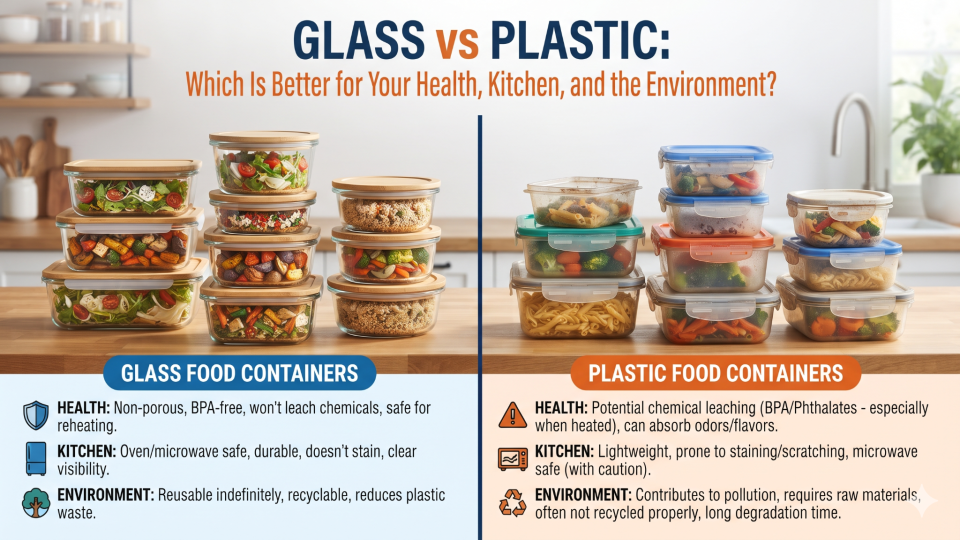
Choosing between glass food containers and plastic food containers may seem like a small decision, but it can influence your daily cooking routine, food storage habits, household expenses, and environmental footprint.
Food storage containers are essential in modern kitchens. Whether you are preparing meals for the week, packing lunch for work, organizing leftovers, or storing fresh ingredients, the right containers can make everyday life easier.
However, with growing concerns about plastic waste, chemical migration, microplastics, and sustainable consumption, many consumers are reconsidering traditional plastic food storage solutions.
Glass containers are often promoted as durable, reusable, and environmentally friendly alternatives. They are resistant to staining, do not absorb food odors easily, and can often be used for reheating food when specifically designed for that purpose.
Plastic containers, on the other hand, remain popular because they are lightweight, affordable, portable, and generally resistant to breaking when dropped.
But does choosing glass automatically mean making a healthier or more sustainable decision?
Not necessarily.
Both materials have advantages and disadvantages. Their environmental impact depends on manufacturing, transportation, lifespan, cleaning habits, and disposal methods. Their suitability for food storage also depends on how they are manufactured and used.
This comprehensive guide explores glass food containers vs plastic food containers, comparing their safety, durability, convenience, environmental impact, cost, and long-term practicality.
By the end, you will understand which material works best for different situations and how to make a more informed, sustainable choice.
The Short Answer
Glass food containers are generally a better choice for people who frequently reheat meals, store strongly flavored foods, and want durable containers that resist staining and odors. Plastic food containers are better suited to lightweight meal transportation, children's lunches, and situations where breakage is a concern.
From an environmental perspective, neither material is automatically superior. The most sustainable option often depends on how long the container lasts, how frequently it is reused, how it is washed, and whether it can be recycled locally.
Are Glass Food Containers Better Than Plastic for Food Safety?
Glass has several advantages for food storage because it is chemically stable, nonporous, and resistant to absorbing flavors or odors. However, properly manufactured food-grade plastic containers can also be suitable for food storage when used according to their instructions.
Understanding the Safety of Glass Food Containers
Glass is made primarily from mineral-based raw materials, including silica sand, soda ash, and limestone.
Once manufactured, ordinary food-contact glass is relatively inert under normal storage conditions. This means it generally does not react with foods or transfer components into them in the same way that some plastic materials can under certain conditions.
Several properties make glass attractive for food storage.
1. Resistance to chemical interactions
Glass does not contain the polymer additives associated with certain plastic products, such as bisphenol A (BPA) or some plasticizers.
This makes glass particularly appealing to consumers who want to minimize contact between food and plastic materials.
However, it is important to distinguish the glass body from its lid. Many glass containers use plastic lids, silicone seals, or other components that may have different temperature and cleaning requirements.
2. Suitable for many types of food
Glass is useful for storing acidic foods such as tomato sauce, citrus-based dishes, and vinegar-containing preparations.
It also works well for oily foods, soups, curries, and strongly flavored leftovers.
Because glass is nonporous, it is less likely to retain persistent food odors or discoloration after washing.
3. Easier visual inspection
Transparent glass allows you to see food without opening the container.
This can make refrigerator organization easier and help reduce forgotten leftovers.
4. Easy cleaning
Smooth glass surfaces are generally easy to wash and sanitize. Many glass containers are dishwasher-safe, although their lids may require separate care.
Understanding the Safety of Plastic Food Containers
Plastic food containers are manufactured from several different polymers.
Common materials include:
- Polypropylene (PP), frequently used for reusable food containers.
- High-density polyethylene (HDPE), used for various food storage applications.
- Low-density polyethylene (LDPE), commonly used in flexible food packaging.
- Polyethylene terephthalate (PET), widely used in beverage bottles and certain food packages.
These materials have different properties, and their suitability depends on the specific product and intended use.
Plastic food-contact materials are subject to regulatory requirements in many countries. A plastic container designed and evaluated for cold food storage should not automatically be assumed suitable for microwave reheating.
The USDA notes that some food-packaging components can migrate into food, especially when packaging is used under conditions for which it was not intended.
What About BPA and Other Chemicals?
BPA is a chemical historically used in certain polycarbonate plastics and epoxy resins.
It has received significant scientific and regulatory attention because of concerns about potential health effects.
However, not all plastic containers contain BPA, and BPA-free labeling does not automatically establish that a product is safer in every respect.
Other substances used in plastic manufacturing may also require evaluation.
The practical approach is to choose containers specifically intended for food contact and follow the manufacturer's instructions regarding temperature, cleaning, and reuse.
Food safety verdict: Glass is a useful default for consumers who prefer to minimize food contact with plastic, especially during reheating. Properly designed plastic containers remain practical for appropriate food-storage applications.
Which Is Better for Microwave and Oven Use: Glass or Plastic?
Glass is generally more versatile for reheating, provided the specific container is labeled microwave-safe or oven-safe. Plastic containers may be suitable for microwave use, but only when the manufacturer explicitly identifies them as appropriate.

Glass containers
Useful for reheating when specifically rated for the appliance.

Plastic containers
Convenient for cold storage; heating suitability varies by product.
Can You Microwave Glass Food Containers?
Many glass food storage containers are designed for microwave use.
Heat-resistant glass can withstand temperatures associated with normal microwave reheating, but not every glass product is microwave-safe.
Decorative glass, damaged containers, certain glass jars, and products with metallic components may be unsuitable.
Always check the manufacturer's labeling.
When microwaving glass containers:
- Confirm that the glass body is microwave-safe.
- Remove lids that are not rated for microwave use.
- Avoid sudden temperature changes that could cause thermal shock.
- Do not use cracked or chipped glass.
- Handle the container carefully because it can become hot from the food.
The USDA identifies heatproof glass and labeled microwave-safe cookware as appropriate choices for microwave cooking.
Can You Microwave Plastic Food Containers?
Some reusable plastic containers are specifically designed for microwave reheating.
However, plastic containers intended only for refrigeration or room-temperature storage should not be used for heating.
Thin takeaway packaging, margarine tubs, yogurt containers, and other disposable packages are not necessarily suitable for microwave use.
Excessive heat can cause some plastics to warp or melt, potentially increasing chemical migration.
For households that regularly reheat leftovers, glass containers may offer greater versatility.
Can Glass Food Containers Go in the Oven?
Some glass food containers are oven-safe, but many are not.
Oven suitability depends on the type of glass, manufacturing process, maximum rated temperature, and manufacturer's instructions.
Never assume that a microwave-safe glass container is also oven-safe.
Plastic storage containers should not be placed in conventional ovens unless they are specifically manufactured and labeled for that use.
Heating verdict: Choose appropriately rated glass containers if you regularly transfer meals from storage to microwave or oven. For cold food storage, reusable plastic can be equally convenient.
Which Is More Environmentally Friendly: Glass or Plastic Food Containers?
Neither glass nor plastic is universally the greener choice. Their environmental impacts vary according to raw materials, manufacturing energy, product weight, transportation, washing, lifespan, and disposal.
Environmental Impact of Glass Containers
Glass is manufactured using high-temperature industrial processes.
Producing glass requires substantial energy to melt raw materials and form finished products.
Glass containers are also heavier than plastic containers of similar capacity.
This additional weight can increase transportation-related emissions, particularly when products are shipped long distances.
However, glass has important environmental advantages.
Long service life
Well-maintained glass containers can remain useful for many years.
They resist staining and odor retention, which may reduce the desire to replace them for cosmetic reasons.
Recyclability
Glass can be recycled repeatedly through suitable recycling systems.
However, recycling availability varies by location, and heat-resistant cookware or storage glass may not be accepted in ordinary glass-bottle recycling streams.
Reduced reliance on plastic
Choosing glass may help households reduce their use of plastic food storage products, especially when replacing disposable packaging.
Environmental Impact of Plastic Containers
Plastic containers are generally lighter and often require less energy to manufacture than equivalent glass products.
Their low weight can reduce transportation energy requirements.
However, plastic presents environmental challenges.
Many conventional plastics are derived from fossil-based feedstocks.
Plastic waste can persist in the environment, and improperly managed waste may contribute to pollution and microplastic contamination.
Recycling is also complicated by differences in polymers, additives, contamination, and local collection systems.
A recycling symbol does not guarantee that a particular container will actually be recycled.
What Does Life Cycle Assessment Research Show?
A life cycle assessment (LCA) evaluates environmental impacts across stages such as raw material extraction, manufacturing, transportation, use, washing, and disposal.
A 2018 study published in Science of the Total Environment compared reusable glass and plastic food storage containers under European conditions.
The researchers found that glass containers had 12%–64% higher impacts than plastic alternatives across the assessed environmental categories. Depending on the impact category, glass containers needed up to 3.5 times the lifespan to match the environmental performance of plastic containers.
The study also identified washing as an important contributor to environmental impacts.
PubMed
+1
These results do not mean plastic is always more sustainable.
Instead, they demonstrate why product longevity, energy consumption, washing behavior, and actual reuse matter.
A glass container used for many years may be a reasonable sustainable investment. A durable plastic container already in your kitchen may also be environmentally preferable to purchasing a replacement unnecessarily.
The U.S. Environmental Protection Agency emphasizes reducing waste and reusing products before generating additional waste.
Environmental verdict: Prioritize durability and repeated use rather than assuming one material is automatically environmentally superior.
Which Food Containers Last Longer: Glass or Plastic?
Glass containers often maintain their appearance and functionality longer under ordinary kitchen conditions, while plastic containers are generally more resistant to damage from accidental drops.
Durability of Glass Containers
Glass has several durability advantages.
It resists scratches from normal food contact, does not readily absorb odors, and is less likely to become permanently stained by colorful foods.
A quality glass container can remain functional for years when handled properly.
However, glass has one major weakness: breakage.
Dropping a glass container onto a hard kitchen floor may cause it to crack or shatter.
Temperature shock can also damage some glass products.
Lids and silicone seals may wear out before the glass body, so replacement-part availability matters.
Durability of Plastic Containers
Plastic containers are usually lighter and more impact-resistant.
This makes them convenient for transporting meals, packing school lunches, and carrying food during travel.
However, plastic can develop scratches, discoloration, and lingering odors.
Repeated exposure to high temperatures, aggressive cleaning, and ordinary wear may also affect some products.
A damaged plastic container should be replaced if cracks, severe abrasion, deformation, or other signs of deterioration make it unsuitable for safe food storage.
Singapore's food safety authority advises replacing reusable plastic containers when they become cloudy, discolored, cracked, or heavily abraded.
Durability verdict: Glass generally performs well for long-term stationary kitchen use, while plastic offers greater resistance to accidental drops.
Quick Comparison: Glass vs Plastic Food Containers
When comparing glass food containers vs plastic food containers, several important factors should be considered, including food safety, durability, convenience, environmental impact, cost, and everyday usability. Both materials have unique advantages, and the best choice depends on your lifestyle and storage needs.
1. Food Safety
Glass food containers are generally chemically stable, nonporous, and resistant to interactions with food. They do not contain BPA or plasticizers in the glass itself, making them an appealing choice for people who want to minimize food contact with plastic materials.
Plastic food containers can also be suitable for food storage when made from food-grade materials and used according to manufacturer instructions. However, some plastics may release substances into food under certain conditions, particularly when exposed to excessive heat or used improperly.
Best choice: Glass is a practical option for minimizing plastic contact, especially when storing or reheating hot foods.
2. Durability and Lifespan
Glass food containers can last for many years because they resist scratches, stains, and lingering odors. Their main disadvantage is that they may crack or shatter if dropped or exposed to sudden temperature changes.
Plastic food containers are lightweight and generally more resistant to accidental drops. However, they may develop scratches, discoloration, odors, or deformation after prolonged use.
Best choice: Glass for long-term resistance to wear and staining; plastic for impact resistance and portability.
3. Environmental Impact
Glass food containers are reusable and can offer a long service life. However, manufacturing glass requires high temperatures and substantial energy, while its heavier weight can increase transportation emissions. Recycling options also depend on the type of glass and local facilities.
Plastic food containers generally require less material by weight and are easier to transport. Nevertheless, conventional plastics are often produced from fossil-based resources, and plastic waste can contribute to long-term environmental pollution.
Best choice: Neither material is automatically more sustainable. A durable container that is reused frequently and maintained properly is often the better environmental choice.
4. Microwave and Oven Compatibility
Glass food containers are convenient for reheating meals when specifically labeled microwave-safe. Certain heat-resistant glass containers can also be used in conventional ovens, provided they are designed for that purpose.
Plastic food containers may be suitable for microwave reheating if explicitly labeled microwave-safe. Most conventional plastic storage containers are not designed for oven use, and excessive heat can cause warping or damage.
Best choice: Appropriately rated glass containers offer greater versatility for reheating and cooking.
5. Weight and Portability
Glass food containers are heavier, which can make them less convenient for commuting, traveling, or carrying multiple meals. They also require more careful handling to prevent breakage.
Plastic food containers are lightweight, easy to transport, and generally resistant to impacts. These qualities make them particularly useful for packed lunches, outdoor activities, and children's meals.
Best choice: Plastic for portability and everyday transportation.
6. Cleaning and Maintenance
Glass food containers are easy to clean because their smooth, nonporous surfaces resist food stains and odors. Many are dishwasher-safe, although lids and seals may require separate cleaning.
Plastic food containers are also convenient to wash, but some materials may retain odors or discoloration from foods such as tomato sauce, curry, and strongly flavored dishes. Scratched surfaces can become more difficult to clean thoroughly.
Best choice: Glass for easier long-term cleaning and resistance to stains and odors.
7. Cost and Long-Term Value
Glass food containers typically have a higher initial purchase price. However, their durability and resistance to staining may make them cost-effective over time, especially when used regularly and protected from breakage.
Plastic food containers are generally more affordable upfront and available in a wide range of sizes and designs. Their long-term value depends on material quality, frequency of use, and how often they need replacement.
Best choice: Plastic for lower upfront costs; glass may offer better long-term value when it lasts significantly longer.
8. Food Freshness and Storage Performance
Glass food containers provide excellent storage performance when paired with well-fitting, airtight lids. They are particularly useful for storing sauces, leftovers, and foods with strong flavors because they resist absorbing odors.
Plastic food containers can also preserve freshness effectively when equipped with reliable seals. However, some plastic containers may retain food odors or become stained after repeated use.
Best choice: Both materials can maintain food freshness effectively. Lid quality, refrigeration temperature, and proper food handling matter more than container material alone.
9. Recycling and End-of-Life Disposal
Glass food containers may be recyclable through specialized or local glass recycling programs. However, heat-resistant glass is not always accepted alongside ordinary glass bottles and jars because its composition can differ.
Plastic food containers may be recyclable depending on their polymer type, condition, and local recycling infrastructure. Unfortunately, not every plastic container collected for recycling is successfully processed into a new product.
Best choice: Check local recycling guidelines and prioritize products designed for repeated use.
Overall Comparison: Which Should You Choose?
Glass food containers are generally the better option for households that prioritize reheating convenience, stain resistance, odor resistance, and long-term kitchen storage.
Plastic food containers are particularly suitable for people who need affordable, lightweight, and impact-resistant containers for school, work, travel, or outdoor activities.
From an environmental perspective, choosing a long-lasting container and using it consistently is more important than selecting a material based solely on its reputation as eco-friendly.
Final recommendation: Use glass containers for storing and reheating meals at home, and choose durable, reusable plastic containers when portability and breakage resistance are essential. If your existing containers are still safe and functional, continuing to use them is often more sustainable than replacing them unnecessarily.
How to Choose the Best Food Storage Containers for Your Needs
The best container is not necessarily the most expensive or the one marketed as the most environmentally friendly.
It is the container that meets your storage needs, remains safe under intended conditions, and can be reused consistently.
1. Consider How You Store Food
If you mainly store leftovers in the refrigerator, both glass and reusable food-grade plastic can work well.
If you frequently prepare meals that will be reheated, microwave-safe glass may be more convenient.
For dry pantry foods, either material can provide effective storage when fitted with an appropriate lid.
2. Think About Portability
For school lunches, work bags, hiking, or travel, lightweight plastic containers may be easier to carry.
Glass containers are heavier and may be less suitable for situations involving frequent movement.
3. Evaluate Container Quality
Look for containers with:
- Durable construction and reliable seals.
- Clear food-contact and temperature-use instructions.
- Secure lids that help prevent leaks.
- Easy-to-clean surfaces.
- Replaceable lids or gaskets when available.
- Appropriate capacity and stackable designs.
A well-designed container that lasts for years can offer better value than a poorly constructed alternative requiring frequent replacement.
4. Consider Your Budget
Glass containers often cost more initially.
However, their resistance to staining and odor retention may make them attractive for long-term household use.
Plastic containers are often more affordable and may be a better choice for households needing many lightweight containers.
5. Check Recycling Availability
Before buying containers based on recyclability claims, investigate local recycling rules.
Not all types of glass are accepted in the same recycling stream.
Likewise, not all plastic food containers are accepted by municipal recycling programs.
6. Avoid Unnecessary Replacement
If your existing reusable plastic containers are in good condition and suitable for their intended use, replacing all of them immediately with glass is not necessarily the most environmentally responsible decision.
Continue using functional products and replace them when needed.
Are Glass Containers Better for Meal Prep?
Glass containers are especially useful for meal preparation when meals will be refrigerated and reheated in the same container.
Meal preparation involves cooking food in advance, dividing it into portions, and storing it for later consumption.
Glass containers offer several advantages for this routine.
They allow users to see prepared meals clearly, resist staining from sauces, and can simplify reheating when appropriately rated.
For example, someone preparing rice, vegetables, and tomato-based dishes for several days may appreciate the convenience of glass containers.
However, glass meal prep containers have limitations.
A set of several filled glass containers can become heavy, making transportation less convenient.
They may also occupy more space than lightweight, nestable plastic alternatives.
For people who commute long distances or carry multiple meals, plastic containers may be more practical.
A combination of both materials can work well: glass for refrigerator storage and reheating, and durable plastic for portable cold meals.
Regardless of container material, proper food handling is essential.
The CDC recommends refrigerating perishable foods within two hours, or within one hour when exposed to temperatures above 90°F (32°C). Refrigerators should be maintained at 40°F (4°C) or below.
Do Glass Food Containers Keep Food Fresh Longer Than Plastic?
Glass does not automatically keep food fresh longer than plastic.
Freshness depends on the container's seal, storage temperature, moisture conditions, food type, and handling practices.
An airtight plastic container may preserve food more effectively than a glass container with a loose-fitting lid.
Similarly, a high-quality glass container with a reliable seal may perform better than a poorly designed plastic alternative.
The Importance of Airtight Lids
Airtight lids can help limit exposure to air and prevent moisture loss.
They may also reduce the transfer of odors between foods stored in the refrigerator.
However, airtight storage does not eliminate bacteria or make perishable food safe indefinitely.
Does Container Material Affect Food Flavor?
Glass generally resists absorbing food flavors and odors.
This can be particularly useful when storing garlic-heavy dishes, curries, tomato sauces, or marinated foods.
Some plastic containers may retain odors after repeated use.
While this does not automatically indicate a food safety problem, it can affect convenience and user satisfaction.
Does Glass Prevent Food Spoilage?
No.
Glass does not prevent microbial growth simply because it is glass.
Both glass and plastic containers must be cleaned properly, and perishable foods must be refrigerated promptly.
Freshness verdict: Lid quality, refrigeration, and food handling are more important than choosing glass or plastic alone.
Are Glass Food Containers Worth the Higher Price?
Glass food containers can offer good long-term value for households that use them frequently and maintain them carefully.
However, the financial advantage depends on product price, lifespan, breakage, and replacement costs.
Consider this hypothetical example.
A household purchases a set of glass containers for $40 and uses them for eight years.
The initial purchase cost averages $5 per year, excluding cleaning costs and any replacement lids.
Another household purchases a plastic container set for $20 and replaces it every three years.
Over nine years, three sets would cost $60.
In this simplified example, glass offers better long-term purchase value.
But the result changes if the glass containers break or if the plastic containers last significantly longer.
These numbers are illustrative, not representative market prices.
When comparing value, consider:
- Initial purchase price.
- Expected product lifespan.
- Likelihood of breakage or damage.
- Replacement lid availability.
- Frequency of use.
- Cleaning requirements.
- Convenience and storage space.
A durable, frequently used product is generally a better investment than an expensive product that remains unused.
Important Safety Considerations
Both glass and plastic containers require appropriate handling.
Avoid Thermal Shock With Glass
Rapid temperature changes can cause some glass products to crack or break.
Do not move a glass container directly between extreme temperatures unless the manufacturer explicitly allows that use.
For example, placing a very cold glass container into a hot oven may be unsafe.
Always follow the product's temperature ratings.
Do Not Heat Unapproved Plastic Containers
Plastic containers should only be used for microwave reheating when labeled for that purpose.
Do not assume that all food-grade plastic products are microwave-safe.
Avoid reheating food in disposable packaging unless the manufacturer specifically provides microwave instructions.
Inspect Containers Regularly
Check glass containers for cracks, chips, and damaged edges.
Inspect plastic containers for severe scratches, deformation, discoloration, and damaged lids.
Damaged products may become difficult to clean or unsuitable for continued use.
Follow Freezer Instructions
Not all glass containers are freezer-safe.
If freezing food in glass, use containers designed for freezing and leave appropriate expansion space for liquids.
Avoid overfilling containers with soups, sauces, or other water-rich foods.
Clean Lids and Seals Thoroughly
Food residue can accumulate around lid edges and silicone gaskets.
Remove and clean detachable seals according to manufacturer instructions.
Allow containers and lids to dry before storage.
Follow Food Safety Guidelines
Use clean containers, avoid cross-contamination, and refrigerate perishable foods promptly.
When reheating leftovers, ensure they reach a safe internal temperature. The USDA recommends reheating leftovers to 165°F (74°C).
Frequently Asked Questions
1. Are Glass Food Containers Healthier Than Plastic?
Glass offers advantages because it is chemically stable and does not contain additives associated with certain plastics.
However, food-grade plastic containers can also be appropriate for food storage when manufactured and used according to applicable safety requirements.
For consumers who want to reduce plastic contact during reheating, microwave-safe glass is a practical option.
2. Is It Better to Store Food in Glass or Plastic?
Both materials can store food effectively.
Glass is particularly useful for leftovers, sauces, and meals that will be reheated.
Plastic is often more convenient for packed lunches, travel, and lightweight storage.
The best choice depends on your needs and the product's intended use.
3. Can Glass Containers Go From the Freezer to the Microwave?
Only if the manufacturer specifically permits that transition.
Some freezer-safe glass containers may still be vulnerable to sudden temperature changes.
Follow the manufacturer's instructions for thawing and reheating.
4. Are Plastic Food Containers Bad for the Environment?
Plastic food containers have environmental impacts associated with raw material production, manufacturing, waste management, and pollution.
However, durable reusable plastic containers can reduce reliance on disposable packaging.
Their environmental performance depends on how they are manufactured, used, and disposed of.
5. Is Glass Always More Sustainable Than Plastic?
No.
Glass manufacturing is energy-intensive, and glass containers are generally heavier than plastic alternatives.
Life cycle research shows that environmental outcomes depend on lifespan, washing, transportation, and other factors.
Long-term reuse is an important part of making either material more sustainable.
6. Can You Recycle Glass Food Storage Containers?
Sometimes, but not always through ordinary household glass recycling.
Heat-resistant glass containers may have a different chemical composition from glass bottles and jars.
Check local recycling instructions before disposal.
7. How Long Do Glass Food Containers Last?
High-quality glass containers can last many years if they are handled carefully and remain free from damage.
Their actual lifespan depends on manufacturing quality, frequency of use, temperature exposure, and accidental impacts.
Lids and seals may need replacement before the glass body.
8. Should I Throw Away My Plastic Containers and Switch to Glass?
Not necessarily.
If your existing plastic containers are in good condition, designed for repeated food contact, and used appropriately, continuing to use them may be more resource-efficient than replacing everything immediately.
Consider transitioning gradually as containers wear out.
9. Are Glass Containers Better for Freezing Food?
Glass containers designed for freezer use can work well, but they are heavier and more vulnerable to breakage.
Plastic freezer containers may be more convenient for stacking and transportation.
Always leave adequate expansion space for liquids and follow product instructions.
10. What Is the Best Alternative to Both Glass and Plastic Containers?
Stainless steel containers are another reusable option.
They are durable, lightweight compared with many glass containers, and generally resistant to breakage.
However, ordinary stainless steel containers should not be used in microwave ovens unless the appliance and container manufacturers explicitly approve that use.
The Bottom Line
When comparing glass food containers vs plastic food containers, there is no single winner for every household.
Glass is a strong option for long-term kitchen storage, reheating, odor resistance, and minimizing food contact with plastic materials. It is particularly suitable for people who prepare meals at home and want containers that remain easy to clean over time.
Plastic offers advantages in affordability, portability, lightweight construction, and impact resistance. High-quality reusable plastic containers can remain useful for many everyday applications.
From a sustainability perspective, the most important consideration is not simply whether a container is made from glass or plastic.
It is whether the product is durable, appropriately used, regularly reused, and responsibly managed at the end of its life.
For many households, the most practical solution is to use both materials strategically: glass for home storage and reheating, and durable reusable plastic for situations where portability matters.
Rather than replacing every container in your kitchen, start by evaluating what you already own. Keep functional products, replace damaged items when necessary, and choose long-lasting alternatives that match your actual habits.
Small, thoughtful decisions about everyday products can help reduce unnecessary waste while making your kitchen more organized, convenient, and sustainable.
Editorial Sources
The following sources provide supporting guidance and research on food storage safety, reusable containers, environmental impact, and responsible consumption.
1. U.S. Environmental Protection Agency (EPA) — What You Can Do to Reduce Plastic Waste. Guidance on waste prevention and reusable products. Read EPA guidance.
2. U.S. Department of Agriculture (USDA) — Cooking with Microwave Ovens. Guidance on microwave-safe containers and reheating food. Read USDA guidance.
3. Science of the Total Environment (2018) — Improving the Environmental Sustainability of Reusable Food Containers in Europe. Life cycle assessment comparing reusable glass and plastic containers. Read the research.
4. U.S. Food and Drug Administration (FDA) — Microwave Ovens. Information about microwave cooking and suitable materials. Read FDA information.
5. Singapore Food Agency (SFA) — Safe Use of Plastic Food Packaging. Recommendations on appropriate use, reheating, and replacement of plastic containers. Read food safety recommendations.
6. U.S. Environmental Protection Agency (EPA) — How Do I Recycle Common Recyclables? Guidance on recycling glass, plastic, and other household materials. Read recycling guidance.
7. Centers for Disease Control and Prevention (CDC) — Preventing Food Poisoning. Food handling, refrigeration, and reheating recommendations. Read CDC food safety guidance.