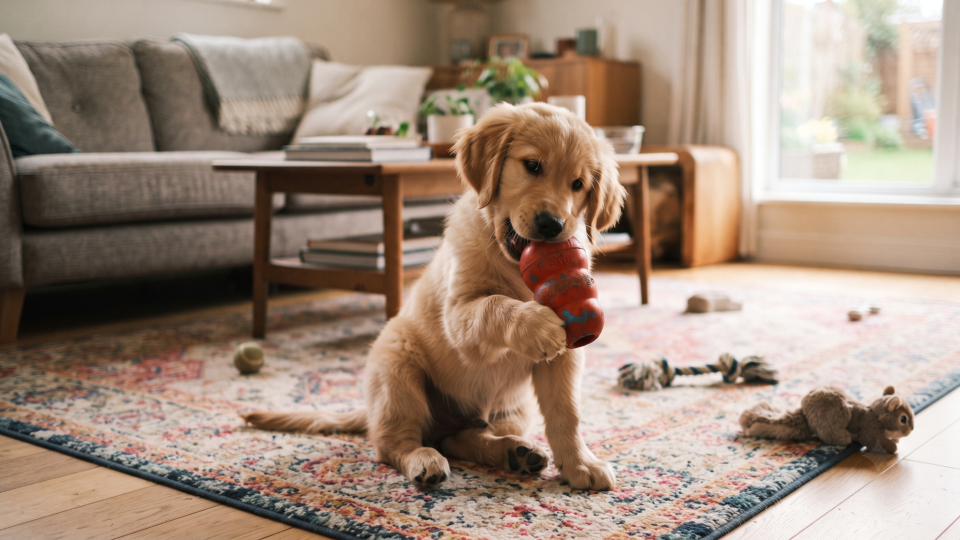
Buying toys for your dog should be enjoyable, but the number of options can make a simple purchase surprisingly confusing. There are rubber chew toys, squeaky plush animals, treat dispensers, puzzle boards, tug toys, and balls in dozens of sizes. Many promise to provide hours of entertainment, while others advertise exceptional durability.
The right choice depends on how your dog actually plays. A dog that gently carries a stuffed animal has different needs from one that immediately pulls apart seams. A dog that enjoys chasing a ball may show little interest in a complicated food puzzle.
A useful toy collection provides several suitable activities without filling your home with products your dog rarely uses. This guide explains how to compare the main types of dog toys, assess their practical features, introduce them gradually, and recognize when a toy needs replacing.
The Short Answer
Choose dog toys according to your dog’s size, play style, chewing habits, and individual needs. Prioritize an appropriate fit, inspect the construction, and supervise new toys while you learn how your dog uses them; no single toy is suitable for every dog or guaranteed to remain safe indefinitely. humaneworld.org
Why Are Dog Toys Important?
Toys can provide opportunities for physical activity, mental engagement, and interaction with people. The RSPCA identifies these as useful functions of suitable dog toys within a dog’s home environment. rspca.org.uk
For owners, the practical question is what activity a particular toy will add to the day.
A ball might support a short shared game outdoors. A food puzzle offers a different activity during a quiet period at home. A soft toy may be something your dog enjoys carrying.
Thinking in terms of activities helps you avoid buying several products that all serve the same purpose.
Before purchasing, finish this sentence:
“I want this toy to help us enjoy…”
Your answer might be:
- A supervised chewing session.
- A short game of fetch.
- An easy food-search activity.
- Interactive play together.
- Gentle carrying and exploration.
A clear purpose makes it easier to compare products and decide whether a new purchase adds anything useful.
How Can You Identify Your Dog’s Play Style?
Observe what your dog chooses to do with toys you already have. Look at the full interaction, rather than whether they approach a toy once.
Useful questions include:
- Do they carry it, chase it, chew it, or pull it apart?
- Do they enjoy the toy independently or mainly when you join in?
- Do they return to it across several sessions?
- Does their behavior change when food is involved?
- Which parts show wear first?
You can keep a simple note for each toy: its size, material, intended activity, and what your dog actually does with it.
Dogs That Prefer Carrying
If your dog regularly picks up toys and walks around with them, compare products by shape, weight, and ease of carrying.
Check whether a toy has protruding decorations, accessible seams, or attachments that complicate its construction.
Dogs That Prefer Chasing
For chasing games, consider where you will play before choosing the toy.
A product intended for a garden may be impractical in a small room. Compare its dimensions, weight, movement, and visibility against the space available.
Dogs That Prefer Investigating Food
For dogs that willingly explore food toys, compare how the reward is accessed.
Some products release food as they roll. Others require lifting, sliding, or nosing a component. The useful distinction is the action involved, not simply the word “interactive” on the packaging.
Dogs That Quickly Damage Toys
Record how the damage happens. Does your dog open fabric seams, remove small attachments, or bite pieces from the main body?
That information helps you identify unsuitable constructions. Buying a product labeled “tough” provides less guidance than understanding where the previous toy failed.
What Size Dog Toy Should You Buy?
Choose a size appropriate for the individual dog and the intended activity. Humane World for Animals warns that toys that are too small may be swallowed or become lodged in a dog’s throat. humaneworld.org
Read the manufacturer’s size guidance, but also inspect the actual measurements. Labels such as “small,” “medium,” and “large” are useful only within the context of that product range.
Check Every Relevant Dimension
For a ball, check its diameter.
For an elongated toy, check its width as well as its length. A product can look substantial in photographs while having a narrow section that changes how your dog can hold it.
For a puzzle board, review the dimensions of the whole product and any accessible components.
Consider Weight and Handling
A toy should also work for the activity you have planned.
For example, compare whether a carrying toy is manageable for your dog and whether a tug toy gives you sufficient room to hold it comfortably.
Buying the largest available version is not automatically the best solution.
Reassess as Your Dog Grows
A toy purchased for a young puppy may no longer be suitable later.
Include size checks in your routine inspections, particularly when your dog’s body size or chewing behavior changes.
Which Dog Toy Materials Should You Consider?
Material names provide a starting point, but the finished construction matters too. Two toys described as rubber can differ in flexibility, thickness, shape, and intended use.
Rubber Toys
When comparing rubber products, look for clear information about their intended activity.
A fetch toy, a food dispenser, and a chewing product should not be assumed interchangeable simply because they use the same broad material category.
Check:
- Available sizes.
- Cleaning instructions.
- Food-contact guidance where relevant.
- Restrictions on use.
- Signs of wear specified by the manufacturer.
For hollow products, inspect whether the interior can be reached and cleaned.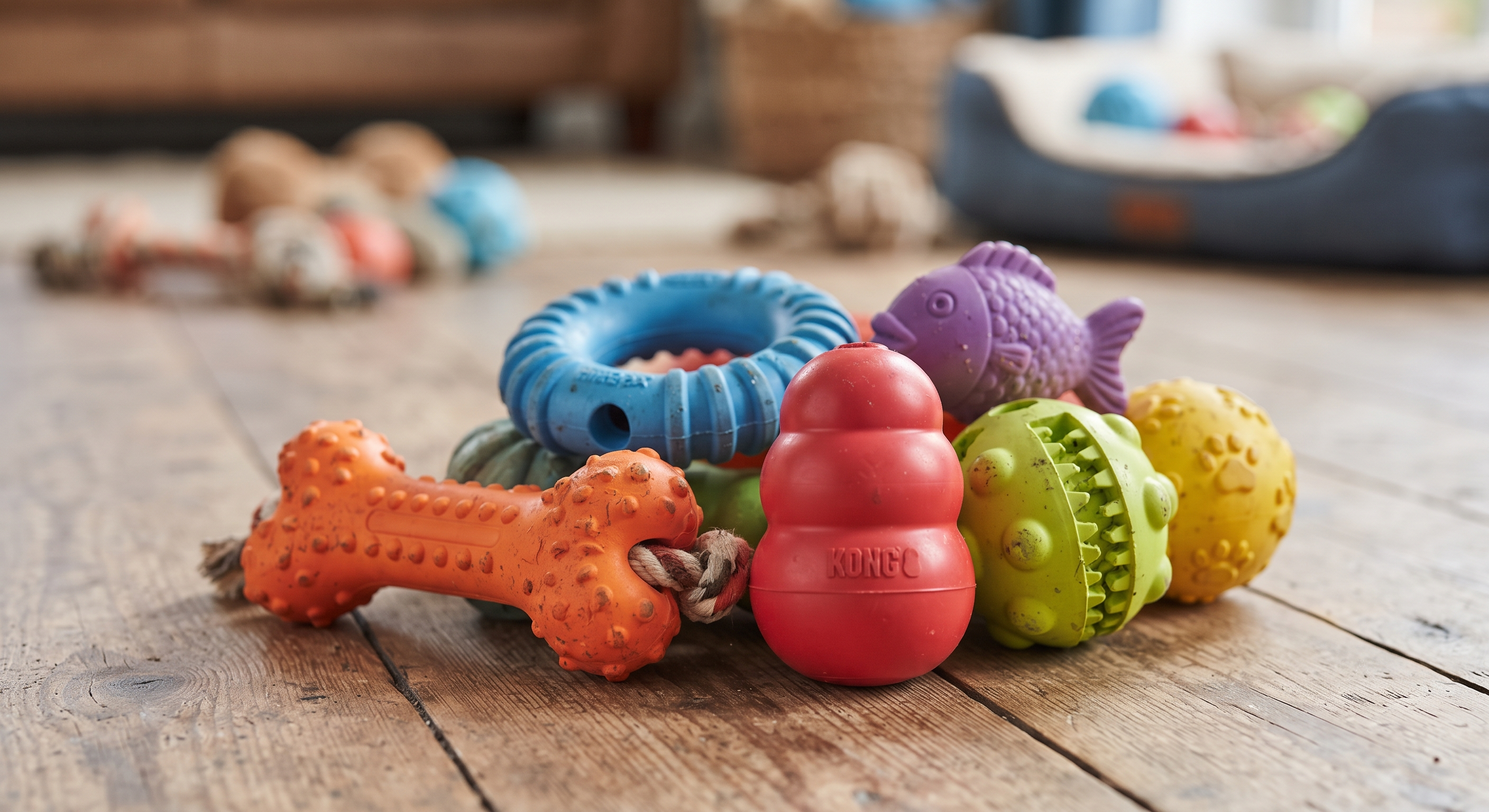
Plush Toys
Plush products vary in fabric, seams, stuffing, and internal components.
Compare embroidered details with attached decorations, and check whether the product contains a squeaker. Decide how easily you can inspect it after play.
A washable cover or clear laundering instructions may make maintenance more practical.
Rope and Fabric Tug Toys
For these products, examine the complete shape, grip areas, knots, and edges.
Plan how you will inspect them for wear and where you will store them between sessions. A product intended for shared tug games should be evaluated for that purpose rather than assumed suitable for prolonged independent chewing.
Rigid Chew Products
Do not equate greater hardness with greater suitability. Cornell warns that chewing hard objects, including some manufactured toys, can wear or fracture teeth. vet.cornell.edu
If you are uncertain about a chewing product—particularly for a dog with dental problems—ask your veterinarian about appropriate options.
Are Puzzle Toys Worth Buying?
Puzzle toys can be worth considering if you want to add a food-search or problem-solving activity and can supervise its introduction.
Dogs Trust recommends making enrichment easy initially and gradually increasing the difficulty. Dogs Trust
The most complicated product is therefore not necessarily the most useful first purchase.
Start with a Clear Task
Choose a design you can explain simply:
- Nudge the toy to release food.
- Find food in shallow compartments.
- Move one accessible slider.
- Search through a suitable feeding mat.
Review whether the manufacturer provides an introductory setup. Avoid improvising by removing components that are intended to remain attached.
Look for Adjustable Difficulty
A product with several permitted configurations may offer more flexibility than one fixed challenge.
Check what “adjustable” actually means. Does it change the opening size, movement required, or access to the reward?
Assess Cleaning Before Buying
Food toys create additional cleaning work.
Look for instructions covering disassembly, washing, drying, and reassembly. Check whether small crevices are accessible and whether any parts require hand washing.
A product that is inconvenient to maintain may receive less use than a simpler alternative.
Count Preparation as Part of the Experience
Consider how long it takes to fill, set up, supervise, empty, and clean the toy.
Those tasks are part of ownership. Choose something that fits your routine rather than focusing only on the minutes your dog might spend using it.
Quick Comparison
Chew Toys
Chew toys are worth investigating when your goal is a suitable chewing activity.
Compare size, construction, intended chewing style, and replacement guidance. Pay particular attention to hardness and ask for veterinary advice when dental suitability is uncertain.
Fetch Toys
Fetch toys suit a planned chasing and retrieving game.
Compare visibility, dimensions, handling, and suitability for your play area. Consider whether you can inspect the product easily after outdoor use.
Tug Toys
Tug toys are designed around shared interaction.
Look for practical grip areas, suitable spacing between your hand and your dog’s mouth, and construction that can be checked for wear. Read the instructions for the intended style of play.
Plush and Squeaky Toys
These offer a different texture and play experience from solid toys.
Inspect seams, attachments, and internal components. Humane World for Animals specifically recommends supervision with squeaky toys because some dogs try to remove and ingest the squeaker. humaneworld.org
Treat-Dispensing Toys
Treat dispensers combine movement or manipulation with access to food.
Compare the filling opening, food compatibility, difficulty adjustment, and internal cleaning access. Check whether the product works with the food you actually intend to use.
Puzzle Boards and Feeding Mats
These provide a more stationary activity.
Assess the available floor space, stability, accessible parts, and cleanup requirements. Choose an introductory challenge appropriate for your dog’s experience.
How to Choose
Use this checklist before making a purchase:
- Define the activity: Decide whether you want chewing, fetch, shared play, carrying, or food enrichment.
- Observe your dog: Base the decision on their actual play and damage patterns.
- Check measurements: Review dimensions rather than relying only on size labels.
- Examine construction: Identify seams, openings, attachments, and accessible components.
- Read usage instructions: Confirm supervision requirements and any restrictions.
- Plan cleaning: Make sure you can maintain the product as directed.
- Compare ownership costs: Include replacement parts, refills, or charging equipment where applicable.
- Buy selectively: Try one useful addition before ordering several similar products.
A practical starter collection might include one suitable toy for shared play, one food-enrichment option, and another product chosen around your dog’s strongest preference. The exact number matters less than whether each item has a clear use.
How Should You Introduce a New Dog Toy?
Introduce one new product at a time so you can observe the interaction clearly.
Step 1: Read and Prepare
Remove packaging and follow setup instructions. Check the product before use, including any closures or assembled sections.
For food toys, confirm that the food is appropriate for your dog’s diet. Account for the amount used within their daily food allowance.
Step 2: Choose a Suitable Setting
Use a space where you can watch closely without competing distractions.
For a moving toy, clear enough room for the intended activity. For a puzzle, choose a surface compatible with the product’s instructions.
Step 3: Keep the First Session Simple
Let your dog investigate. For a puzzle, begin with an easy permitted configuration.
Watch whether your dog engages with the intended task or starts dismantling the product. Those are different uses and may require different decisions.
Step 4: Review Before Repeating
After the session, inspect the toy and note what happened.
Ask whether the size worked, whether the activity remained manageable, and whether cleanup was practical. Use that information to decide how to offer it next time.
How Can You Keep a Toy Collection Interesting?
You do not necessarily need to buy new products continuously. Dogs Trust suggests rotating toys and using activities such as food enrichment to vary a dog’s routine. Dogs Trust
Organize your collection by purpose:
- Toys for supervised shared play.
- Food toys requiring preparation and cleaning.
- Products your dog enjoys carrying.
- Items awaiting inspection or replacement.
This makes it easier to choose an activity rather than repeatedly offering everything at once.
Keep a small record of purchases if you often replace toys. Note the model, size, price, use, and reason for retirement. Over time, this can reveal which products provide useful value for your particular dog.
Important Safety Considerations
Inspect Toys and Retire Damaged Products
Check for tearing, missing pieces, exposed internal components, or other changes in condition. Humane World for Animals advises discarding toys that are torn or beginning to break into pieces. humaneworld.org
Follow product-specific replacement instructions as well. A familiar toy still needs inspection.
Treat Durability Claims Carefully
Terms such as “heavy duty” and “indestructible” should not replace observation.
A toy that withstands one dog’s play may behave differently with another. Assess the actual product and your dog’s interaction with it.
Protect Dental Health
A toy marketed for chewing or dental use does not automatically provide complete dental care. Cornell identifies toothbrushing as the most effective home-care method for preventing dental disease. vet.cornell.edu
Discuss dental products and suitable chewing activities with your veterinarian when necessary.
Supervise Children During Play
Adults should manage toy selection and supervise interactions between children and dogs. American Humane’s toy guidance emphasizes selecting suitable products and supervising play. American Humane Society
Do not encourage children to pull toys from a dog’s mouth or approach a dog that appears uncomfortable.
Get Professional Advice When Needed
If you suspect your dog swallowed part of a toy, contact a veterinarian promptly. Breathing difficulty or choking requires immediate emergency veterinary help.
New pain, reluctance to chew, or repeated problems with toys also warrants advice before continuing the activity.
Frequently Asked Questions
What Is the Best Dog Toy for a First Purchase?
Start with a clear activity your dog already enjoys.
For a dog that likes retrieving, compare suitable fetch products. For one interested in finding food, investigate a beginner food toy. There is no single product category that is the best starting point for every dog.
Are Expensive Dog Toys Better?
Not automatically.
Compare construction, clear instructions, cleaning access, and usefulness for your dog. A high purchase price does not establish that a product will remain suitable or receive regular use.
Are Soft Toys Suitable for Every Dog?
No. Suitability depends on how the individual dog interacts with the product.
Examine whether your dog carries it gently or immediately opens seams and removes contents. Use that behavior to guide future choices and supervision.
Can a Puzzle Toy Replace a Walk?
Plan puzzles as one activity within a broader routine.
They provide a different experience from going outdoors, moving through an environment, and spending time with you. The RSPCA’s guidance includes both suitable toys and appropriate exercise as parts of caring for a dog. rspca.org.uk
How Often Should Dog Toys Be Replaced?
Use condition and manufacturer guidance rather than a fixed calendar.
Inspect after use and replace when damage or wear makes continued use unsuitable. Keep replacement parts compatible with the exact model.
Should I Choose Toys Based on Breed?
Breed can provide background, but observe the individual dog.
Size, mouth shape, experience, play preferences, and chewing behavior give more specific information for comparing a particular product.
What If My Dog Ignores a New Toy?
Review the activity, setup, and timing before buying another.
Try an appropriate introduction without forcing participation. If several similar products remain unused, consider whether a different type of activity would be a better investment.
The Bottom Line
Choose dog toys around the activities your dog enjoys and the care you can provide. Check fit, construction, cleaning requirements, and condition throughout the product’s life.
Start with a few purposeful choices, observe how they work, and let those experiences guide your next purchase.
Editorial Sources
- Humane World for Animals — How to Pick the Best and Safest Dog Toys
- Cornell University — Dental Disease and Home Dental Care
- Cornell University — Brushing Your Dog’s Teeth
- Dogs Trust — Enrichment Activities to Keep Your Dog Entertained
- Dogs Trust — Feeling Overwhelmed by Your Dog?
- RSPCA — Creating a Good Home for Your Dog
- American Humane — Choosing Safe Toys for Pets