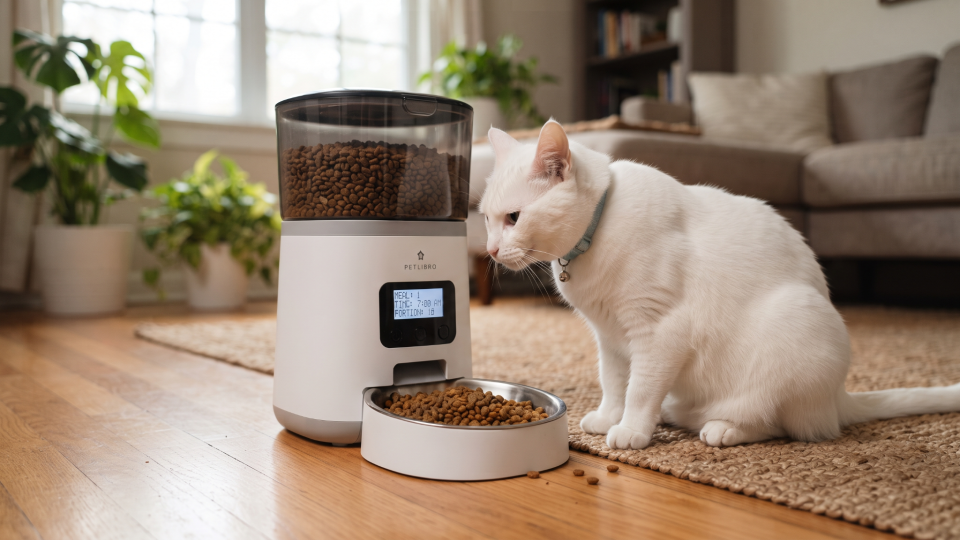
An automatic cat feeder can make everyday feeding more manageable. It can serve breakfast before you wake up, provide a scheduled meal while you are at work, and help different household members follow the same feeding routine.
However, choosing one can be confusing. Some feeders offer Wi-Fi, cameras, voice recordings, food-level sensors, and detailed activity logs. Others provide a simple timer and a few adjustable portions. A longer feature list does not necessarily mean a feeder will suit your cat better.
The most useful starting point is your cat’s feeding routine: what they eat, how much they need, whether they share their home with other animals, and how comfortable they are around moving or noisy devices.
This guide explains which automatic cat feeder features deserve priority, which are useful in particular situations, and which can remain optional.
The Short Answer
For most cats eating dry food, prioritize reliable scheduling, suitable portion sizes, compatibility with the actual kibble, easy cleaning, secure food storage, and a dependable power arrangement. Confirm how the exact model behaves during a power failure or internet outage before relying on it.
Wet-food diets and households where pets steal each other’s meals need different solutions, such as purpose-built temperature-controlled feeders or selective-access feeding stations. Cameras, apps, and voice recordings can be convenient, but they do not replace checking that your cat has eaten or arranging care when you are away.
What Can an Automatic Cat Feeder Actually Do?
An automatic feeder can help deliver food consistently according to a programmed routine. Depending on the design, it may dispense measured amounts from a hopper, uncover a prefilled compartment, or open a lid for an identified pet.
These functions solve different problems.
A timed dispenser helps with meal timing. A compartment feeder lets you prepare individual servings yourself. A selective-access feeder helps control which animal can reach a bowl.
Before comparing products, identify which problem you need to solve:
- Breakfast is due before you normally wake up.
- Your work schedule makes a midday meal difficult.
- Several people sometimes feed the cat without realizing someone else already did.
- You want to distribute an agreed daily food allowance across several meals.
- One pet regularly eats another pet’s food.
- Your cat’s usual wet-food meal needs to be available later.
A feeder can support a consistent routine, but there is no single ideal meal schedule for every cat. Cornell University’s feline health guidance explains that feeding frequency depends on factors such as age, health, and individual circumstances. vet.cornell.edu
An automatic feeder manages access to food. It does not determine the correct diet, daily calorie allowance, or medical feeding plan.
Which Features Are Essential for a Dry-Food Automatic Cat Feeder?
For a typical dry-food routine, the essential features concern dependable delivery, appropriate quantities, practical maintenance, and protection against foreseeable interruptions.
1. Scheduling That Matches Your Actual Routine
Look for enough programmable meals to reproduce your intended schedule.
More meal slots are useful only if you need them. A feeder offering many daily feeding events has little practical advantage if you plan to use only two or three.
Check whether you can:
- Set specific meal times.
- Assign different quantities to different meals.
- Review the full schedule clearly.
- Pause a meal without deleting the entire program.
- Dispense food manually when necessary.
- Prevent accidental changes to the settings.
Also check how the clock handles time changes. For connected devices, confirm which time zone the schedule uses.
Buying priority: A schedule you can understand and verify is more valuable than a large number of settings you will rarely use.
2. Portion Settings Small Enough for Your Cat
“Adjustable portions” can sound more precise than it really is.
Some feeders dispense fixed mechanical increments described as portions, servings, or units. Those units are not universal measurements. Their weight may depend on the food’s size, shape, and density.
Before buying, find out:
- What the smallest dispensing increment is.
- Whether portion sizes are expressed in grams, volume, or proprietary units.
- Whether the advertised weight is approximate.
- Whether the manufacturer explains how to calibrate the feeder.
- Whether you can create your cat’s intended daily allowance without large rounding errors.
A model with many settings may still be unsuitable if its smallest increment is too large.
3. Compatibility With Your Actual Food
Check the manufacturer’s requirements against the food you already use.
Important details include:
- Permitted kibble dimensions.
- Restrictions on irregular shapes.
- Whether the mechanism accepts dry food only.
- Whether particular textures or mixed foods are excluded.
- Instructions for managing crumbs and food dust.
Do not assume that a feeder will accept every product sold as dry cat food.
For example, PETLIBRO specifies dry food and a particular kibble-size range for its Essential Wi-Fi feeder. This illustrates why compatibility needs to be checked at model level. petlibro.com
If you change diets later, repeat your dispensing checks.
4. A Dependable Power Arrangement
Choose a power setup appropriate to your home.
For a mains-powered feeder, battery backup can be valuable. Some models also operate primarily on batteries or use a rechargeable battery.
Before purchasing, ask:
- Are backup batteries included?
- Which battery type is required?
- Will scheduled dispensing continue on backup power?
- Which functions stop working in battery mode?
- Is there a low-battery warning?
- Does the schedule survive a complete loss of power?
PetSafe’s FlexFeed support information, for example, describes an adapter and battery-backup arrangement. That specification applies to that product; it should not be assumed for every automatic feeder. support.petsafe.net
Buying priority: Read what backup power actually supports, then test that behavior at home while you are available to supervise.
5. Food-Contact Parts You Can Clean Properly
A feeder becomes less convenient if cleaning requires a long disassembly process or leaves inaccessible food residue.
Look for:
- A removable feeding bowl.
- Accessible food-contact surfaces.
- Clear instructions for cleaning the hopper and dispensing components.
- Parts that can be dried thoroughly.
- Specific identification of dishwasher-safe components.
- A design that can be reassembled correctly without guesswork.
Do not assume the whole unit is washable because the bowl is removable.
Follow both the feeder’s cleaning instructions and appropriate food-hygiene practices. The FDA recommends washing and drying pet-food bowls after each use. FDA
6. Secure Storage and Stable Construction
Consider how your own cat interacts with objects.
A cat that pushes containers around, lifts lids, or reaches into openings may need a more secure design than a cat that simply waits beside the bowl.
Useful details include:
- A locking or firmly secured hopper lid.
- A stable base.
- A bowl that stays in position.
- Controls that can be locked.
- A dispensing opening that does not offer easy access to stored food.
A feeder should be assessed with your cat present during supervised use. Product photos cannot show whether your particular cat will knock it over or work out how to access extra food.
How Accurate Are Automatic Cat Feeder Portions?
Accuracy depends on the mechanism, the food, and the way the feeder is configured. A setting shown in an app should be checked against what reaches the bowl.
It helps to distinguish two questions:
Does the feeder deliver the intended amount?
A setting that repeatedly delivers the same quantity can still be wrong for your feeding plan.
Does it deliver a similar amount each time?
A suitable average can hide substantial variation between individual meals.
Check Portions With a Kitchen Scale
As a practical home check:
- Use the food you intend to feed.
- Place an empty bowl on a gram scale and zero it.
- Dispense one programmed serving.
- Record the weight.
- Repeat several times without returning food to the hopper during the measurement.
- Compare the results and adjust the schedule if necessary.
- Repeat checks after changing food or servicing the dispensing mechanism.
This is a setup check rather than a laboratory certification.
AAHA’s nutrition guidance recommends weighing food with a gram scale to improve precision and accuracy compared with measuring cups. aaha.org
Count the Whole Day’s Food
Suppose a cat’s established feeding plan includes 48 grams of a particular dry food per day, divided across four meals. Each meal would contain 12 grams.
That is an arithmetic example, not a feeding recommendation.
If the feeder cannot dispense close to the intended amounts, you may need a different distribution of meals or a different device. Include separately served food, treats, and manual “feed now” commands when reviewing the total.
A machine can follow its settings correctly while the household still provides too much food overall.
Does an Automatic Cat Feeder Need Wi-Fi?
No. Wi-Fi is useful when you need remote control or information, but a suitable feeder can work through local controls and a timer.
A non-connected model may suit you if:
- Your schedule changes infrequently.
- Someone checks the feeder daily.
- You prefer buttons to an app.
- You do not need remote access.
- Your home internet connection is unreliable.
A connected model may be useful if:
- Several caregivers need visibility of the schedule.
- You want to review dispensing records remotely.
- You need to change a meal while away from home.
- You value supported low-food or fault notifications.
Check Offline Operation Separately
Losing internet access and losing electrical power are different events.
Ask what happens if:
- The home router stops working.
- The feeder loses its Wi-Fi connection.
- The manufacturer’s online service is unavailable.
- The feeder restarts while the internet is disconnected.
Some manufacturers document continued operation of saved schedules while remote functions are unavailable. PETLIBRO provides this information for particular models, including its Granary Smart feeder. Confirm the behavior of the exact model and test it rather than relying solely on a general “works offline” claim. Petlibro
Also check whether routine setup, schedule changes, or particular alerts require an account or subscription.
Are Cameras, Notifications, and Voice Recordings Worth Paying For?
They can be useful, but their value depends on what information you need and how you will act on it.
Cameras: Useful for Observation
A camera may help you see whether your cat approaches the feeder or whether another pet is taking an interest.
Before paying extra, consider:
- Can the camera actually see the bowl?
- Does the angle show the animal eating clearly?
- Are recordings available without a subscription?
- Who can access the camera account?
- Will the camera work in the conditions where the feeder is placed?
A video can provide context, but it does not automatically establish how many grams a cat consumed.
Notifications: Useful When They Describe a Specific Problem
Alerts can be valuable if they tell you something actionable, such as low food, low battery, or a detected obstruction.
However, read the definitions carefully.
A “meal completed” notification might indicate that the motor ran or that a dispensing cycle finished. It may not confirm that the intended quantity reached the bowl or that your cat ate it.
Before relying on an alert, understand what the device actually detects.
Voice Recordings: Optional
A familiar recording may become a meal cue, but many households will not need this feature.
Introduce any sound at a comfortable volume and observe your cat’s response. If it causes hesitation or distress, disable it.
Buying priority: Spend first on suitable portions, reliable operation, and cleanability. Add remote features when they solve a clear problem.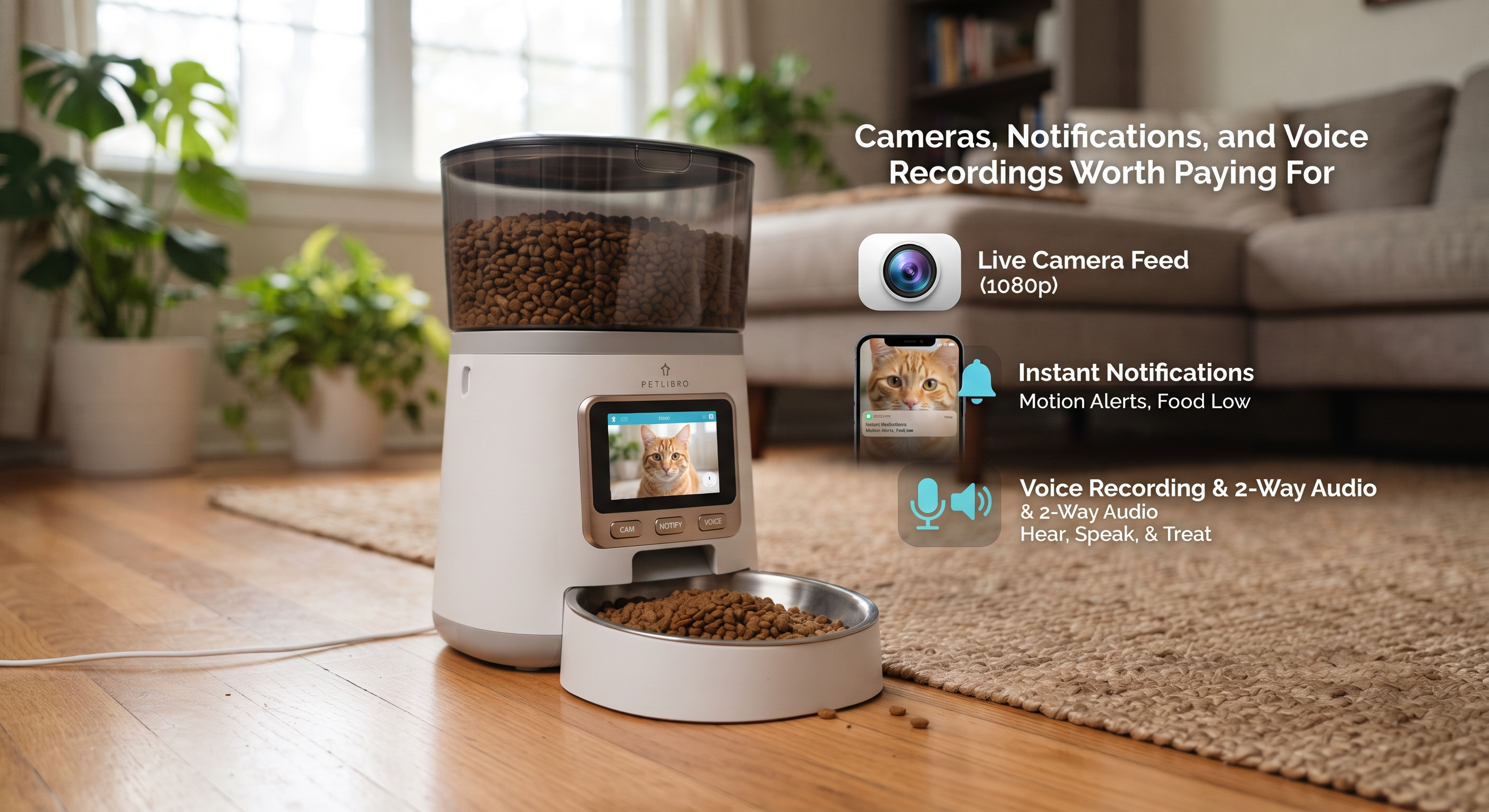
What Features Matter for Wet-Food Automatic Feeders?
Wet food requires a feeder designed for that purpose and an appropriate plan for temperature control.
Do not place wet food, moistened kibble, or other incompatible foods in a dry-food hopper.
Wet-food feeders may use:
- Prefilled timed compartments.
- Ice packs in a purpose-built cooling arrangement.
- Active refrigeration.
- Selective-access lids over a prepared serving.
These designs differ substantially.
A Covered Bowl Is Not Refrigeration
A lid may limit access or exposure, but it does not necessarily keep food at a safe temperature.
The FDA advises promptly refrigerating or discarding unused or leftover canned and pouched pet food. A feeder’s cover or “freshness” description should not be treated as a replacement for temperature control. FDA
Check the Entire Food Timeline
Before choosing a wet-food model, establish:
- How cold food should be when loaded.
- How cooling performance is documented.
- The supported room-temperature range.
- What happens during a power failure.
- How long food remains available after the compartment opens.
- What the food manufacturer says about handling opened food.
Ice packs eventually warm up. Active cooling also needs to be evaluated according to the exact model’s instructions and operating conditions.
Avoid applying a universal “safe for all day” assumption to every wet-food feeder.
Which Features Matter in a Multi-Cat Home?
Individual access may matter more than remote scheduling.
Two bowls connected to one dispenser do not guarantee that two cats receive equal meals. One animal may eat faster, switch bowls, or prevent another from approaching.
Selective Access Can Help Separate Diets
Microchip- or tag-activated feeders are designed to restrict access to registered animals.
However, selective access and timed dispensing are separate functions. A feeder may open a lid for an identified cat without measuring or scheduling new servings.
Check whether the model provides:
- Access control.
- Timed meals.
- Portion dispensing.
- Intake measurement.
- Some combination of these functions.
Do not infer one capability from another.
Placement and Training Still Matter
A selective feeder may need gradual introduction, and a determined second cat may still try to reach the food while the authorized animal is eating.
Sure Petcare’s microchip-feeder manual includes staged training, separate feeding arrangements, and adjustments intended to help manage food stealing. Those instructions show why setup and observation remain important even with access-control technology. media.surepetcare.com
Allow enough time to confirm that each cat can eat comfortably.
Quick Comparison
Feeder typeMain purposeFeatures to prioritizeMain limitationLocal-control dry-food dispenser | Scheduled dry-food meals | Suitable portions, clear controls, food compatibility, power reliability | Limited remote visibility
Wi-Fi dry-food dispenser | Scheduling with remote access | Verified offline behavior, useful alerts, understandable app | Remote functions depend on connectivity and service availability
Camera-equipped feeder | Feeding plus visual observation | Core dispensing performance, useful camera angle, privacy settings | Video does not necessarily measure consumption
Timed compartment feeder | Access to prepared servings | Secure lid, easy cleaning, appropriate food handling | Limited number of compartments
Purpose-built cooled wet-food feeder | Later access to wet-food meals | Documented cooling conditions, hygiene, power-failure instructions | Cooling and food-safety limits still apply
Microchip- or tag-access feeder | Restricting food access by animal | Reliable recognition, comfortable access, training options | May not provide timed portion dispensing
How to Choose
- Start with the food. Choose a device explicitly compatible with your cat’s diet and food dimensions.
- Write down the routine. Record intended meal times, amounts, and who checks the cat.
- Check the smallest portion. Make sure the feeder can reproduce the planned daily allowance.
- Assess other pets. Decide whether separate locations or selective access are needed.
- Read outage instructions. Distinguish internet failure, mains-power failure, and complete power loss.
- Review cleaning before buying. Look at how the bowl, hopper, and food-contact parts come apart.
- Evaluate ongoing costs. Include batteries, filters or desiccants where specified, replacement parts, and optional subscriptions.
- Use the return period for supervised trials. Confirm that your cat accepts the feeder and that it works with your food.
- Pay for extras selectively. A camera or app should address a need you can identify.
Important Safety Considerations
An Automatic Feeder Does Not Replace Daily Care
A large hopper describes storage capacity. It does not establish how long a cat can safely remain without human care.
Arrange appropriate in-person care when you are away. Someone should check your cat’s condition, food intake, water, litter area, and the feeder’s operation.
Remote access cannot refill an empty reservoir, clear every obstruction, or assess an unwell cat adequately.
Check That Your Cat Is Actually Eating
Distinguish between:
- A scheduled dispensing event.
- Food visible in the bowl.
- Your cat approaching the feeder.
- Your cat consuming an appropriate amount.
A reduction in appetite should not automatically be blamed on the device. Cornell notes that refusing food can lead to serious medical problems. Contact your veterinarian promptly if your cat stops eating or shows a concerning appetite change, particularly with other signs of illness. vet.cornell.edu
Use Extra Care With Medical Feeding Plans
If feeding is linked to medication, a prescribed diet, or management of a health condition, discuss the setup and failure plan with your veterinary team.
Do not assume that a scheduled meal confirms food was eaten before administering medication.
Introduce the Feeder Gradually
Set up the device while you are home.
Allow your cat to investigate it, supervise early dispensing events, and confirm that noise or moving parts do not discourage eating.
Do not force a frightened cat to approach or withhold necessary food to make them use the machine.
Store and Handle Food Correctly
Follow the food manufacturer’s storage directions and the feeder’s instructions. Clean and dry food-contact components before refilling as directed, and retain the original food packaging information for identification if a problem occurs.
Keep desiccant packets inaccessible and use only the type specified by the feeder manufacturer.
Keep a Practical Backup Plan
Retain an ordinary bowl, suitable food, written feeding instructions, and a person who can help if the feeder fails.
For smart models, caregivers should understand the schedule well enough to avoid accidental duplicate meals.
Frequently Asked Questions
Can an Automatic Feeder Help With Weight Management?
It can help deliver a planned allowance consistently, but it cannot establish the right calorie target or prevent every source of extra food.
Weight management still requires an appropriate diet, accurate measurement, monitoring, and a plan agreed with your veterinarian.
Will an Automatic Feeder Stop My Cat From Waking Me Up?
It may help if waking you is strongly associated with breakfast.
However, early waking can have several causes. A feeder cannot guarantee a change in behavior, and a new change in hunger or routine may warrant investigation.
Can I Use One Feeder for Two Cats?
Possibly, if you can confirm that both cats receive their intended food comfortably.
A shared dispenser becomes less suitable when cats need different diets, have different feeding plans, or compete for access. Separate feeding arrangements may be more practical.
Do Automatic Feeders Work Without the Internet?
Some do, including local-control models and certain connected models with saved schedules.
Check the exact product documentation. Initial setup, remote controls, notifications, and scheduled operation may have different connectivity requirements.
Are Bigger Food Hoppers Better?
Only when the capacity suits your routine.
A larger hopper means fewer refills, but you still need to inspect the food, maintain the equipment, and follow storage guidance. Capacity should not encourage leaving food unchecked for long periods.
Can I Put Wet Food in a Dry-Food Feeder?
No, unless the manufacturer explicitly states that the particular design supports it.
Use equipment intended for wet food and follow appropriate temperature-control and cleaning instructions.
Is a Food-Dispensing Log the Same as an Eating Log?
No.
A dispensing log usually records an action by the machine. An eating record requires additional information about access or consumption, and its reliability depends on the technology and its limitations.
How Long Should I Test a New Feeder?
Test it across enough supervised meals to check the schedule, portions, food compatibility, cleaning, and your cat’s comfort.
Also test documented backup-power and offline behavior safely. There is no single number of days that proves long-term reliability.
The Bottom Line
Choose an automatic cat feeder around your cat’s food, portion requirements, and feeding environment. Reliable delivery, easy cleaning, and a practical failure plan deserve priority; selective access or suitable cooling becomes essential when the household or diet requires it.
Once those needs are met, decide whether an app, camera, or other extra will make daily care easier. The best choice is one you can verify, maintain, and use confidently while continuing to monitor your cat.
Editorial Sources
- Cornell University College of Veterinary Medicine: How Often Should You Feed Your Cat?
- Cornell University College of Veterinary Medicine: Feeding Your Cat
- AAHA: Nutrition and Weight Management Guidelines—Feeding Plan Resources
- FDA: Proper Storage of Pet Food and Treats
- FDA: Tips for Safe Handling of Pet Food and Treats
- PetSafe: FlexFeed Automatic Pet Feeder Support
- PETLIBRO: Granary Smart Feeder Pre-Sale Questions
- Sure Petcare: Microchip Pet Feeder User Manual