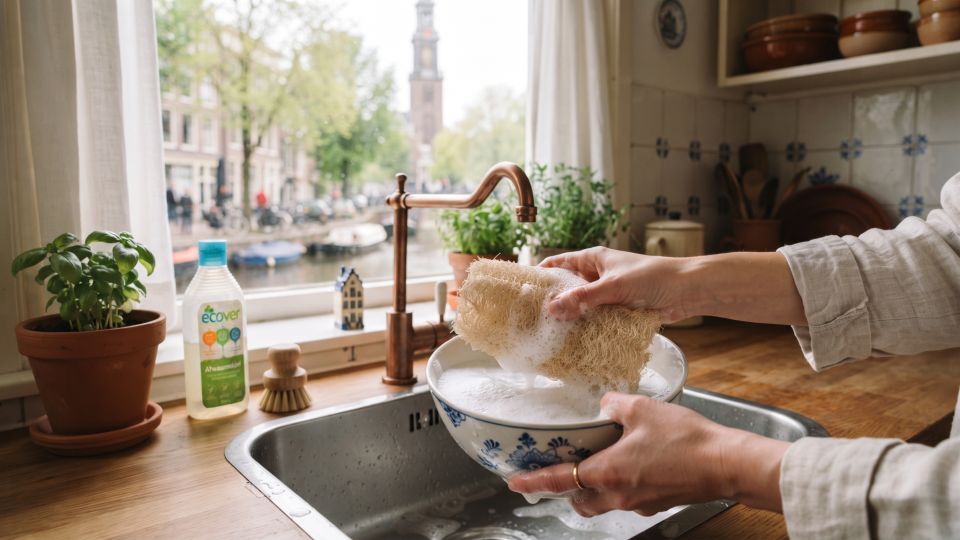
A kitchen sponge is a small purchase, but it is one you make repeatedly. If you are trying to reduce disposable plastic in your home, replacing a conventional synthetic sponge with a plant-based alternative may seem like an easy place to start.
Loofah dish sponges are made from the fibrous interior of a mature gourd. Their textured structure makes them useful for everyday scrubbing, while their plant-based composition offers an alternative to plastic foam and synthetic scouring pads.
However, choosing a natural material does not remove the need to think about hygiene, surface compatibility, or disposal. A loofah can hold food particles, remain damp, and wear out. Some products also include synthetic stitching or backing that complicates claims about being plastic-free or compostable.
This guide explains what loofah dish sponges are, where they work well, how to choose one, and how to care for it without overstating its environmental benefits.
The Short Answer
A loofah dish sponge can be a practical alternative to a synthetic sponge for routine dishwashing, especially if you choose a product made entirely from disclosed plant-based materials. Its usefulness depends on whether it suits your dishes and can be cleaned and dried properly between uses.
Natural loofah is biodegradable, but it is not automatically antibacterial, safe for every cookware surface, or compostable as a finished product with added materials.
What Is a Loofah Dish Sponge Made From?
A genuine loofah sponge comes from a plant rather than the ocean. It is the fibrous framework left inside a mature luffa fruit after the outer skin, seeds, and remaining pulp have been removed.
The University of Florida’s IFAS Extension describes mature luffa fruits as becoming fibrous and suitable for processing into biodegradable sponges for cleaning or personal care. Gardening Solutions
The words loofah, loofa, and luffa are often used for the same material. In product listings, “luffa” may refer to the plant, while “loofah” commonly describes the finished sponge.
Common loofah dish sponge designs
Loofah kitchen products come in several forms:
- Sliced sections: Pieces cut from a dried gourd, with the original open fiber structure.
- Flattened pads: Loofah compressed into a flatter shape for handling.
- Stitched pads: Layers of loofah sewn together, sometimes with a hanging loop.
- Combination sponges: Loofah attached to fabric, foam, or another scrubbing material.
These differences matter. A plain piece of loofah and a layered pad with polyester thread are not the same product from a material or disposal perspective.
Before buying, check the composition of the entire sponge, including its thread, loop, label, backing, and adhesive.
Do Loofah Dish Sponges Clean Dishes Effectively?
Loofah can work well for ordinary dishwashing tasks that need light to moderate scrubbing. Performance varies with fiber density, pad thickness, how thoroughly the sponge is wetted, and the type of food residue.
It is best understood as one tool in a dishwashing routine rather than a universal replacement for every brush, scraper, and sponge.
Where loofah is useful
Depending on the product and the surface manufacturer’s instructions, a wetted loofah may be useful for:
- Removing everyday food residue from plates.
- Washing utensils and suitable serving dishes.
- Scrubbing accessible areas of food containers.
- Loosening softened residue after soaking.
Start with light pressure. If food does not release easily, soaking the item or using an appropriate scraper may be more effective than scrubbing harder.
Where another tool may work better
Loofah is less convenient for narrow bottle necks, deep corners, or spaces that a flexible pad cannot reach. A bottle brush or small dish brush is usually easier to control in these areas.
Heavily burned food may also require a different approach. Follow the cookware manufacturer’s cleaning instructions rather than assuming that a firmer natural sponge is suitable.
What about grease?
Loofah supplies scrubbing texture; dishwashing detergent does the main work of helping remove grease.
Scrape leftover food into the appropriate waste container before washing. Avoid loading the sponge with thick grease or sticky food that becomes difficult to rinse from its fibers.
There is no need to judge cleaning performance by the amount of foam alone. Use detergent according to its instructions and assess whether the dishes are actually clean.
Are Loofah Dish Sponges More Environmentally Friendly?
A plain loofah sponge offers a clear material difference: it can replace a plastic-containing scrubber with plant fiber.
That makes it worth considering for people who want to reduce plastic in everyday cleaning tools. However, a material substitution alone does not establish that every loofah product has a lower overall environmental impact than every alternative.
Look beyond the main ingredient
Consider the full product:
- Does it contain synthetic thread or backing?
- Is it packaged in plastic?
- Is the material composition clearly disclosed?
- Does it remain usable with appropriate care?
- Does its recommended cleaning routine require substantial extra resources?
- Can you actually compost it when it is worn out?
A product that looks natural may still contain plastic components. Similarly, a product described as “biodegradable” may not come with enough information to establish how the complete item should be disposed of.
Avoid unsupported environmental comparisons
Without a relevant life-cycle assessment, it would be difficult to justify precise claims such as “uses 80% less energy” or “has the lowest carbon footprint.”
A more useful purchasing principle is to choose a clearly described product that meets your cleaning needs, requires manageable care, and has a realistic disposal route.
Buying a large collection of alternative sponges before testing one can create unnecessary waste. Start with a small quantity and see whether the material works in your kitchen.
Are Loofah Dish Sponges Hygienic?
Loofah should be treated as a reusable cleaning tool that requires regular care. Its natural origin does not establish that it resists harmful microorganisms.
Kitchen sponge research shows why caution is appropriate. The German Federal Institute for Risk Assessment reports that conventional sponges can harbor and transfer foodborne pathogens, even without a noticeable smell or dirty appearance. These findings concern conventional kitchen sponges; they do not establish an exact replacement schedule for loofah. They do show why appearance alone is an unreliable hygiene check. bfr.bund.de
Drying matters, but it does not sterilize the sponge
After washing dishes, do not leave loofah submerged in water or sitting in a puddle beside the sink.
A holder that allows drainage and airflow is more practical than a closed container. Hanging may also help, provided the sponge is not pressed against a wet surface.
Drying is part of sensible care, but a dry sponge should not be assumed to be free of pathogens.
Is loofah more hygienic than a dish brush?
There is not enough evidence here to rank all loofah products against all dish brushes.
A published study comparing several sponges with a brush found that the brush dried faster and that bacterial survival differed between the tools tested. It did not establish that every plant-based sponge behaves the same way. PubMed
If your sponge routinely stays damp, a brush that drains readily may suit your kitchen better.
How Should You Use and Care for a Loofah Dish Sponge?
Follow the care instructions for the particular product. Loofah pads differ in thickness, construction, and added materials, so one method may not suit every version.
1. Inspect it before first use
Check for loose components, damaged stitching, visible mold, or an unexplained strong odor. Contact the seller if the product arrives in questionable condition.
Confirm whether the pad contains anything besides loofah.
2. Wet it thoroughly
Dry loofah can feel stiff. Wet it before use and allow the fibers to become flexible according to the product instructions.
Do not assume that a dry, rigid pad will behave the same way as a fully wetted one.
3. Apply detergent as directed
Use a dishwashing detergent suitable for the items being washed. Begin with gentle pressure and use an appropriate tool for food that remains stuck.
4. Rinse out trapped food
After use, work clean water through the fibers to remove visible food and detergent residue.
If particles remain lodged inside and cannot be removed, the sponge may no longer be practical to keep using.
5. Drain and air-dry
Gently squeeze out excess water and place the pad where air can reach it. Avoid leaving it beneath other wet cleaning tools.
6. Follow a suitable cleaning and replacement routine
Rinsing removes debris, but it does not necessarily sanitize a cleaning tool. USDA guidance distinguishes cleaning, which removes dirt and some bacteria, from sanitizing or disinfecting processes that reduce or kill microorganisms. Food Safety and Inspection Service
Ask the manufacturer for a supported cleaning method. If the recommended routine is unclear or impractical, consider a tool that is easier to clean reliably.
What about microwaving, boiling, or using a dishwasher?
Do not assume that generic kitchen sponge advice applies to every loofah product.
A stitched pad may include materials or adhesives that are unsuitable for high heat. Microwaving can also create a fire risk with unsuitable materials or insufficient moisture.
Only use a method explicitly supported for the product, following the relevant appliance and cleaning-product instructions. A homemade vinegar soak should not be treated as a validated sanitizing method.
How Long Does a Loofah Dish Sponge Last?
There is no reliable universal lifespan for all loofah dish sponges.
The number of dishes washed, food residues encountered, product construction, cleaning method, and drying conditions all affect how it holds up. Structural durability and hygienic suitability are also different: a pad may remain intact while still requiring replacement.
Reasons to replace it sooner
Replace a loofah if it develops:
- Visible mold or persistent mustiness.
- Food residue that cannot be removed.
- Fibers that break down extensively.
- Damaged layers or stitching that trap debris.
- A condition that prevents effective cleaning and drying.
These are reasons to act, not a complete test of safety. A sponge that looks and smells normal may still need replacement.
For conventional kitchen sponges, BfR recommends regular replacement and advises discarding a sponge used on surfaces contaminated by raw meat. Applying a cautious approach to loofah is sensible, while recognizing that this is not a loofah-specific lifespan study. bfr.bund.de
Do not keep a questionable sponge solely to make a sustainability purchase last longer.
Can You Compost a Loofah Dish Sponge?
Plain, untreated loofah can be composted. University of Florida IFAS Extension identifies composting as an end-of-life option for natural luffa sponges. Gardening Solutions
However, the compostability of the finished product depends on what else it contains.
Check every component
Before composting, look for:
- Synthetic stitching or hanging loops.
- Plastic labels.
- Foam backing.
- Adhesives or coatings.
- Added treatments with unclear disposal guidance.
Do not put an entire composite sponge into compost merely because its main ingredient is plant-based.
Prepare suitable material
For a plain loofah used with ordinary dish detergent, rinse away remaining food and detergent. If appropriate for the product and compost system, cut the worn material into smaller pieces.
EPA guidance explains that breaking compost ingredients into smaller pieces can help decomposition. It also emphasizes the importance of moisture, oxygen, and a balance of materials. US EPA
A sponge used with solvents, paint, or other unsuitable chemicals should not be treated like ordinary untreated plant waste.
Check local collection rules
A municipal food-waste service may not accept cleaning sponges, even when they are plant-based. Confirm acceptance with the operator.
There is also no single decomposition time that applies to every loofah and compost system. Thickness, preparation, moisture, temperature, and management all matter.
Quick Comparison
Cleaning toolMain advantageMain limitationMaterial and disposal considerationsPlain loofah sponge | Plant-based scrubbing texture for everyday washing | Can trap food and requires careful drying | Untreated loofah can be composted; inspect added components
Synthetic foam sponge | Soft, flexible, familiar to use | Can remain damp and requires regular replacement | Composition varies; do not assume it is recyclable
Cellulose sponge | Absorbent and convenient for wiping | May contain a synthetic scouring layer or reinforcement | Check the whole product before accepting compostability claims
Dish brush | Handle offers control and keeps hands away from some residue | May be awkward for particular shapes or delicate items | Bristles, handle, and replaceable parts determine disposal options
Washable dishcloth | Flexible and suitable for laundering | Needs a consistent washing and drying routine | Fiber composition and care requirements vary
The best option is the one that matches the task and can be kept clean with a routine you will actually follow.
How to Choose
- Look for complete material disclosure. Check the fibers, stitching, backing, loop, labels, and adhesives.
- Choose a manageable size. A pad that fits your hand is easier to control and rinse.
- Consider thickness. A bulky pad may be harder to rinse thoroughly or dry in your kitchen.
- Check surface compatibility. Follow cookware instructions, especially for nonstick coatings and delicate finishes.
- Read the care instructions before buying. Make sure the recommended routine is realistic.
- Be skeptical of vague claims. “Natural,” “green,” and “antibacterial” need supporting detail.
- Start with a small pack. Test comfort, performance, and drying before buying in bulk.
- Consider packaging and disposal together. Minimal packaging is useful, but the sponge itself still needs an appropriate end-of-life route.
Important Safety Considerations
Natural does not mean scratch-free
Loofah texture varies, and trapped grit or hardened food can affect how it behaves on a surface.
Check the item manufacturer’s instructions and test an inconspicuous area when appropriate. Use a specifically recommended cleaning tool for delicate coatings.
Keep raw-food cleanup separate
Avoid using your everyday dish sponge to wipe up raw meat, poultry, or seafood juices.
Clean and, where appropriate, sanitize affected surfaces with suitable products according to their labels. Keeping cleaning tasks separate helps reduce opportunities for cross-contamination. USDA guidance identifies the spread of microorganisms between raw foods and kitchen surfaces as a food-safety concern. Food Safety and Inspection Service
Do not rely on smell to prove cleanliness
An unpleasant odor is a reason to investigate or replace a sponge. The absence of odor does not establish that it is hygienically safe.
Never mix cleaning chemicals
Do not mix bleach with vinegar, ammonia, or other cleaning products. Follow labels and avoid improvised chemical treatments.
Use greater caution where needed
Households with people at higher risk of serious foodborne illness should prioritize tools that can be cleaned reliably and replaced appropriately. BfR specifically highlights greater risks for young children, older adults, and people with underlying health conditions. bfr.bund.de
Frequently Asked Questions
Is a loofah dish sponge the same as a bath loofah?
The base plant material can be the same, but finished products may differ in construction, treatments, and intended use.
Choose a product intended for dishwashing and keep kitchen and bathroom tools separate.
Are loofah sponges naturally antibacterial?
Do not assume so. Plant origin alone does not demonstrate an antibacterial effect or prevent contamination during use.
Any antibacterial claim should be supported by relevant testing for the finished product and the claimed conditions.
Can I use loofah on nonstick pans?
Only if the cookware instructions permit it. “Natural” and “gentle” are not guarantees of compatibility.
When uncertain, use the cleaning tool specifically recommended by the cookware manufacturer.
Can I put a loofah dish sponge in the dishwasher?
Only if the product instructions explicitly allow it. Construction materials and heat tolerance vary.
Dishwasher compatibility also should not be interpreted as permission to keep using a sponge indefinitely.
Why is my loofah sponge still damp the next morning?
Possible causes include limited airflow, high humidity, excess thickness, or placement against a wet surface.
Improve drainage and ventilation. If it remains difficult to dry, choose a thinner pad or a different cleaning tool rather than accepting persistent dampness.
Is a white loofah better than a brown one?
Color alone does not establish cleanliness, quality, or safety. Natural variation and processing can both affect appearance.
Focus on material disclosure, sound construction, clear care instructions, and the absence of visible mold.
Can I grow my own loofah for dishwashing?
Yes, where growing conditions and the season allow the fruit to mature. University extension guidance describes processing mature fruits by peeling, removing seeds, rinsing, and drying the remaining fiber. Gardening Solutions
Homegrown loofah still requires appropriate cleaning, drying, and replacement once used in the kitchen.
Does switching to loofah make dishwashing zero-waste?
It can reduce plastic in your cleaning tools, but dishwashing still involves detergent, water, energy, packaging, and eventual tool replacement.
A more useful goal is a practical routine that reduces unnecessary waste while maintaining cleanliness.
The Bottom Line
A loofah dish sponge is worth trying if you want a plant-based scrubber for everyday washing and can give it suitable care.
Choose a product with fully disclosed materials, confirm that it suits your dishes, and provide good drainage between uses. Treat composting as a material-dependent disposal option and replace the sponge when hygiene or performance calls for it.
Editorial Sources
- University of Florida IFAS Extension — Luffa
- German Federal Institute for Risk Assessment — Kitchen sponge contamination and hygiene
- Møretrø et al. — Dishwashing sponges and brushes: Consumer practices and bacterial growth and survival
- USDA Food Safety and Inspection Service — Washing Food: Does It Promote Food Safety?
- U.S. Environmental Protection Agency — Composting at Home