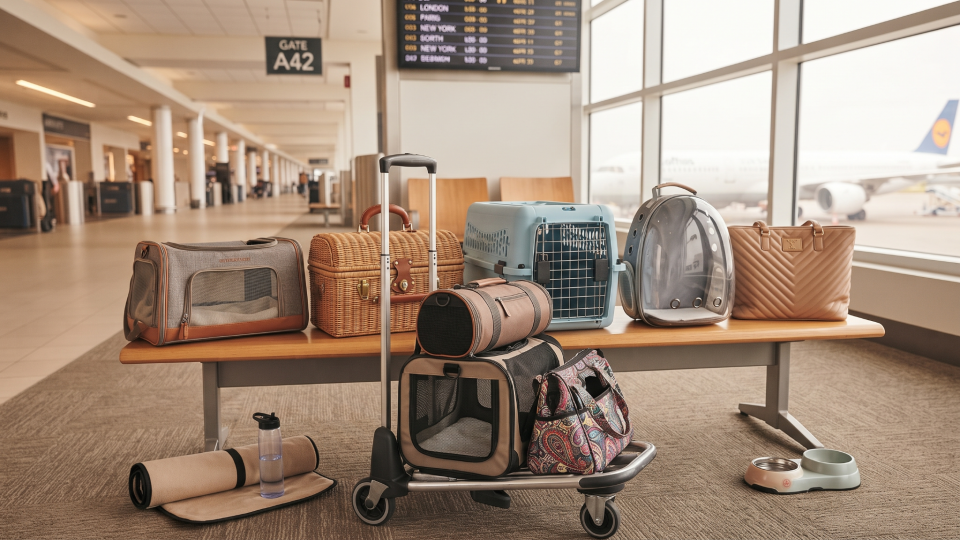
A pet carrier is one of the most useful items you can buy for your cat or dog. Whether you are visiting the veterinarian, moving to a new home, or planning a trip, the right carrier gives your pet a secure place to travel and makes handling easier.
However, choosing a carrier involves more than finding a bag or crate that can hold your pet’s weight. Interior dimensions, ventilation, door security, cleaning access, and your method of transportation all matter. A carrier that works well for a short walk to a veterinary clinic may be unsuitable for a flight or lack the restraint features needed for car travel.
This guide explains how to compare pet carriers, check the fit, evaluate practical features, and help your cat or dog become comfortable before the first journey.
The Short Answer
Choose a pet carrier that fits your pet’s body, supports their weight, provides unobstructed ventilation, and closes securely. Your pet should be able to maintain a natural posture and change position comfortably, while the carrier must also meet the requirements of your intended transportation method.
Before buying, check the usable interior dimensions, inspect the doors and fasteners, and confirm any airline or vehicle installation requirements. Introduce the carrier gradually at home so your pet has time to become familiar with it.
What Should You Consider Before Buying a Pet Carrier?
Start with how you will actually use the carrier. Daily convenience matters, but the carrier also needs to suit your pet and the journey.
Your Main Reason for Using It
Think about your most frequent situation:
- Short trips to a veterinary clinic.
- Walking or using public transportation.
- Regular car journeys.
- Occasional flights.
- Moving house.
- Emergency evacuation.
For routine veterinary visits, easy access and simple cleaning may be especially valuable. If you walk significant distances, the carrier’s empty weight and carrying balance become more important.
For car journeys, investigate how the specific carrier should be secured. For flights, check the airline’s requirements before selecting a model.
Your Pet’s Size and Body Shape
Two pets with the same weight may need different carriers.
A long-bodied dog may need more floor length than a compact dog of the same weight. A tall cat may need additional headroom, while a broad-chested dog may require more width.
Use weight limits to check load capacity, then use measurements and a supervised fit check to judge comfort.
Your Pet’s Behavior
Consider whether your pet:
- Scratches at mesh panels.
- Chews fabric or plastic.
- Pushes against doors.
- Tries to work through zipper openings.
- Settles more easily in a sheltered space.
- Has difficulty stepping over a high entrance.
These observations help identify useful features. A persistent fabric chewer, for example, needs a different assessment from a calm pet that already rests comfortably in a soft carrier.
Your Own Handling Needs
The carrier must be manageable when your pet is inside it.
Check whether you can lift the combined weight, keep the base level, and move through doorways without awkward tilting. Large crates may require two people or a different transport arrangement.
A comfortable shoulder strap cannot compensate for a carrier that is too heavy for you to control.
How Do You Choose the Correct Pet Carrier Size?
Choose by usable interior space rather than the size label alone.
Terms such as “small,” “medium,” and “large” vary between manufacturers. Exterior measurements can also be misleading because thick walls, curved roofs, and padded inserts reduce the space available inside.
Measure Your Pet While Standing Naturally
Record:
- Body length: From the nose to the base of the tail.
- Standing height: From the floor to the highest point of the head or ears.
- Body width: Across the widest part of the body.
- Current weight: To compare with the manufacturer’s load limit.
Avoid pulling your pet into an unnatural position to obtain a measurement. If measuring causes distress, ask someone to help or discuss an easier approach with your veterinary team.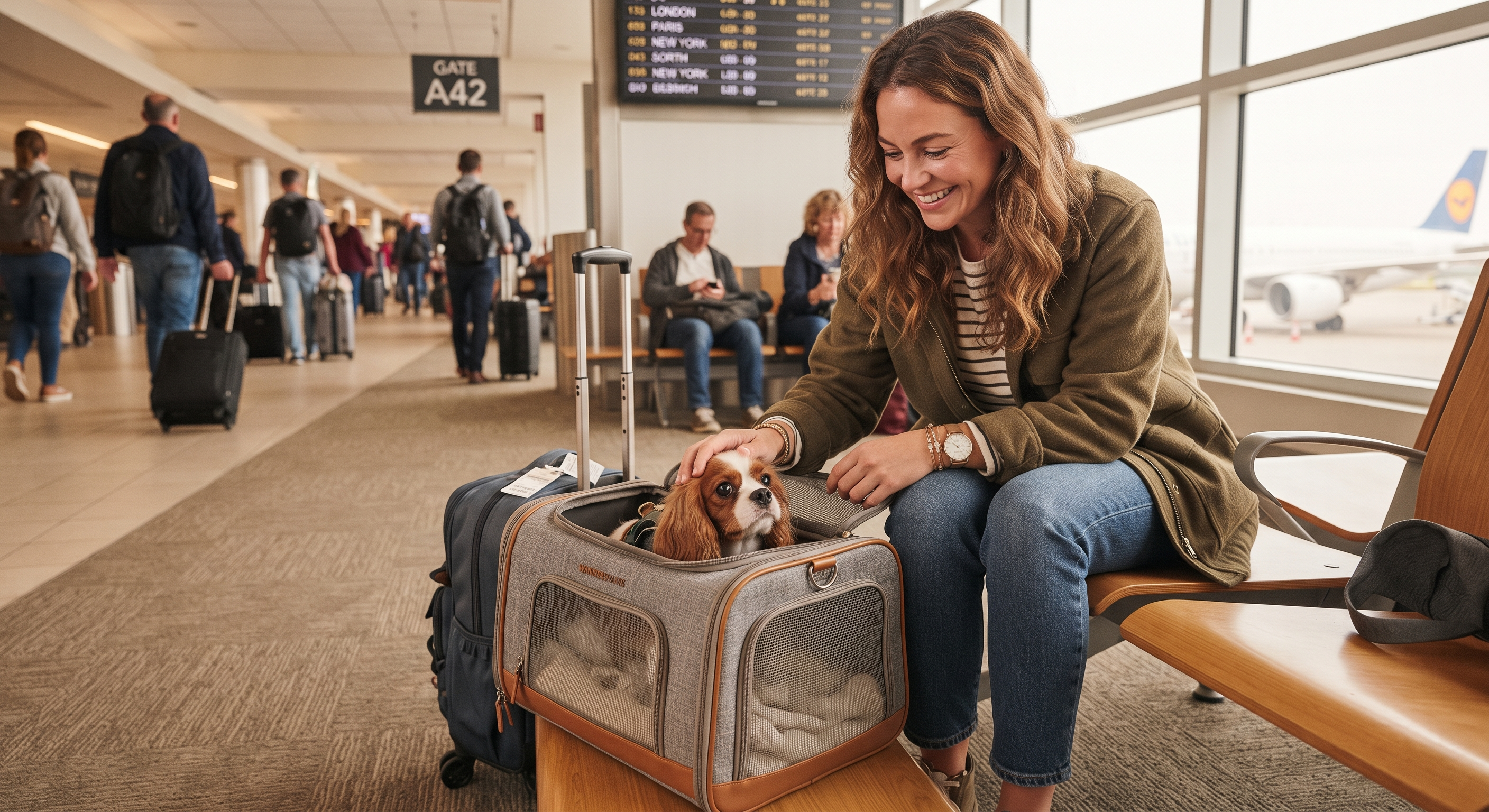
Check Movement and Posture
During a supervised trial, observe whether your pet can:
- Enter without being squeezed through the doorway.
- Stand without being forced to crouch.
- Turn around without becoming wedged.
- Lie down in a natural position.
- Change position without the sides collapsing inward.
For air transport, IATA describes space for normal turning while standing, standing and sitting upright, and lying naturally. Its sizing guidance also accounts for bedding when assessing internal height; the airline may impose additional requirements. Traveler's Pet Corner
Check the Fit With the Bedding Installed
A thick cushion can make an apparently roomy carrier too low.
Try the carrier with the actual mat or liner you intend to use. Check that the bedding stays flat, does not slide excessively, and does not obstruct the entrance.
Avoid Choosing by Weight Alone
Imagine two carriers both advertised for pets weighing up to 8 kilograms. One may have a long, low interior, while the other is shorter and taller.
Both may support the weight, but only one may fit your pet’s proportions. If a seller does not provide interior measurements, request them before ordering.
Is a Hard-Sided or Soft-Sided Pet Carrier Better?
Neither type is best for every situation. Compare the construction and intended use of the individual product.
Hard-Sided Pet Carriers
Hard-sided carriers usually have a rigid plastic shell with ventilation openings and a secured door.
Their practical advantages often include:
- A defined interior shape.
- Surfaces that are relatively easy to wipe clean.
- Removable upper sections on some models.
- Replaceable doors or hardware on some designs.
- Less exposed fabric for pets that scratch or chew.
They can be bulky to store, and carrying comfort varies considerably.
Before buying, inspect the connection between the upper and lower sections. Check the door hinges, latch engagement, handle attachment, and any removable parts.
A rigid shell alone does not demonstrate crash protection. If you are buying for vehicle use, look for relevant testing and clear installation instructions for that exact model.
Soft-Sided Pet Carriers
Soft-sided carriers typically combine fabric, mesh, zippers, and a supporting frame or base.
They can be useful when you need:
- Lower empty weight.
- A shoulder strap.
- Compact storage.
- Multiple access panels.
- A model designed for an airline’s cabin requirements.
Construction quality is particularly important. Check whether the base sags under load, the mesh is firmly attached, and the carrier maintains adequate space when lifted.
Also inspect the zippers. A carrier with several openings gives you flexibility, but every opening needs to close reliably.
Which Is More Suitable for Veterinary Visits?
For cats, a carrier with a removable top can make access easier and may allow parts of an examination to take place while the cat remains in the lower section. Feline veterinary guidance identifies removable-top designs as a useful option for reducing difficult handling. catvets.com
For any pet, consider how the veterinary team would access them if they were reluctant to come out. A narrow front opening may be less convenient than a design offering several practical access options.
Which Pet Carrier Features Are Worth Prioritizing?
Focus on features that improve fit, containment, cleaning, and handling.
A Stable Base
The base should support your pet without folding sharply or sagging excessively.
Check the carrier on the floor and while lifting it according to the manufacturer’s instructions. A product that looks spacious when empty may change shape under your pet’s weight.
Secure Doors and Closures
Inspect:
- Door alignment.
- Latch engagement.
- Zipper ends and locking features.
- Connections between removable sections.
- Gaps around access panels.
- Fasteners that could loosen during handling.
Do not assume a carrier is escape-proof because the product listing uses that phrase.
Practical Ventilation
Consider where air can enter when the carrier is in its actual travel position.
A mesh panel provides little benefit if it is pressed against luggage. Likewise, a cover or blanket should not block airflow.
Be cautious about choosing a carrier mainly for a large transparent window. Assess the complete design, including shaded areas, ventilation, and the conditions in which you intend to use it.
Accessible Cleaning
Look for:
- A removable liner.
- Clear washing instructions.
- Interior corners you can reach.
- A base that can be cleaned after an accident.
- Replacement bedding or parts.
Check whether “washable” refers to the whole carrier or only the removable pad. This distinction affects long-term maintenance.
Comfortable Carrying
Useful features may include padded handles, an adjustable strap, and a base that remains level.
Try carrying the loaded carrier over a short distance at home. Pay attention to swinging, tipping, and whether your leg repeatedly knocks against the side.
Replaceable Components
A carrier may last longer if the manufacturer supplies replacement mats, doors, bolts, or clips.
Check availability before buying, especially for a model you expect to use frequently.
Can You Use the Same Pet Carrier for Car Travel and Flying?
Sometimes, but suitability needs to be checked separately for each use.
Car Travel
A carrier helps contain your pet, but it also needs an appropriate restraint arrangement. Follow the carrier manufacturer’s vehicle instructions rather than improvising with a carrying handle or shoulder strap.
The FDA advises keeping pets properly restrained in the back seat using an appropriate crate, carrier, or safety harness. A pet should not travel loose or on the driver’s lap. FDA
If a product advertises crash testing, look for details:
- Which exact model and size were tested?
- What installation method was used?
- What pet weight was represented?
- Is the test information publicly available?
- Does your planned setup match the tested arrangement?
A seat-belt loop is a feature to investigate, not proof of crash protection.
Air Travel
Confirm the airline’s current rules for your specific itinerary before purchasing.
Ask about:
- Whether your pet can travel on the intended flight.
- Cabin versus hold transport.
- Maximum carrier dimensions.
- Weight limits and how they are calculated.
- Construction and ventilation requirements.
- Breed, age, and health restrictions.
- Required reservations and documents.
Rules can differ between airlines, aircraft, routes, and transport arrangements. A carrier accepted on one trip may not be accepted on another. Traveling with Pets
What Does “IATA Approved” Mean?
Do not treat that phrase as a product certification.
IATA explicitly states that it does not certify, approve, endorse, or sell particular pet containers. Assess the actual carrier against the applicable requirements and obtain confirmation from your airline. iata.org
How Can You Help Your Pet Become Comfortable With a Carrier?
Begin before travel day whenever possible.
A well-chosen carrier can still be frightening if your pet encounters it only when something unfamiliar is about to happen.
Make the Carrier Part of the Home
Place it in a quiet, accessible area with the door safely secured open.
Add suitable familiar bedding and let your pet investigate without being pushed inside. Position it so that the entrance is easy to reach and the carrier will not wobble.
Reward Voluntary Exploration
For cats, AAHA recommends gradually placing treats near the carrier, then just inside, and eventually farther inside while allowing the cat to progress at their own pace. Keeping the carrier available as a familiar resting place can help build a more positive association. AAHA
Use rewards your pet already enjoys. The goal is comfortable participation, rather than getting the door closed as quickly as possible.
Introduce Closure and Movement Gradually
Once your pet rests comfortably inside, try a brief door closure, followed by reopening it while your pet remains calm.
Later steps can include lifting the carrier briefly, walking a short distance, and introducing short car journeys. The AVMA recommends familiarizing pets with their carrier and car travel before longer trips. American Veterinary Medical Association
If your pet becomes distressed, make the next session easier. There is no single training schedule that suits every animal.
Quick Comparison
Hard-sided carriers provide a rigid structure that maintains its shape during handling. Their surfaces are generally easy to wipe clean, and some models have removable tops for easier access during veterinary visits. However, they can be bulky to store and awkward to carry over longer distances. Check the door latch, shell connections, and combined weight before choosing one.
Soft-sided carriers are often lighter and easier to store, making them convenient for carrying smaller pets. Many include shoulder straps and multiple openings, while some are designed for airline cabin travel. Inspect the mesh, zippers, and base support carefully. Airline acceptance must be confirmed for your specific flight.
Backpack carriers keep your hands free and may make walking more manageable for some owners. Their suitability depends on whether your pet has enough room to maintain a natural posture and whether the base remains stable. Pay particular attention to ventilation, movement during walking, and your ability to monitor your pet.
Wheeled carriers can reduce the effort of carrying a heavier pet over smooth surfaces. However, uneven ground may create vibration, and stairs still require lifting. Check stability, wheel quality, and whether the carrier remains level while being pulled.
Vehicle-focused carriers and crates may offer dedicated mounting or restraint features for regular car journeys. Evaluate the exact model’s installation instructions, vehicle compatibility, and any available crash-test evidence. A rigid shell or seat-belt attachment alone does not establish crash protection.
How to Choose
- Start with the journey. Identify whether your priority is veterinary visits, walking, driving, or flying.
- Measure your pet. Compare body dimensions with usable interior space.
- Confirm load capacity. Include your pet’s current weight and any items carried inside.
- Check the fit in person. Observe natural posture and movement with the liner installed.
- Inspect containment. Test doors, zippers, shell connections, and fasteners.
- Assess ventilation in use. Consider where the carrier will sit and what might block its panels.
- Try lifting it. Check balance and your ability to control the combined weight.
- Review cleaning instructions. Confirm which parts can be removed and washed.
- Verify transport requirements. Check airline rules or vehicle installation guidance before purchase.
- Allow time for familiarization. Buy early enough to introduce it gradually.
When comparing prices, include replacement pads, necessary mounting accessories, and spare parts. A lower purchase price may be less attractive if the carrier is difficult to clean or repair.
Important Safety Considerations
Never Leave Your Pet in a Parked Car
A carrier does not protect against a vehicle becoming dangerously hot. The AVMA advises never leaving pets in a car, including in shade or with windows partly open. American Veterinary Medical Association
Discuss Higher-Risk Travel With Your Veterinarian
Short-nosed pets, including some dogs and cats, face additional risks of breathing problems and overheating during travel, particularly flying. Health, age, injury, and temperament can also affect whether a journey is appropriate. Consult your veterinarian before making travel arrangements when these concerns apply. American Veterinary Medical Association
Do Not Give Travel Medication Without Veterinary Advice
If your pet has severe travel anxiety or motion sickness, ask your veterinarian for a plan.
Do not use human medication or leftover prescriptions on your own. For flights, sedatives and tranquilizers require particular caution because they can increase heart or respiratory risks and may conflict with airline policies. ebusiness.avma.org
Inspect the Carrier Before Every Journey
Check for cracked plastic, torn mesh, loose hardware, damaged zippers, and incomplete latch engagement.
Replace or properly repair damaged components before putting the carrier back into service. Avoid temporary fixes that create sharp edges or interfere with the door.
Open the Carrier in a Controlled Location
Before opening it, consider whether your pet could escape through a nearby door, window, or vehicle opening.
Keep the carrier closed while the vehicle is moving. Arrange any necessary access after stopping safely.
Keep Identification Current
Attach readable contact details to the carrier and check that your pet’s identification information is up to date. The AVMA includes a carrier labeled with contact information among emergency travel supplies. American Veterinary Medical Association
Frequently Asked Questions
Is a Bigger Pet Carrier Always Better?
No. The carrier needs enough room for comfortable natural movement, but an unnecessarily large model can be difficult to carry, secure, or fit into your intended transport space.
Choose according to your pet’s measurements and the journey requirements rather than buying the largest option available.
Are Soft-Sided Carriers Suitable for Cats?
They can be suitable when they fit properly and have secure zippers, strong mesh, and a stable base.
Consider your cat’s behavior. Persistent scratching, chewing, or escape attempts may make a particular fabric design unsuitable.
Is a Top-Opening Carrier Better Than a Front-Opening Carrier?
Top access can be convenient, but a removable top provides different benefits from a small roof opening.
Look at how easily your pet can enter and how a veterinary team could access them. A model with both front access and a removable upper section may offer useful flexibility.
Can Two Pets Share One Carrier?
For ordinary personal travel, separate carriers are a practical default because they allow individual handling and avoid forcing pets to share limited space.
Do not assume pets that get along at home will remain comfortable together during transport. For flights or special circumstances, confirm the applicable rules and seek advice about the animals involved.
Are Backpack Carriers a Good Choice?
They may work for some small pets and owners, but hands-free carrying should not override fit and airflow.
Check whether your pet can maintain a natural position, whether the base stays stable, and whether you can monitor them during use. Try the setup at home before taking a longer journey.
Should You Cover a Cat Carrier With a Towel?
Some cats may settle more easily with partial visual cover, but the effect varies.
Use a cover only when it leaves ventilation unobstructed and allows you to monitor your cat. Consider the temperature and conditions before adding any covering.
How Often Should You Clean a Pet Carrier?
Clean visible dirt and accidents promptly, and follow the manufacturer’s instructions for routine washing.
Allow the carrier and bedding to dry thoroughly before storage. Inspect seams, fasteners, and liners while cleaning so wear is easier to spot.
When Should You Replace a Pet Carrier?
Replace it when it no longer fits, cannot close reliably, has structural damage, or cannot be cleaned adequately.
Also reassess it when your travel needs change. A carrier bought for short veterinary trips may not meet the requirements of a future flight or vehicle setup.
The Bottom Line
The right pet carrier fits your cat or dog comfortably, closes securely, and suits the way you travel. Prioritize usable space, ventilation, reliable construction, and practical handling before cosmetic features.
Measure first, verify transport requirements, and introduce the carrier gradually. Those steps will help you choose a product that is easier to use throughout your pet’s life.
Editorial Sources
- International Air Transport Association: Traveler’s Pet Corner
- IATA: How to Select the Correct Container for Air Transport
- U.S. Food and Drug Administration: Travel Training for You and Your Pets
- American Animal Hospital Association: Helping Your Cat Cope With Veterinary Visits
- American Veterinary Medical Association: Traveling With Your Dog or Cat
- American Veterinary Medical Association: Warm Weather Pet Safety