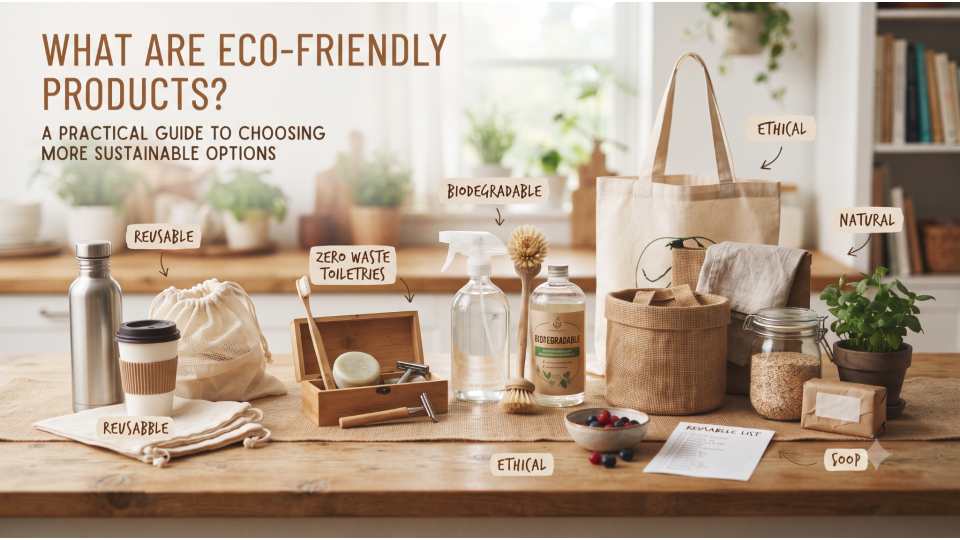
Choosing eco-friendly products can feel surprisingly complicated. One brand promotes a reusable bottle, another advertises biodegradable packaging, and a third describes its products as natural or plant-based. These descriptions may highlight useful features, but they do not explain the whole environmental picture.
A product’s impact depends on more than its main material. How it is manufactured, how long it lasts, how you maintain it, and what happens when you no longer need it all matter. A reusable item that sits unused in a cupboard offers little practical benefit. Compostable packaging also needs an appropriate disposal route.
This guide explains what eco-friendly products are, how common environmental labels differ, and how to choose options that suit your everyday life. Whether you are reducing waste in the kitchen, changing your shopping habits, or comparing household products, the aim is to help you make informed decisions without buying more than you need.
The Short Answer
Eco-friendly products are generally described as products intended to reduce particular environmental impacts compared with alternatives serving the same purpose. Useful features may include durability, repairability, reusable designs, recycled content, or reduced packaging, but each benefit needs supporting evidence and suitable conditions. Start with what you already own, then choose replacements you can use for a long time and manage responsibly after use.
What Makes a Product Eco-Friendly?
A meaningful environmental benefit should be specific, supported by evidence, and relevant to how the product will actually be used.
“Eco-friendly” is a broad description. On its own, it does not tell you whether a product uses less energy, creates less waste, contains recycled materials, or lasts longer than another option.
The U.S. Federal Trade Commission advises marketers to avoid broad, unqualified environmental claims and to identify specific benefits clearly. For shoppers, this offers a useful principle: look for an explanation behind the label.
For example, these hypothetical descriptions communicate different amounts of information:
- Vague: “A better choice for the planet.”
- More specific: “The bottle contains 50% recycled plastic by weight, excluding the cap.”
- More specific: “Replacement lids and seals are available.”
- More specific: “This refill uses 70% less packaging by weight than our standard bottle.”
Specific statements are easier to check. They also help you understand the limits of a claim.
Look at the Whole Life Cycle
A product goes through several stages: obtaining raw materials, manufacturing, distribution, use, maintenance, and waste management. The U.S. Environmental Protection Agency’s sustainable materials management approach considers impacts across these stages rather than judging a product only at disposal.
For a practical shopping decision, ask:
- What materials does the product use?
- Is it designed to last?
- Can damaged components be replaced?
- Does it require frequent replacement consumables?
- How much cleaning or maintenance does it need?
- Is there a realistic route for reuse, recycling, or appropriate disposal?
You will not always find complete answers. When information is missing, acknowledge that uncertainty instead of assuming the product has a lower overall impact.
Are Reusable Products Always Better Than Disposable Products?
Reusable products can reduce dependence on disposable items, but their benefits depend on repeated use and the conditions of production, cleaning, and disposal.
A reusable shopping bag, lunch container, or coffee cup is designed to perform the same task many times. However, producing a durable item also requires resources. Its usefulness depends on whether it actually replaces disposable products over its working life.
UNEP’s life cycle work emphasizes reducing single-use consumption and supporting reuse systems, rather than assuming that replacing one disposable material with another solves the problem.
Choose Something You Will Carry and Use
Imagine buying a large insulated bottle because it looks impressive. If it is too heavy for your commute or does not fit in your bag, you may leave it at home and continue purchasing disposable bottles.
A smaller bottle that meets your needs may be the more useful purchase.
Before choosing a reusable product, consider:
- Convenience: Will it fit into your routine?
- Capacity: Is it the right size for your usual needs?
- Maintenance: Can you clean it properly without difficulty?
- Durability: Are the parts most likely to fail replaceable?
- Storage: Do you have space for it?
- Frequency: How often will you realistically use it?
There Is No Universal “Break-Even” Number
Be cautious with claims that every reusable bag or cup becomes environmentally preferable after one fixed number of uses. Results depend on the products being compared, the impact measured, and assumptions about washing, transport, and disposal.
UNEP’s review of shopping-bag life cycle assessments illustrates why comparisons need context. A finding about climate impact does not automatically answer questions about water use, litter, or other environmental effects.
As a practical rule, use suitable items you already own, avoid collecting unnecessary duplicates, and maintain the products you rely on.
What Is the Difference Between Biodegradable and Compostable?
Biodegradable describes biological breakdown under particular conditions. Compostable describes breakdown under specified composting conditions and requirements.
These terms are related, but they are not interchangeable.
Biodegradable Needs Context
A biodegradable claim should prompt questions about the environment and time frame involved. Conditions in soil, water, a composting facility, and a landfill differ.
A label that simply says “biodegradable” does not explain where you should dispose of the item or how quickly it will break down.
Compostable Needs the Right System
Compostable plastics are designed for specified composting conditions. Industrial composting and home composting are different processes, so a product intended for a commercial facility should not automatically go into a garden compost bin.
EPA also explains that plant-based plastics are not necessarily biodegradable: their behavior depends on their chemical structure.
Before buying compostable packaging or liners, check:
- Whether the claim covers the whole item.
- Whether it specifies home or industrial composting.
- Whether there is a verifiable certification or test reference.
- Whether your local facility accepts that exact product category.
If you cannot identify an appropriate collection or treatment route, do not assume the compostable label makes the item a better choice for your situation.
Does Recyclable Mean a Product Will Be Recycled?
No. Recyclable describes a potential processing route; actual recycling depends on collection, acceptance, sorting, and available facilities.
A package may be made from a material that can be recycled somewhere, while your local service does not accept its particular format.
EPA recommends checking local recycling requirements and explains that compostable plastics should not be mixed into conventional plastic recycling because they can disrupt the recycling stream.
Recycled Content and Recyclability Answer Different Questions
Recycled content concerns what went into making the product.
Recyclability concerns what can happen after use.
A product can contain recycled material while remaining difficult to recycle locally. Likewise, a recyclable container may have been made entirely from new material.
For recycled-content claims, check whether the percentage applies to the product, its packaging, or only one component. A precise claim is more informative than a recycling symbol without an explanation.
A useful habit is to check your waste service’s accepted-material list before purchasing products whose main selling point is recyclability.
Are Natural and Plant-Based Products Automatically More Sustainable?
No. A material’s origin does not establish the environmental performance of the finished product.
“Natural” and “plant-based” describe aspects of a material or formulation. They do not provide a complete assessment of manufacturing, durability, use, or disposal.
For example, when evaluating a bamboo household item, you might need to investigate:
- Whether it is solid bamboo or a composite.
- What coatings, adhesives, or other materials it contains.
- Whether it can withstand its intended use.
- What care the manufacturer requires.
- How the finished product should be handled after use.
The same approach applies to cotton bags, paper packaging, and plant-derived plastics.
Rather than selecting a material because it sounds appealing, compare products that perform the same task. Identify the benefits that are documented and the questions that remain unanswered.
How Can You Recognize Greenwashing?
Look for environmental language that is broader or more confident than the evidence supporting it.
Greenwashing can make a product appear environmentally preferable without giving shoppers enough information to assess the claim.
The FTC’s guidance provides a useful reference for evaluating environmental claims, including the need to clarify the basis of certification seals. Its guidance concerns the U.S. market; advertising requirements differ between countries.
Signs That Deserve a Closer Look
Vague language.
Words such as “green,” “earth-friendly,” or “responsible” appear without an explanation.
An unclear comparison.
A brand claims “less waste” without identifying the previous product or alternative used as the comparison.
Missing scope.
The packaging has a documented improvement, but the wording appears to describe the entire product.
An unexplained badge.
A logo resembles a certification, but there is no named organization, standard, or verification page.
A claim without disposal instructions.
The item is described as compostable or recyclable, but the brand does not explain the relevant conditions.
These signs are reasons to investigate, rather than proof that a company is being dishonest.
Ask Three Questions
- What exactly is being claimed?
- What evidence supports it?
- Does that benefit apply to my use and local disposal options?
If the answers are unclear, compare another product or contact the company for details.
Which Everyday Products Are Worth Evaluating First?
Start with items connected to frequent purchases or recurring waste in your own household.
There is no need to replace everything at once. A useful first step is to observe what you regularly throw away, replace, or forget to use.
Shopping Bags
Check whether you already have suitable bags. If so, focus on remembering them.
Keep one near your keys or in the bag you take shopping. When buying a replacement, consider comfortable handles, useful capacity, and repairable construction.
Drink Bottles and Coffee Cups
Choose around your actual routine: commuting, exercising, working at a desk, or buying takeaway drinks.
Check the opening, lid design, cleaning instructions, and availability of replacement seals. A complicated lid may be inconvenient if you need to clean it frequently.
Food Storage Containers
Start by identifying what you store most often: packed lunches, leftovers, dry ingredients, or freezer portions.
Choose dimensions and materials suitable for those tasks. Check the manufacturer’s instructions for refrigeration, freezing, heating, and washing.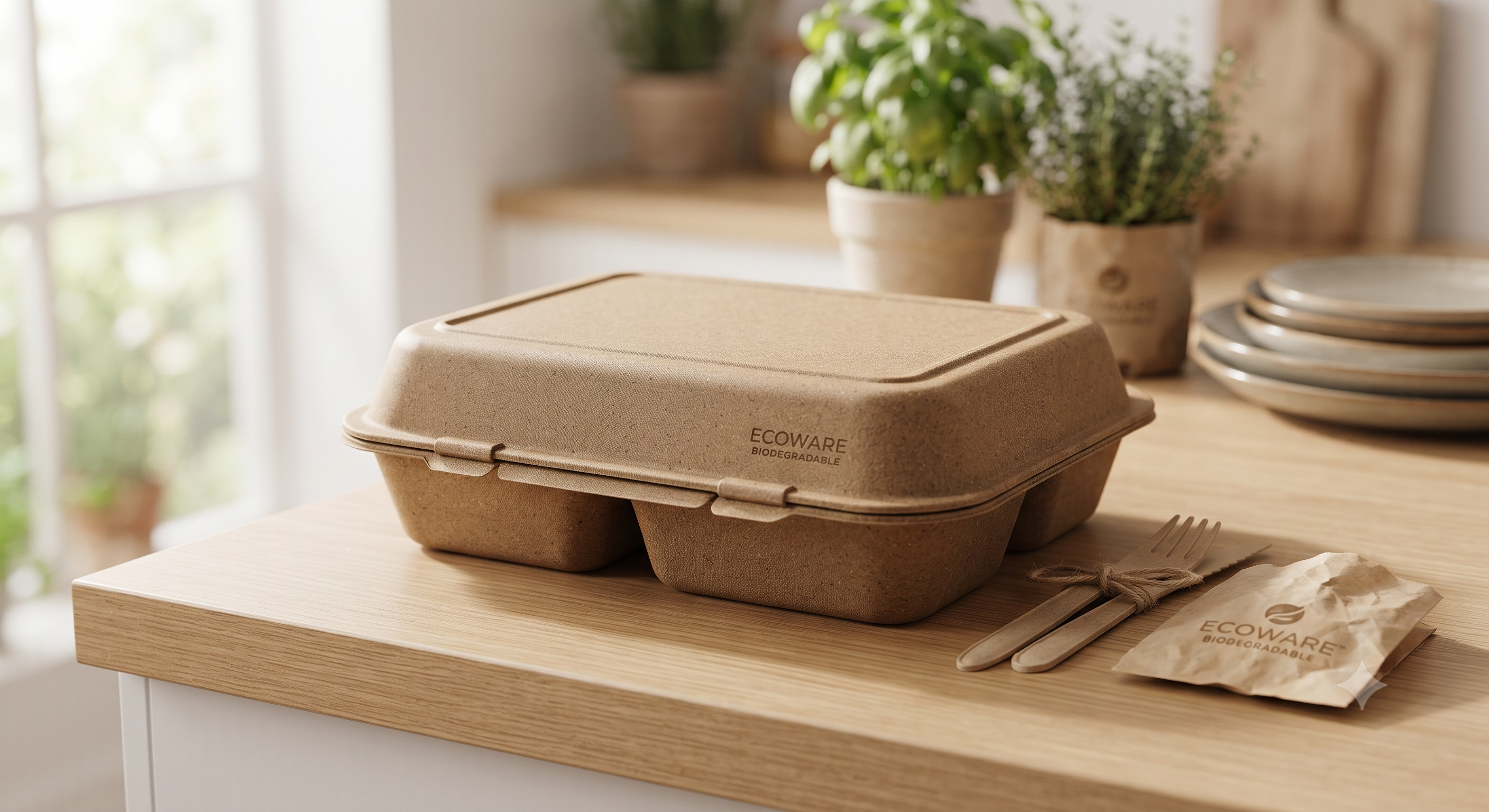
Refillable Household Products
Investigate the refill system before buying the starter container.
Ask whether refills are easy to obtain, what they cost per usable quantity, how much packaging they use, and what happens to that packaging.
Washable Cloths
Consider whether a cloth can replace a recurring disposable item in a task you already perform.
Plan how you will wash, dry, and store it. A convenient supply of clean cloths is more useful than an attractive set that is difficult to maintain.
Secondhand and Repairable Goods
For suitable products, consider buying secondhand or repairing what you own.
EPA places source reduction and reuse ahead of recycling in its materials-management hierarchy. Repair, reuse, and avoiding unnecessary purchases can therefore be useful starting points before choosing a newly manufactured alternative.
How to Choose
Use these practical steps before purchasing:
- Define the need. Identify the task the product must perform.
- Check what you own. A suitable existing item may make a new purchase unnecessary.
- Prioritize frequent use. Choose changes that address your recurring habits.
- Compare equivalent products. Consider similar capacity, function, and expected use.
- Look for precise claims. Identify the benefit, its scope, and its evidence.
- Inspect durability. Check weak points, warranties, and replacement parts.
- Assess maintenance. Choose something you can clean and care for consistently.
- Verify the disposal route. Check local acceptance before relying on recycling or composting.
- Calculate total cost. Include refills, consumables, maintenance, and likely replacements.
- Buy gradually. Test whether one change works before expanding it.
Estimate Cost per Use
A simple calculation can help compare purchase prices:
Cost per use = total ownership cost ÷ number of uses
Suppose a reusable item costs $20 and you use it 200 times. Its purchase cost averages $0.10 per use, before cleaning and maintenance.
This is a hypothetical financial example. It does not measure environmental performance or prove that the product is better than a particular alternative.
For refillable products, also compare the cost per usable quantity. Concentrated products may require dilution, so package size alone can be misleading.
Keep a Short Decision Record
For a purchase you are uncertain about, write down:
- What it will replace.
- How frequently you expect to use it.
- Which environmental claims you verified.
- How you will maintain it.
- What you will do when it is worn out.
This makes it easier to evaluate the product after several weeks and avoid repeating purchases that did not suit your routine.
Important Safety Considerations
Environmental claims do not replace instructions for safe use.
Select products that are appropriate for the task and follow their labels.
Food-Contact Products
For containers, wraps, bottles, and utensils, verify the intended food-contact uses.
Check whether the manufacturer permits hot liquids, freezing, microwaving, dishwashing, or other conditions you need. Do not assume every component has the same limits: a container, lid, seal, and coating may have different instructions.
Inspect items regularly and follow replacement guidance when parts become damaged or difficult to clean.
Cleaning Products and Refills
Use the recommended dilution, storage, ventilation, and protective measures. Keep cleaning products in appropriate labeled containers and out of reach of children and pets.
A product described as natural or environmentally preferable still needs safe handling.
For shoppers in the United States, EPA’s Safer Choice program can help identify qualifying products assessed against its criteria for safer ingredients and other requirements. The label does not remove the need to follow directions.
Hygiene and Reuse
Follow cleaning and drying instructions for bottles, food containers, washable cloths, and other reusable items.
If a product has components that trap residue, check whether they can be removed for cleaning. Choose a design you can maintain properly.
Composting and Disposal
Do not add compostable plastics to ordinary plastic recycling. Confirm acceptance with the relevant collection service or facility.
Environmental labels also do not provide permission to litter. Keep products and packaging within an appropriate collection or treatment system.
Frequently Asked Questions
What Is the Easiest Way to Start Buying More Sustainably?
Start by reviewing one recurring habit.
If you frequently buy takeaway drinks, evaluate the cup you already own and whether the café accepts it. If you regularly purchase shopping bags, make existing bags easier to remember.
Choose a manageable change and assess whether it works before buying more equipment.
Should I Replace All My Plastic Products?
No. Evaluate their condition, suitability, and instructions first.
Replacing a functional item solely because another material looks more sustainable does not establish an environmental improvement. Consider the whole life cycle and the specific alternatives available.
Can Biodegradable Products Go in a Home Compost Bin?
The word “biodegradable” alone is insufficient.
Check for explicit home-composting suitability and follow the product’s conditions. EPA advises against putting compostable plastics in home compost unless the label indicates they are suitable for that environment.
Is Glass Always Better Than Plastic?
There is no universal answer.
The comparison depends on the function, product design, expected life, transport, cleaning, and disposal. Choose a suitable item and investigate the evidence for any claimed advantage rather than judging only by material.
Are Eco-Friendly Products More Expensive?
Some have a higher purchase price, while others may be inexpensive or already available in your home.
Compare total ownership costs and realistic use. A durable product can still be poor value if it does not suit your needs, while repairing an existing item may avoid a new purchase entirely.
Does a Certification Prove a Product Is Sustainable in Every Way?
No. Read what the certification covers.
It may concern a particular material, ingredient assessment, production requirement, or disposal characteristic. Verify the product and certification through the issuing organization where possible, and avoid extending a limited certification to unrelated claims.
What If My Area Has Limited Recycling or Composting?
Choose around the services you can actually access.
Ask your waste provider about accepted materials and available drop-off routes. Meanwhile, focus on avoiding unnecessary purchases, maintaining useful belongings, and selecting products that do not depend on an unavailable disposal system.
Can Small Changes Still Be Useful?
Yes, especially when they become consistent habits.
Judge progress by what changes in your routine: fewer unnecessary purchases, longer use of belongings, successful repairs, or less reliance on disposable items. You do not need a complete collection of products marketed as green to begin.
The Bottom Line
Choose products by their usefulness, evidence, and expected life in your home. Start with existing belongings, replace them thoughtfully, and verify any environmental claim that influences your purchase.
A good first step is to identify one recurring source of waste this week and find a practical way to reduce it. Choose a change you can maintain, then build from that experience.
Editorial Sources
- Federal Trade Commission: Environmental Claims—Summary of the Green Guides. Guidance on specific environmental claims and their qualifications.
- U.S. Environmental Protection Agency: Sustainable Materials Management Basics. An introduction to assessing materials across their life cycles.
- United Nations Environment Programme: Addressing Single-Use Plastic Products Pollution Using a Life Cycle Approach. A review of single-use products and alternatives.
- United Nations Environment Programme: Single-Use Plastic Bags and Their Alternatives. Recommendations drawn from life cycle assessments.
- U.S. Environmental Protection Agency: Frequently Asked Questions About Plastic Recycling and Composting. Explanations of biodegradable, compostable, and biobased plastics.
- U.S. Environmental Protection Agency: How Do I Recycle Common Recyclables?. Recycling guidance and the importance of local acceptance.
- U.S. Environmental Protection Agency: Materials and Waste Management Hierarchy. Guidance on reduction, reuse, and subsequent waste-management options.
- U.S. Environmental Protection Agency: Learn About the Safer Choice Label. Information about the program’s product assessment and label.