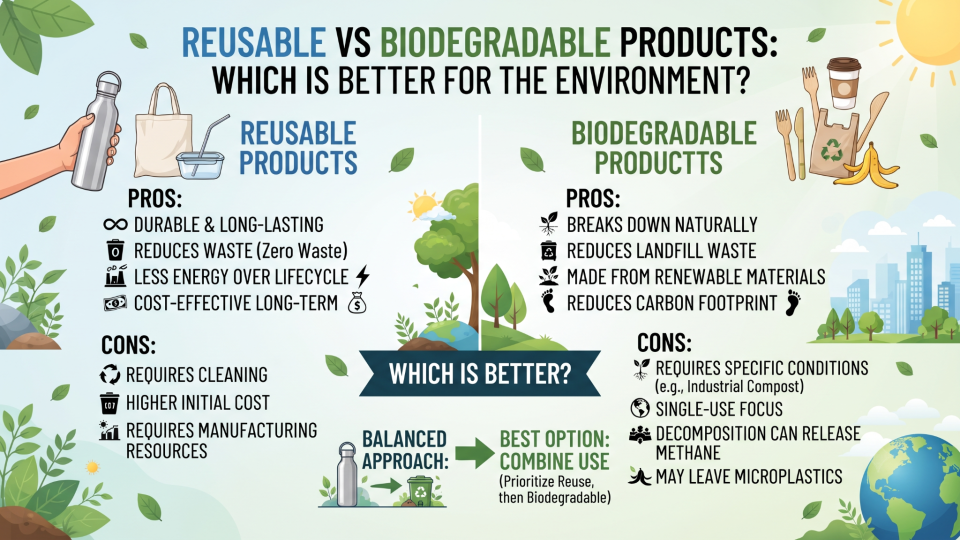
You are shopping for a more sustainable alternative to disposable plastic bags. One option is a sturdy bag designed for repeated use. Another is a lightweight bag labeled “biodegradable.” Both appear to offer an environmental benefit, but they solve different problems—and neither label tells you everything you need to know.
The reusable bag depends on you keeping it in service. The biodegradable bag depends on the conditions it encounters after disposal. To make a useful comparison, you need to look beyond the packaging and consider what happens throughout each product’s life.
This question applies to much more than shopping bags. It comes up when choosing coffee cups, food containers, cleaning supplies, kitchen accessories, and takeaway packaging. Understanding the differences can help you spend more carefully, avoid misleading claims, and choose products that fit your everyday habits.
The Short Answer
Reusable products are often a practical starting point for reducing repeated disposable purchases, provided you use them frequently and maintain them properly. Biodegradable or compostable products can serve specific purposes, but their usefulness depends on verified material properties and a suitable disposal route. The better choice is the product—or existing item—that meets your needs with less avoidable waste across its full life cycle.
What Is the Difference Between Reusable and Biodegradable Products?
Reusable describes how a product can be used. Biodegradable describes how a material can break down under particular conditions.
These characteristics belong to different parts of a product’s life. A reusable item is intended to perform its job repeatedly: carrying groceries, holding a drink, storing food, or cleaning a surface. Its useful life depends on its design, durability, care, and the way you use it.
A biodegradable material can undergo biological breakdown in a suitable environment. The term alone does not specify where that happens, how long it takes, or whether the conditions will exist where you dispose of it. The European Commission distinguishes biodegradability from a material’s origin and emphasizes the conditions needed for environmental benefits.
The two characteristics are not necessarily opposites. A product may be reusable during its useful life and contain biodegradable materials. Equally, a reusable item may be made from conventional plastic, glass, or metal.
For shopping purposes, separate the questions:
- Use: How many times can I realistically use this item?
- Performance: Will it do the job well enough that I keep it?
- Disposal: What happens when it is no longer useful?
- Evidence: Which claims can I verify?
A product that performs poorly may be abandoned quickly, regardless of what its label promises.
Are Biodegradable, Compostable, and Biobased the Same Thing?
No. These terms describe different properties, and confusing them can lead to the wrong buying or disposal decision.
Biobased refers to the source of some or all of a material’s raw ingredients. Those ingredients come from biological resources rather than being entirely fossil-based. It does not automatically mean that the finished product will biodegrade or can be composted.
Biodegradable concerns biological breakdown under particular environmental conditions. A claim needs context: the receiving environment and the time required matter.
Compostable concerns breakdown within a composting process. Products may be intended for industrial composting or for home composting, and those are different settings. The European Commission’s framework addresses these distinctions because the terms are sometimes used in ways that confuse consumers.
For example, a product made from plant-derived material could still require a specific industrial treatment process. Its origin does not tell you where to put it after use.
Instead of asking only whether an item is “natural,” look for a clearly described end-of-life route. If the instructions are missing, ask the manufacturer what the claim covers and check whether your local waste service accepts the product.
Why Can Reusable Products Be a Better Everyday Choice?
They can replace a pattern of repeated disposable purchases with an item that stays useful.
A reusable lunch box is a good example. If you use it regularly for packed meals, it can take the place of some wrappers and disposable containers. A reusable bottle can serve a similar role when it replaces drinks you would otherwise buy in single-use bottles.
The principle is to keep a finished product doing its job for longer. UNEP’s work on single-use products supports approaches that retain resources in useful service, including reusable systems, while considering environmental impacts across the life cycle.
That does not mean buying a reusable product automatically improves a routine. The item must be convenient enough to use.
Consider two people who purchase the same travel cup. One keeps it near the door, takes it on the commute, and washes it after use. The other finds it awkward to carry and continues buying drinks in disposable cups. The products are identical; the routines are not.
Before buying, picture the item in an ordinary week:
- Where will you keep it?
- Will you remember to carry it?
- Is it comfortable and the right size?
- Can you clean it without difficulty?
- Does it replace something you actually use often?
A simple design that fits your habits may be more useful than an elaborate product with features you rarely need.
How Many Times Must You Reuse a Product?
There is no single number that applies to every reusable product.
You may see claims that a bag or cup must be used a specific number of times to become the better environmental option. Such findings depend on the products being compared, the environmental measure being studied, and assumptions about production, washing, transport, and disposal.
A study of climate impacts does not necessarily answer every question about water use, litter, or other effects. A comparison between two particular bag designs also cannot automatically be applied to every bag on the market.
Life cycle assessment examines impacts across stages such as raw material extraction, manufacturing, distribution, use, and end of life. UNEP’s analysis of shopping bags uses that approach rather than judging products by material alone.
For an everyday decision, focus on a reliable principle: choose something you will use often, care for it, and avoid replacing it unnecessarily.
If your existing bag is strong enough for shopping, keep using it. If your bottle works well, you do not need a new one because another brand advertises a more sustainable design. Regular use is more important than repeatedly upgrading your collection.
When Can Compostable Products Be Useful?
They can be useful when they match a specific task and an available treatment system.
A compostable food-waste liner is one possible example. Its practical value depends on whether the local collection service accepts that exact type of liner. If it does, the liner may fit the way that service collects and treats organic waste. If it does not, a compostable claim does not make it acceptable.
The same question applies to takeaway packaging. Before choosing it for a workplace or event, find out where it will go afterward. A product intended for industrial composting needs an appropriate route to that process.
The EPA advises consumers to check collection options and, where necessary, ask waste services about facilities accepting compostable plastics.
A useful purchase decision therefore has two parts:
- Does this product meet the relevant requirements?
- Can I actually send it through the intended treatment route?
A clearly labeled item without an accessible disposal route may offer less practical value than the buyer expects.
Can Compostable Packaging Go in a Home Compost Bin?
Only when it is specifically suitable for home composting and you can follow the applicable instructions.
Industrial and home composting do not provide identical conditions. Industrial processes generally use controlled conditions that a typical garden compost pile may not reach. A product labeled simply “compostable” should not be assumed to work in a home bin.
The EPA states that compostable plastic is generally intended for industrial or commercial composting unless its label indicates suitability for home composting.
Even with an appropriate product, composting is a process that needs attention. Microorganisms require suitable ingredients, oxygen, and moisture to turn material into finished compost. A neglected pile or a container used as a general rubbish bin is not the same as a managed composting system.
If you are new to home composting, start by learning which materials your system can handle. Treat unfamiliar packaging as a separate question rather than assuming it behaves like vegetable scraps or fallen leaves.
Does “Biodegradable” Mean a Product Is Safe to Leave Outdoors?
No. It is not permission to litter.
A material’s behavior depends on the environment it enters. A claim associated with one set of conditions should not be extended to soil, rivers, beaches, or the sea without evidence.
The European Commission’s framework emphasizes that material characteristics, the receiving environment, and sufficient time all matter to biodegradation.
There is also a difference between an item visibly breaking into pieces and evidence that it has fully biodegraded. A bag becoming brittle or tearing apart is not enough to prove its environmental claim.
After using a product, follow an established disposal route. If that route is unclear, ask the manufacturer or local waste provider. Leaving the item outdoors creates uncertainty about where it will travel and what conditions it will encounter.
How Do These Choices Compare in Everyday Situations?
The most useful choice changes with the task, your habits, and local services.
Grocery shopping
If you shop regularly, a sturdy bag that you remember to bring is a practical option. Keep it in a place connected to the trip: beside your keys, in a backpack, or in another suitable location.
A biodegradable bag addresses a disposal claim, but it does not prevent the repeated need for a new bag. Before buying one, identify what you will do with it afterward.
Drinking away from home
A reusable bottle makes sense when you can carry and refill it conveniently. If a shared return system exists for cups, that may suit someone who does not want to carry a personal cup.
The useful option is the one connected to a routine you can sustain.
Packed lunches
A reusable container can fit a regular work or school meal routine. Select it for the food you carry: a sandwich box is not automatically suitable for soup, and not every container can be reheated.
Food-waste collection
Follow the collection service’s requirements. If it accepts certain compostable liners, choose a compliant product. If it requires a different approach, follow that instruction rather than relying on the word “compostable.”
Occasional events
Before purchasing disposable packaging, consider whether reusable items can be collected and washed. If single-use items are necessary, confirm what the waste contractor can process. Sorting arrangements at the venue matter as much as the product label.
These examples show why there is no universal winner. The full arrangement determines whether the product’s intended benefit can be realized.
Quick Comparison
Reusable products
Their main strength is the ability to serve repeatedly. They are a good starting point for frequent activities such as shopping, drinking, packing meals, and cleaning.
Their limitations include cleaning, carrying, storage, and eventual wear. Some also need replacement parts. Their practical value grows when they become part of a consistent routine.
Biodegradable products
Their defining claim concerns breakdown under suitable conditions. To assess them, you need information about the environment, timescale, and scope of the claim.
Their limitation is that normal disposal may not provide the stated conditions. “Biodegradable” alone does not tell you which bin to use.
Compostable products
They offer a more specific treatment claim, but require a compatible composting route. Check whether the claim concerns home or industrial composting and whether the local service accepts the item.
Their practical role is strongest when product choice, collection, and treatment are planned together.
Items you already own
A functional item may already meet your needs. Continuing to use it can avoid an unnecessary purchase.
The EPA recommends considering reuse and repair before replacement, including everyday items such as grocery bags and containers.
How to Choose
- Start with a real need. Identify the product or habit you want to replace. Avoid buying an item simply because its packaging looks sustainable.
- Check what you already have. A suitable bottle, bag, or container may be available at home.
- Choose for performance. Look at capacity, strength, comfort, cleaning, and the instructions for your intended use.
- Estimate realistic use. Consider how often you will use a reusable item—not just how often you hope to use it.
- Read disposal claims precisely. Identify whether the product is biodegradable, home-compostable, or industrially compostable.
- Check the whole item. Ask whether the claim applies to all components or only a particular material.
- Confirm local acceptance. Recycling and composting services differ. Check the provider that handles your waste.
- Compare total costs. Include refills, care, or replacement parts when relevant. Cost per use can help with budgeting, but it is not a calculation of environmental impact.
- Try one change before buying several products. Observe whether it is convenient enough to keep using.
A helpful final question is: “Can I explain what this product will change in my routine?” If the answer is unclear, you may need more information—or may not need the purchase.
Important Safety Considerations
Environmental claims do not replace product-specific safety and care instructions.
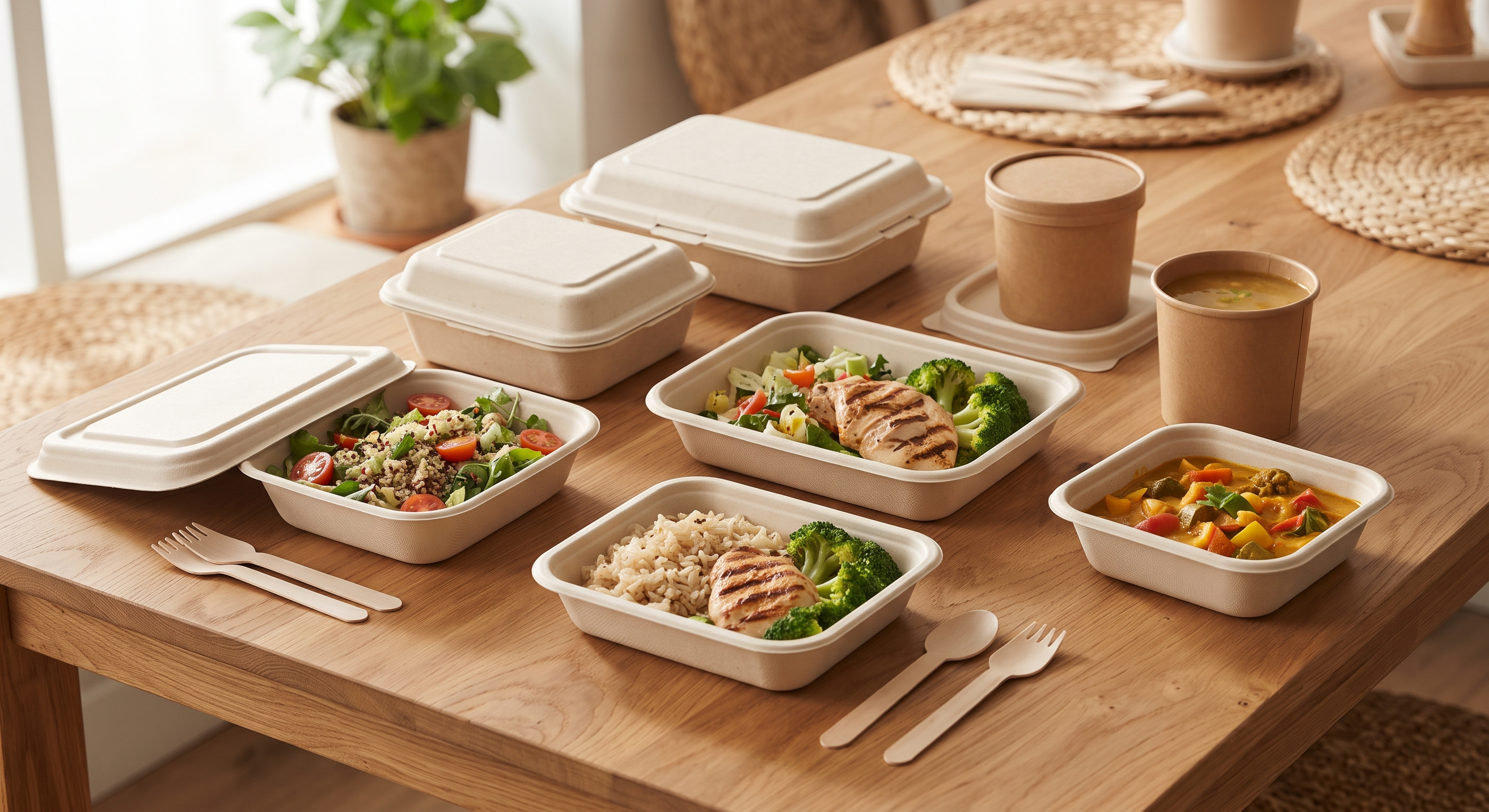
For food containers, check suitability for the foods, temperatures, and cleaning methods you intend to use. A reusable or compostable label does not establish that an item can hold hot liquids, go in a microwave, or be washed in a dishwasher.
For reusable items, clean and maintain them according to their instructions. Inspect worn parts, closures, and surfaces that affect function. Replace an item or component when it is no longer appropriate for the task.
For disposal, do not put unfamiliar compostable packaging into household recycling on the assumption that all plastics belong together. The EPA recommends checking which materials a local program accepts, including separate guidance for compostable and biobased plastics.
Small home experiments also have limits. Seeing a product soften or fragment does not verify a compostability claim. Use credible product documentation and instructions instead.
Frequently Asked Questions
Are reusable products always better than biodegradable products?
No. They address different parts of a product’s life. Reusable products need frequent use; biodegradable products need suitable breakdown conditions. Compare the specific products and the arrangements available to you.
Is a paper bag automatically compostable?
Do not assume so from its appearance. Check the finished product’s documentation, including any coatings or other components, and follow the rules of the relevant composting service.
Are bags made from coconut fibre necessarily biodegradable?
The fibre’s origin does not establish the properties of the finished bag. Check its complete construction and any supporting claims. A product may contain fibre alongside coatings, adhesives, or other materials, so the whole item needs to be considered.
Should I replace all my plastic containers with glass or metal?
No. If a container still works and remains suitable for its intended purpose, you can continue using it. When replacement is needed, choose by function, care requirements, durability, and your actual routine.
How can I recognize a weak environmental claim?
Look for missing details. What part of the product does the claim cover? Under which conditions? Is supporting information available? A statement that cannot answer those questions may be too vague to guide a purchase.
What if my area does not accept compostable packaging?
Do not assume another bin is appropriate. Ask your local provider how the item should be handled. For future purchases, prioritize options that match the services you can actually access.
What is the easiest first step toward using greener products?
Choose one frequent routine. Use an existing shopping bag, carry a suitable bottle, or keep a functional container in service. A change you repeat regularly is a more useful starting point than a large collection of new products.
The Bottom Line
For frequent everyday needs, start with an item you can keep using. Consider biodegradable or compostable alternatives when their claims are clear and the intended treatment route is available.
The label is only the beginning of the decision. A useful product, a consistent routine, and an appropriate disposal route need to work together.