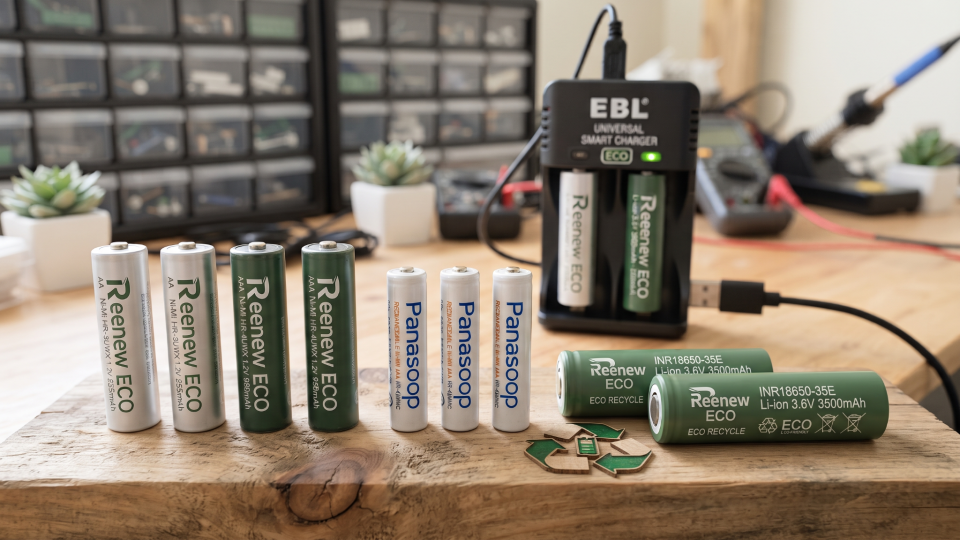
Batteries power many of the small devices that make everyday life convenient: remote controls, wireless keyboards, game controllers, toys, flashlights, and portable accessories. Buying a replacement pack can feel like a minor household expense, but repeated purchases create a continuing cycle of packaging, used batteries, and shopping trips.
Rechargeable batteries offer a different approach. Instead of replacing a battery after one discharge, you recharge it and use it again. For a compatible device that consumes batteries frequently, this can be a practical way to reduce replacement purchases and lower ongoing costs.
However, rechargeable batteries are not interchangeable with every disposable battery. Battery size, chemistry, voltage, device requirements, and charger compatibility all matter. A battery that physically fits may still be unsuitable, and an expensive rechargeable set provides little value if it remains unused in a drawer.
This guide explains how to compare rechargeable and disposable batteries, identify suitable devices, calculate potential savings, choose a charger, and build a safe household battery routine. It focuses primarily on replaceable household batteries, especially AA and AAA formats, rather than large battery packs or electric vehicles.
The Short Answer
Rechargeable batteries are worth considering for compatible devices that need frequent battery replacement, provided you will maintain a reliable charging routine. Disposable batteries may remain appropriate for devices with specific manufacturer requirements or situations where recharging is impractical.
Start with the device manual, choose the correct chemistry and voltage, and compare costs over actual use rather than assuming every rechargeable battery is a universal replacement.
What Is the Difference Between Rechargeable and Disposable Batteries?
Disposable batteries are intended for one discharge, while rechargeable batteries are designed to be recharged using an appropriate charging system.
That distinction sounds simple, but the products within each category vary considerably.
“Rechargeable” describes a capability. It does not identify the battery’s voltage, chemistry, charger requirements, or suitability for a particular device.
Likewise, “disposable” does not mean that every single-use battery has the same performance or disposal instructions.
Disposable Household Batteries
Common single-use products include alkaline batteries and lithium primary batteries.
When choosing replacements, read the markings on the battery and the instructions for the device. Do not identify a battery solely by its shape or packaging color.
Keep the original product information accessible where possible. It can help you distinguish a single-use battery from a similarly shaped rechargeable product later.
Rechargeable Household Batteries
Nickel-metal hydride, commonly abbreviated NiMH, is a rechargeable chemistry found in household AA and AAA products.
Lithium-ion rechargeable batteries are another category. They appear in many devices and battery systems, but their charging and compatibility requirements differ from those of NiMH products.
The practical rule is straightforward: choose a complete compatible system consisting of the device, batteries, and charger.
Why Size Alone Is Insufficient
AA and AAA describe familiar physical formats. They do not settle every electrical requirement.
Before installing a replacement, confirm:
- Battery size.
- Battery chemistry.
- Required voltage.
- Whether rechargeable batteries are permitted.
- Any model-specific restrictions.
Energizer’s battery-care guidance recommends using the size and type specified by the device instructions. That is a more dependable starting point than assuming that any battery fitting the compartment is suitable. Energizer OEM
Are Rechargeable Batteries Better for the Environment?
Repeated reuse can reduce the number of replacement batteries you purchase, but overall environmental performance requires a broader comparison.
The clearest household-level benefit is the opportunity to replace repeated single-use purchases with continued use of an existing battery set.
However, producing rechargeable batteries and chargers also uses materials and energy. Charging uses electricity, and batteries eventually need appropriate end-of-life handling.
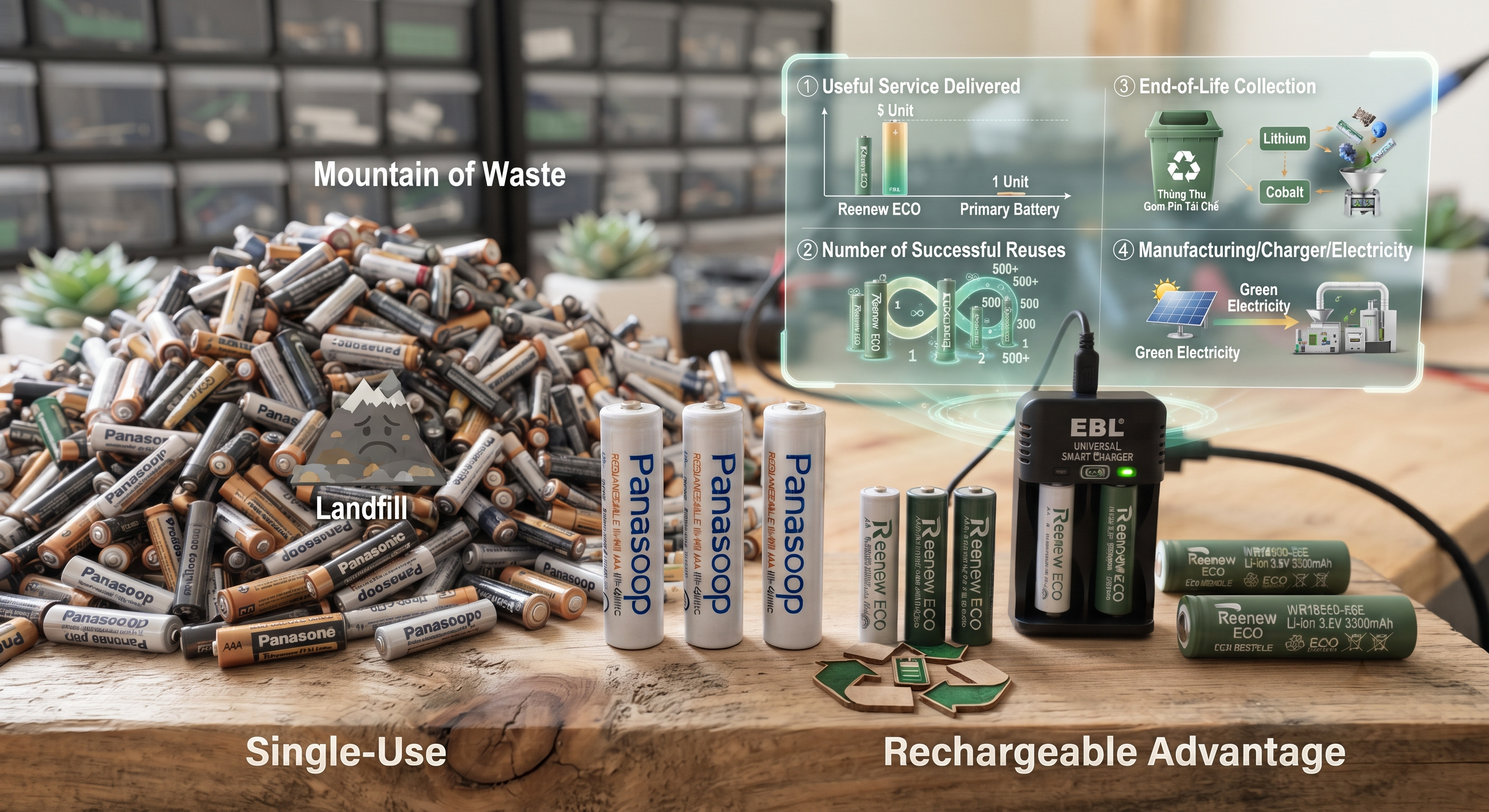
A fair comparison therefore considers:
- Manufacturing.
- Battery chemistry and materials.
- Charger production.
- Charging electricity.
- Useful service delivered.
- Number of successful reuses.
- End-of-life collection and processing.
A life-cycle approach examines these stages rather than judging a product through one attribute. UNEP uses this approach when comparing products and alternatives because trade-offs can occur across production, use, and disposal.
Reuse Has to Happen in Practice
A rechargeable set achieves its purpose through continued use.
Before purchasing, ask yourself:
- Which device will use it?
- How often do I replace batteries in that device?
- Where will the charger be kept?
- Who will recharge the batteries?
- Will I need a spare set?
- Can I distinguish charged batteries from discharged ones?
These questions may seem ordinary, but they determine whether the purchase becomes a working system.
A large rechargeable collection that is rarely used is a different proposition from a small set that repeatedly powers a frequently used device.
Avoid Universal Environmental Claims
There is no single environmental break-even number that applies to every battery, charger, electricity supply, and device.
A claim that a rechargeable battery is always environmentally superior would need evidence covering the relevant comparison.
For household decision-making, a sensible starting point is to identify a compatible device where frequent replacement creates a clear opportunity for reuse. This is a purchasing strategy, not a substitute for product-specific life-cycle evidence.
Which Devices Should You Consider Switching First?
Start with a noncritical device that consumes replaceable batteries regularly and explicitly supports the rechargeable type you intend to buy.
The best first candidate is one you use often enough to evaluate, but where a charging delay would not create a safety problem.
Possible candidates might include a game controller, a toy, or a frequently used accessory. Compatibility must be checked for the exact device.
Begin With Your Replacement History
Look at where batteries are actually being purchased.
You might discover that:
- One controller accounts for most replacements.
- A toy uses several cells at a time.
- A keyboard requires very occasional replacement.
- A flashlight is mainly stored for emergencies.
These patterns suggest different priorities.
A device that uses several sets over a short period gives you a clearer opportunity to assess savings than one whose batteries remain in service for a long time.
Do Not Switch Everything at Once
A gradual trial is easier to manage.
Choose one compatible device, purchase an appropriate battery-and-charger setup, and observe:
- Runtime between charges.
- Charging convenience.
- Device behavior.
- Whether spare batteries are necessary.
- Whether the routine fits your household.
After that trial, decide whether to expand.
Treat Safety-Critical Devices Separately
Smoke alarms, carbon monoxide alarms, medical devices, and other important equipment require particular care.
Use the exact battery type approved in the device instructions. Do not substitute rechargeable batteries simply to reduce household waste.
For example, some Kidde smoke-alarm manuals explicitly prohibit rechargeable batteries. This is a model-specific requirement, so consult the manual for your own alarm. kidde.com
Environmental goals should support reliable operation rather than override it.
Why Do Some Rechargeable AA Batteries Say 1.2V Instead of 1.5V?
Common NiMH AA batteries have a nominal voltage of approximately 1.2V, while common alkaline AA batteries are rated at approximately 1.5V.
Nominal voltage is an identifying specification. It does not, by itself, tell you how long a battery will operate a particular device.
Panasonic explains that its NiMH products and alkaline batteries have different voltage behavior during discharge. Its performance comparisons also specify test conditions, which matters when interpreting the results. Panasonic Battery Products
Compatibility Depends on the Device
Some equipment can operate with approved NiMH batteries. Other equipment may have requirements that make them unsuitable.
Check the manual rather than relying on a general claim that all AA devices support all AA batteries.
If the instructions are unclear, ask the device manufacturer.
Battery Indicators May Need Interpretation
If a device displays a battery level, check whether the manufacturer explains how that indicator behaves with rechargeable batteries.
Do not assume that a displayed percentage provides the same information for every chemistry.
During a trial, observe whether the device provides useful low-battery warning and predictable operation. If behavior seems unusual, consult the manufacturer before continuing.
Avoid Improvised Substitutions
Do not replace a specified battery with a higher-voltage product merely because its dimensions appear similar.
The voltage and chemistry must match what the device permits. Physical fit is only one part of compatibility.
Are Rechargeable Batteries Cheaper Over Time?
They can be, especially when they replace frequent purchases, but the savings depend on upfront cost, runtime, charging costs, and continued use.
A rechargeable system commonly involves an initial investment in batteries and a charger. Disposable purchases spread the spending across replacements.
To compare fairly, define the service you are buying.
For example:
“Enough battery power to operate this controller over a specified period.”
This is more informative than comparing the purchase price of two packs.
A Hypothetical Cost Example
Suppose:
- A device uses four batteries at a time.
- One disposable set costs $4.
- Four compatible rechargeables plus a charger cost $24.
- Each recharge costs an illustrative $0.03 in electricity.
- Both options provide the same runtime per set.
- No batteries or charger need replacement during the comparison.
These are invented figures for explaining the calculation, not current market prices.
After ten equivalent runs:
- Disposable cost: 10 × $4 = $40
- Rechargeable cost: $24 + 9 × $0.03 = $24.27
The example assumes the initial charged set supplies the first run, followed by nine recharges.
Under those assumptions, the rechargeable setup costs less after seven equivalent runs.
Why Actual Results Can Differ
Change any of the following and the calculation changes:
- Price per disposable set.
- Rechargeable runtime in the device.
- Charger price.
- Electricity cost.
- Need for a spare battery set.
- Battery or charger replacement.
- Frequency of device use.
If rechargeable and disposable sets provide different runtimes, compare total cost per operating hour.
Financial Break-Even Is Not Environmental Break-Even
The point where a purchase saves money does not establish the point where it becomes environmentally preferable.
Financial calculations use prices. Environmental comparisons assess impacts across the relevant life cycle.
Keep those conclusions separate.
Avoid Buying More Cells Than You Need
A large pack can look economical while increasing total spending.
Start with enough batteries for your chosen device and, if needed, a manageable spare set. Expand once you understand the routine.
How Do You Choose a Suitable Battery Charger?
Choose a charger explicitly compatible with your battery chemistry, size, and product requirements.
A charger is part of the battery system, not an interchangeable accessory.
Before purchasing, confirm:
- Supported chemistry.
- Supported battery sizes.
- Number of batteries it can charge.
- Whether it charges cells individually or in specified groups.
- Charge-status information.
- Fault or unsuitable-battery detection.
- Charging termination features.
- Power-supply requirements.
Read the Manual Before Buying
A product description may say “AA/AAA charger” while the manual specifies additional restrictions.
For example, Energizer’s NiMH charger instructions state that the charger is intended for NiMH rechargeable batteries and warn that charging other battery types can cause leakage, rupture, or explosion. Energizer
The manual should settle what the charger is designed to do.
Consider How Many Batteries You Use
If your device uses three cells, a charger that only handles specified pairs may make the routine less convenient.
If several household devices use batteries, consider whether the charger can manage the required number without encouraging unnecessary purchases.
Features differ by model. Energizer, for example, provides a charger model with support for two, three, or four NiMH cells and individual status information. This illustrates why model-specific specifications matter. Energizer
Choose Clear Status Information
A readable indicator can help household members distinguish:
- Charging in progress.
- Charge complete.
- A detected problem.
Do not infer a light’s meaning from its color alone. Check the charger’s instructions.
Prioritize a Manageable Routine
The fastest advertised charger may not be necessary for your needs.
A predictable routine with a ready spare set may offer enough convenience. Compare charging time with how and when you use the device, rather than treating speed as the only criterion.
Does a Higher Capacity Rating Mean a Better Battery?
A higher capacity rating does not automatically make a battery the best choice for every device or routine.
Capacity is one specification among several.
When comparing rechargeable products, consider:
- Whether the chemistry is approved.
- Whether the voltage is suitable.
- Capacity under the stated test conditions.
- Charge retention.
- Manufacturer instructions.
- Warranty and support.
- The device’s actual performance.
Compare Like With Like
Avoid comparing ratings across products with different voltage or test conditions as though they were identical measures of usefulness.
A specification should help you understand a product, but the comparison needs context.
Read the Conditions Behind Cycle Claims
A claim about hundreds or thousands of charging cycles describes performance under stated testing conditions.
Panasonic’s FAQ explains the test basis behind its cycle-life figures. These are not guarantees that every household user will achieve the advertised count. Panasonic Energy Co., Ltd.
For your decision, place more weight on compatibility and practical continued use than on a headline number alone.
Buy a Consistent Set for a Device
For a device using multiple cells, follow manufacturer guidance about keeping batteries consistent.
Energizer advises against mixing old and new batteries or different types and makes. North America
Organizing batteries into appropriate sets can make that easier.
How Can You Make Rechargeable Batteries Convenient to Use?
Create a clear system for ready batteries, batteries awaiting charge, and batteries awaiting collection.
A charging routine should remove uncertainty.
Use Separate, Clearly Identified Storage
Keep three categories distinct:
- Ready to use.
- Awaiting charge.
- No longer suitable for use.
Use appropriate battery holders or protective storage. Avoid leaving cells loose with metal objects.
The categories should not depend on someone remembering what happened last week.
Organize Multi-Cell Sets
If a device uses several batteries together, identify the set without obscuring warnings or damaging the battery covering.
This can help you return compatible cells to the same task and notice when one set begins performing differently.
Place the Charger Appropriately
Choose a location that meets its instructions and lets you monitor charging.
Avoid treating the charger as a decorative item that belongs on any available shelf. Consider ventilation, moisture, access by children, and nearby materials.
Keep One Spare Set if Needed
A spare set can prevent a charging wait from interrupting use.
However, purchase it for a demonstrated need. A rarely used device may not justify several backup sets.
Review Performance Before Replacing
If runtime becomes unsatisfactory, confirm that you are charging correctly and that the batteries remain suitable.
Do not attempt to revive damaged cells using improvised procedures. Use manufacturer guidance for troubleshooting and replacement.
How Should You Handle Batteries at the End of Their Life?
Identify the chemistry and use an appropriate collection route. Rechargeable does not mean a battery can remain in service indefinitely.
EPA recommends dedicated collection for used rechargeable batteries rather than putting them in household rubbish or municipal recycling bins. It also recommends protecting terminals or individually separating cells as appropriate.
For alkaline batteries, collection options and rules differ, so check local instructions. EPA’s guidance is U.S.-based; readers elsewhere should consult their local waste authority or battery take-back program. US EPA
Find a Collection Option Before Accumulating Batteries
Check:
- Accepted chemistries.
- Whether the site accepts household quantities.
- Packaging requirements.
- Arrangements for damaged batteries.
- Opening hours or collection dates.
A general electronics collection point may not accept every loose battery.
Do Not Put Damaged Batteries Into an Ordinary Collection Container
If a battery is damaged, leaking, swollen, or otherwise abnormal, seek specific handling advice from the manufacturer or collection service.
EPA provides separate guidance for damaged and defective household batteries because they may need different management. epa.gov
Treat Nonremovable Batteries Separately
Do not dismantle a device merely because you want to recycle its battery.
Follow the device’s servicing instructions. Where removal is not intended for the user, use an appropriate whole-device collection or authorized service route.
Quick Comparison
Initial Cost
Rechargeable batteries generally require a larger initial purchase because you need both the batteries and a compatible charger. Disposable batteries usually cost less upfront, making them convenient when you need an immediate replacement.
The more useful comparison is the total cost of powering your device over time.
Everyday Convenience
Rechargeable batteries require a charging routine. You need to distinguish charged batteries from discharged ones and allow time for replenishment. A suitable spare set can make this process easier.
Disposable batteries are ready to install without charging, but you must keep replacements available and purchase more when your supply runs out.
Suitability for Different Devices
Rechargeable batteries are worth considering for compatible devices that require frequent battery replacement. These provide regular opportunities to reuse the same set.
Disposable batteries may remain appropriate when the device specifies them or when charging is impractical. For alarms, medical equipment, and other safety-critical devices, follow the exact manufacturer requirements.
Compatibility
Both options require checking battery size, chemistry, and voltage against the device instructions.
Rechargeable batteries add another compatibility check: the charger must support the specific battery type. Physical fit alone does not establish that a battery is suitable for either the device or charger.
Long-Term Cost
Rechargeable batteries can reduce ongoing spending when they successfully replace repeated disposable purchases. Include the charger, electricity, replacement batteries, and actual runtime in your calculation.
Disposable batteries involve recurring purchases. If a device needs replacements infrequently, the financial advantage of switching may take longer to appear.
Environmental Considerations
Rechargeable batteries offer an opportunity to reduce replacement purchases through repeated use. Their overall environmental performance also depends on manufacturing, charging, useful lifespan, and disposal.
Disposable batteries should likewise be assessed according to the service they provide and their complete life cycle. Neither category should be judged solely by its purchase price or an environmental slogan.
End-of-Life Handling
Rechargeable batteries eventually wear out and need an appropriate battery collection route.
Disposable battery handling depends on chemistry and local requirements. For either option, identify the battery type and check collection instructions before disposal.
How to Choose
- Read the device instructions first. Confirm approved battery types.
- Identify one frequent replacement task. Start where reuse has a clear practical purpose.
- Match chemistry and voltage. Do not rely on physical fit.
- Choose an explicitly compatible charger. Check its manual.
- Buy a manageable quantity. Add spare sets only when needed.
- Compare cost per useful service. Account for differences in runtime.
- Read conditions behind performance claims. Treat headline figures carefully.
- Create clear storage categories. Separate ready, discharged, and retired batteries.
- Plan collection in advance. Check local requirements.
- Keep critical equipment within its specified requirements. Do not improvise substitutions.
Important Safety Considerations
Never Recharge a Battery Not Designed for Recharging
Only charge products explicitly identified as rechargeable, using an appropriate charger.
Do not experiment with ordinary single-use alkaline or lithium batteries.
Do Not Mix Batteries Contrary to Instructions
Follow guidance about chemistry, age, capacity, and set replacement.
Do not combine whatever cells happen to be available merely to fill the compartment.
Inspect Before Use
Check for visible damage, leakage, corrosion, deformation, or damaged covering.
Do not continue using or charging a battery that appears abnormal. Seek product-specific handling advice.
Prevent Short Circuits
Store batteries so terminals cannot contact conductive objects or other terminals unintentionally.
Do not carry loose batteries alongside keys, coins, or tools.
Follow Chemistry-Specific Charging Guidance
Lithium-ion and NiMH products have different requirements.
The U.S. Fire Administration recommends manufacturer-appropriate charging practices and avoiding unsuitable temperature conditions for lithium-ion batteries. Do not transfer those products between unrelated charging systems. usfa.fema.gov
Keep Small Batteries Away From Children
Button and coin batteries can cause severe injury if swallowed. Keep them inaccessible and ensure battery compartments remain secure.
If ingestion is suspected, seek emergency medical or poison-control advice immediately rather than waiting for symptoms. CPSC provides specific guidance on these hazards. CPSC.gov
Respond Safely to Smoke or Fire
If a battery or device begins smoking or burning, move away, evacuate as necessary, and contact emergency services. Do not handle a burning battery or place yourself at risk attempting to move it.
Frequently Asked Questions
Can Rechargeable Batteries Replace All Disposable Batteries?
No.
Replacement depends on the device’s approved chemistry, voltage, and other requirements. Some equipment has specific restrictions.
Are Rechargeable Batteries Worth It for Remote Controls?
They may be if the remote supports them, but the financial benefit depends on how infrequently you replace batteries.
Start your comparison with actual replacement frequency. A frequently used compatible device with short battery runtime may be a clearer first candidate.
Can I Use Any Charger With Rechargeable AA Batteries?
No.
Confirm compatibility with the battery chemistry and product requirements. AA describes size, not a universal charging method.
Should I Buy the Highest Capacity Available?
Not automatically.
Choose based on compatibility, intended use, charging routine, and documented performance. A capacity figure alone cannot determine suitability.
Do I Need to Fully Discharge Batteries Before Charging?
Follow the instructions for the exact battery and charger.
Do not deliberately run a device until every cell is completely exhausted because of a general rule heard about another battery chemistry.
Can I Leave Batteries in the Charger?
Follow the charger’s manual.
Instructions vary by model. Do not assume that a status light or automatic shutoff authorizes indefinite storage in the charger.
How Many Times Can a Battery Be Recharged?
The achievable number depends on the product, operating conditions, charging, and what counts as useful remaining performance.
Manufacturer cycle claims should be read alongside their testing conditions.
Can I Mix Rechargeable and Disposable Batteries?
Do not mix them in a device unless its instructions explicitly permit the configuration.
Use the specified battery type consistently.
Are All Lithium Batteries Rechargeable?
No.
Lithium single-use batteries and lithium-ion rechargeable products are different categories. Read the label and charging instructions.
Does Switching to Rechargeables Eliminate Battery Waste?
No.
Batteries and chargers eventually reach the end of useful service. The objective is continued appropriate use followed by responsible collection.
What If My Device Performs Poorly With Rechargeables?
Check whether the exact rechargeable type is approved and whether it was charged correctly.
If the problem persists, consult the device and battery manufacturers. Do not solve it by substituting an unapproved higher-voltage cell.
Should I Throw Away Unused Disposable Batteries After Buying Rechargeables?
There is no need to discard suitable batteries simply to complete a transition.
Store them according to instructions and use them where appropriate. Establish the rechargeable routine gradually.
The Bottom Line
Rechargeable batteries are a useful option when they match the device and replace frequent battery purchases. Their value comes from continued, safe use and a charging routine you can maintain.
Start with one compatible device, choose the correct battery-and-charger combination, and compare performance over time. Keep manufacturer requirements central, particularly for safety-critical equipment, and arrange appropriate collection when batteries are no longer usable.