
Shopping for dog toys can feel surprisingly complicated. One toy promises to entertain a bored puppy, another claims to withstand powerful chewing, and a third offers an elaborate puzzle with hidden treats. Yet an appealing design or an impressive product description does not tell you whether a toy suits your dog.
The most useful starting point is your dog’s behavior. Does your dog gently carry soft toys, chase rolling balls, pull enthusiastically during tug, or tear objects apart? A toy that works well for one dog may be unsuitable for another of the same breed or weight.
Choosing thoughtfully also helps you spend your money more effectively. Rather than buying a large collection of toys that your dog ignores or quickly destroys, you can build a smaller selection that fits your dog’s interests and your daily routine.
This guide explains how to choose dog toys by size, play style, material, and everyday practicality. You will also find a comparison of common toy types, a shopping checklist, and guidance on when to retire a toy or contact a veterinarian.
The Short Answer
Choose dog toys that suit your dog’s mouth size, chewing habits, and preferred activity, then observe how your dog uses them. Avoid toys small enough to swallow, remove damaged toys, and remember that a durability claim does not guarantee safe use. Toy safety depends on the individual dog, and undersized toys can become swallowing or choking hazards. humaneworld.org
How Do You Choose the Right Toy Size for Your Dog?
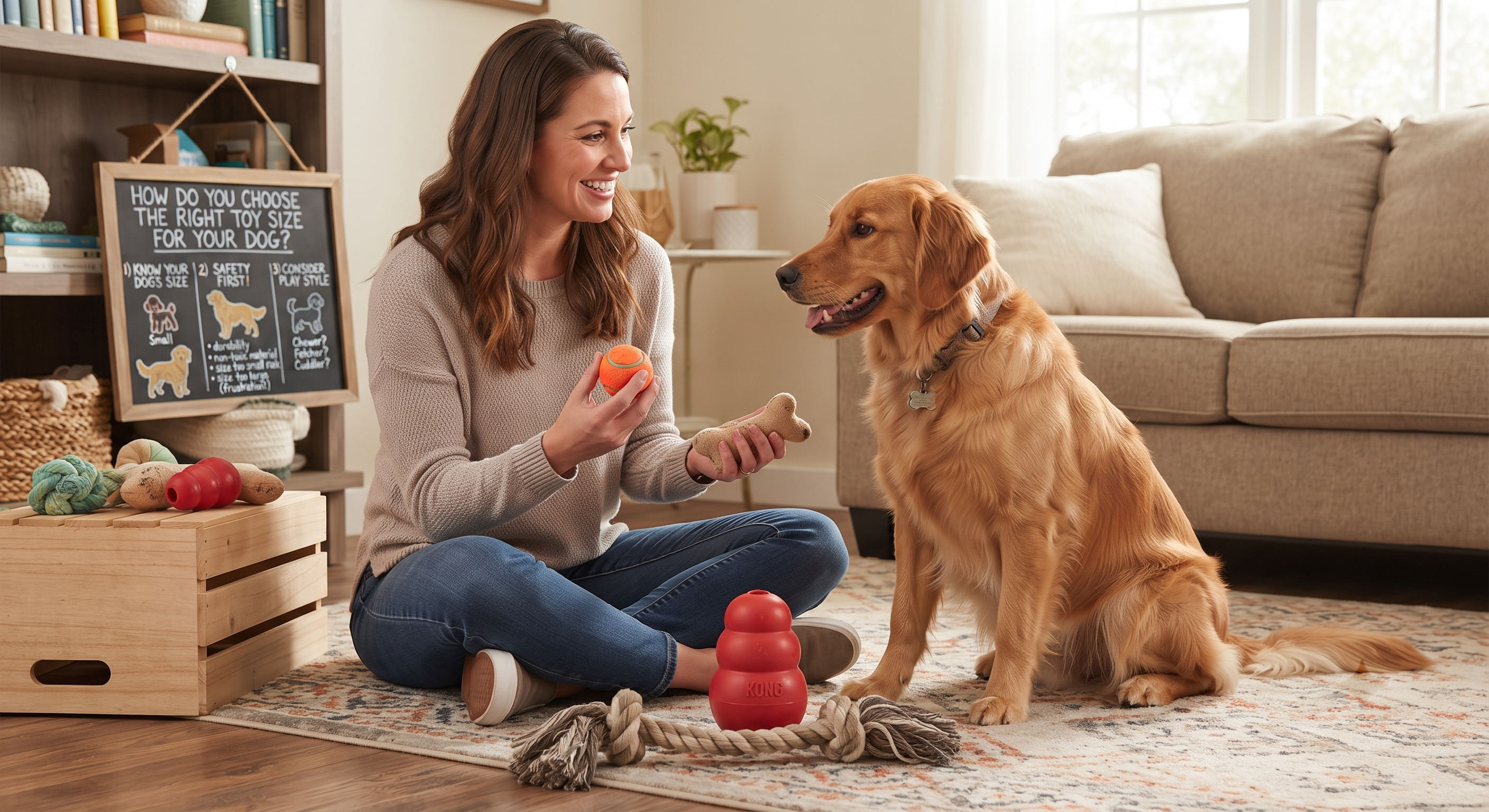
Choose a toy your dog can use comfortably without being able to swallow it. Check the product’s actual dimensions alongside its size label.
“Small,” “medium,” and “large” are useful shopping categories, but they are not precise measurements. A medium ball from one company may differ considerably from a medium ball from another. Online photographs also provide limited scale unless dimensions are included.
Before purchasing, check:
- The toy’s length, width, and diameter, where relevant.
- The manufacturer’s intended size or weight range.
- Whether the toy contains smaller detachable components.
- Whether your dog compresses or destroys similar toys.
- Whether another dog in your household could access it.
Consider Your Dog’s Mouth and Behavior
Body weight provides some context, but it should not be your only selection criterion. Think about how your dog grips, carries, and manipulates objects.
A dog that gently picks up a ball behaves differently from a dog that compresses it repeatedly or tries to push the entire object into its mouth. Your observations should influence which products you consider.
You do not need to deliberately test whether a toy fits entirely inside your dog’s mouth. Instead, compare measurements, follow the manufacturer’s guidance, and reject designs that appear too small for appropriate use.
Account for Other Dogs in the Household
A ball bought for a small dog may also be available to a larger dog during shared play. In that situation, separate play areas or separate toy access may be necessary.
Before adding a toy to a shared collection, consider every dog that might use it. A product suitable for one pet does not automatically suit the others.
Avoid Buying an Impractically Large Toy
Oversized toys can also be difficult to use. A toy that your dog cannot lift, carry, or manipulate may receive little attention.
The aim is a usable toy with an appropriate safety margin. Larger dimensions alone do not establish that a particular design is a good match.
Practical shopping tip: Keep a note of the dimensions of toys your dog already handles well. Use those measurements as a reference when comparing new products, while still checking each toy’s construction and intended use.
Which Dog Toys Match Different Play Styles?
Start with the activity your dog actually enjoys. Use the following categories as a shopping framework rather than assuming every dog needs every type.
For Dogs That Love to Retrieve
Consider a dog-specific ball or fetch toy with a shape and weight that suit your play space.
For indoor use, ask whether the toy will roll under furniture or bounce against fragile objects. For outdoor use, consider visibility, ease of cleaning, and how easily you can retrieve it yourself.
Useful questions include:
- Can I see the toy clearly on grass or other surfaces?
- Does its weight suit the way I intend to throw it?
- Can I clean it easily after outdoor play?
- Is the surface appropriate for the intended activity?
- Does my dog retrieve it or immediately begin dismantling it?
A fetch toy should also be assessed separately for chewing. A product may work well when thrown and retrieved but become unsuitable when a dog settles down to pull it apart.
For Dogs That Enjoy Chewing
Look at both material flexibility and your dog’s destruction habits. A chew toy should not be selected solely because it feels extremely hard.
Cornell veterinarian Brian Collins advises avoiding bones, antlers, hooves, and other very hard or abrasive chewing objects. He suggests looking for chewing items that bend and can be indented with a fingernail. This is a useful screening guideline, not proof that a particular toy cannot break or be swallowed. vet.cornell.edu
For a dog that quickly removes chunks from softer toys, ask your veterinarian about suitable alternatives. Buying an increasingly rigid object can introduce a different risk instead of resolving the original problem.
The useful question is whether your dog can interact with the toy appropriately—not simply how long the material survives.
For Dogs That Like Carrying Soft Toys
A plush toy may appeal to a dog that carries objects gently or settles beside them. Look for straightforward construction, inspectable seams, and clear washing instructions.
Observe whether your dog carries the toy or begins opening seams and extracting its contents. Those are different behaviors and should influence what you purchase next.
A simple design can make inspection easier. Before each session, check the areas your dog tends to grip, including corners, seams, and protruding fabric sections.
For Dogs That Enjoy Interactive Tug
Choose a tug toy that gives both you and your dog a comfortable grip. Consider whether its length allows you to hold it without placing your hand close to the part your dog grips.
Use the toy for shared play, then inspect and store it. The American Kennel Club recommends using rope and braided fleece tug toys interactively and putting them away afterward to reduce opportunities for shredding and eating the material. American Kennel Club
A tug toy’s suitability during a game does not establish its suitability as a freely available chew toy.
For Dogs That Enjoy Searching for Food
Consider a food-dispensing toy or an introductory puzzle. Before buying, ask how food enters the toy, how it comes out, and how thoroughly you can clean the compartments.
Start with an easy setup. The first goal is to help your dog understand the activity, rather than immediately presenting the hardest version.
For example, you might begin with accessible food compartments before using the product’s more challenging settings, where its instructions allow this.
If your dog tries to destroy the puzzle instead of interacting with its intended features, stop and reassess its suitability. Difficulty should be adjustable to your dog’s response.
What Should You Check Before Buying a Dog Toy?
Check the details that affect daily use, including construction, cleaning, and replacement cost.
A toy’s appearance may attract your attention, but practical information helps you decide whether it belongs in your home.
Read Beyond the Product Name
Descriptions such as “tough,” “premium,” or “heavy duty” are not enough to assess suitability. Look for:
- Actual dimensions.
- Identified materials.
- Intended activities.
- Size recommendations.
- Cleaning instructions.
- Warnings and limitations.
- Information about removable components.
If a listing does not provide basic information, you have less evidence on which to base a purchase. A detailed product description is more useful than an enthusiastic slogan.
Treat claims such as “indestructible” cautiously. Continue inspecting the product and observing your dog regardless of the wording used to market it.
Inspect the Construction
Look closely at seams, protruding decorations, glued sections, attachments, and removable pieces. Consider which part your dog is most likely to target.
For instance, a dog that repeatedly attacks fabric ears may find a simpler shape more suitable than a toy with many protruding parts. This is an observation-based buying decision, not a universal rule about plush toys.
Online, look for photographs from several angles. In a store, examine the entire product rather than only its front-facing design.
Consider Cleaning Before You Buy
A toy that holds food should also be practical to clean. Check whether it opens, whether brushes can reach its internal surfaces, and whether the manufacturer permits dishwasher cleaning.
For fabric toys, check washing and drying instructions. Avoid assuming that every plush toy can go into a washing machine or that every rubber toy can withstand high heat.
Ask yourself whether the care routine fits your schedule. An elaborate food puzzle may be appealing, but a simpler design could be a better purchase if it is easier for you to maintain properly.
Assess Value Through Suitable Use
Compare purchase price with how well the toy fits your routine. An expensive toy provides limited value if your dog ignores it, you cannot clean it properly, or it proves unsuitable during the first supervised session.
Begin with a small selection. Once you learn which designs your dog uses appropriately, you can make more informed repeat purchases.
Consider keeping a brief record of purchases: product dimensions, intended activity, your dog’s response, and why you eventually replaced it. This helps you identify useful patterns.
Quick Comparison
This table is a starting point for comparison. Suitability still depends on the individual product and dog.
Toy TypeMain ActivityFeatures to CompareMain LimitationFlexible rubber chew toy | Chewing | Size, flexibility, shape, ease of inspection | Some dogs remove chunks
Dog-specific fetch ball | Chasing and retrieving | Diameter, weight, visibility, bounce | Fetch suitability does not establish chew suitability
Plush toy | Gentle carrying and soft play | Seams, attachments, filling, washability | Dogs may expose stuffing or squeakers
Rope or fabric tug toy | Shared tug games | Grip, length, construction, fraying | Requires inspection and controlled access
Food-dispensing toy | Food-based activity | Openings, food compatibility, cleaning access | Food residue and unsuitable chewing behavior
Puzzle toy | Guided problem solving | Difficulty, stability, moving parts, cleaning | May frustrate a beginner or attract destructive chewing
How to Choose
Use this checklist to narrow your options:
- Identify one purpose: Decide whether you want a toy for fetch, chewing, tug, gentle carrying, or food-based activity.
- Check measurements: Compare actual dimensions with toys your dog already handles comfortably.
- Study your dog’s behavior: Notice whether your dog carries, compresses, shreds, or swallows pieces.
- Inspect likely weak points: Look for exposed attachments, seams, or components your dog may remove.
- Check care instructions: Choose a toy you can clean according to the manufacturer’s directions.
- Start with one product: Observe its suitability before buying several similar toys.
- Plan supervision: Introduce it when you can watch and intervene.
- Reassess over time: Your dog’s behavior and the toy’s condition may change.
For a first purchase, keep the decision simple. Choose a toy for one activity you already know your dog enjoys, rather than a product that promises to meet every need.
After the first few sessions, ask whether your dog used it as intended, whether damage appeared, and whether maintaining it was manageable. Those observations are more helpful than the number of features printed on the packaging.
Important Safety Considerations
Remove Damaged Toys
Stop using a toy when damage exposes internal components or produces loose pieces. Pay particular attention to torn fabric, accessible squeakers, separating seams, and detached sections.
The American Kennel Club warns that swallowed squeakers can cause choking or intestinal blockage and advises discarding plush toys when they tear open and release stuffing. American Kennel Club
Do not continue using a damaged toy simply because your dog is attached to it. Cleaning cannot restore failed seams or replace missing material.
Do Not Treat Supervision as a Guarantee
Watching your dog helps you notice unsuitable behavior and intervene, but it does not make every object appropriate. Replace a poor match instead of repeatedly allowing your dog to damage it.
Cornell’s chewing guidance also recommends supervision because individual dogs can handle the same object differently. vet.cornell.edu
Contact a Veterinarian After Suspected Ingestion
If you believe your dog swallowed a toy or part of one, contact a veterinarian promptly for advice. Explain what is missing, when the incident may have occurred, and whether your dog has symptoms.
Cornell lists vomiting, appetite loss, abdominal pain, diarrhea, dehydration, and lethargy among signs of gastrointestinal foreign body obstruction. An obstruction is an emergency requiring prompt veterinary assessment. These symptoms can have other causes, so a veterinarian must assess the situation. vet.cornell.edu
Choose Food Fillings Carefully
If you fill a toy with food, use ingredients suitable for your dog’s diet. Humane World for Animals specifically warns against peanut butter containing xylitol, which is toxic to dogs. Check the ingredient label rather than relying on the product name. humaneworld.org
For dogs on a prescribed diet, ask the treating veterinarian what fillings are appropriate.
Account for Individual Health Needs
If your dog has dental disease, previous foreign body ingestion, or a medical condition affecting play, ask your veterinarian for individual guidance.
A general shopping checklist cannot account for every health limitation. The appropriate choice may depend on your dog’s examination findings and medical history.
Frequently Asked Questions
Are Expensive Dog Toys Always Better?
No. Price alone does not establish suitability, safety, or how much your dog will enjoy a toy.
Compare construction, dimensions, intended activity, cleaning instructions, and your dog’s observed response. A less expensive toy that suits your dog and is straightforward to maintain may offer better value than a costly design that does not fit your routine.
Can a Strong Chewer Use Plush Toys?
It depends on how the dog interacts with them. A dog that rapidly tears fabric and extracts the contents is a poor candidate for ordinary plush toys. A dog that carries them gently may behave differently.
Make the decision from supervised observation, and remove the toy if your dog begins dismantling it.
How Often Should I Replace Dog Toys?
Replace them according to condition rather than a fixed calendar. Inspect toys before play and after sessions that could cause damage.
Keep cleaning and replacement separate: washing a toy does not repair torn seams, missing pieces, or structural damage.
Should I Buy Toys Based on My Dog’s Breed?
Breed may provide context, but it should not replace observing the individual dog. Two dogs of the same breed can differ in mouth size, play preferences, and destruction habits.
Use your dog’s actual behavior and the product’s specifications to guide the purchase.
What If My Dog Ignores a New Toy?
Try introducing it in a way that matches its intended purpose, such as a short shared game with a fetch or tug toy. Give your dog space to investigate without forcing interaction.
If interest remains low, reconsider the activity, texture, size, or difficulty. Buying more copies of the same design is unlikely to clarify what your dog prefers.
How Many Toys Should I Buy Initially?
Start with a small selection covering a few activities your dog enjoys. For example, you might choose one toy for shared play and another for a different suitable activity.
There is no need to buy every category at once. Learn from your dog’s response before expanding the collection.
Can Toys Replace Walks and Time Together?
Build toy play into a broader daily routine that also includes appropriate exercise, rest, training, and interaction.
A puzzle provides a different experience from a shared game or a walk. Choose toys to complement your routine rather than expecting one product to address every need.
The Bottom Line
Start with your dog’s preferred activity, check the toy’s dimensions and construction, and introduce it under supervision. Keep buying decisions grounded in what you observe: appropriate use, manageable cleaning, and acceptable wear.
For your next purchase, choose one toy with a clear purpose. Watch how your dog uses it, inspect it afterward, and use that experience to guide the next choice.