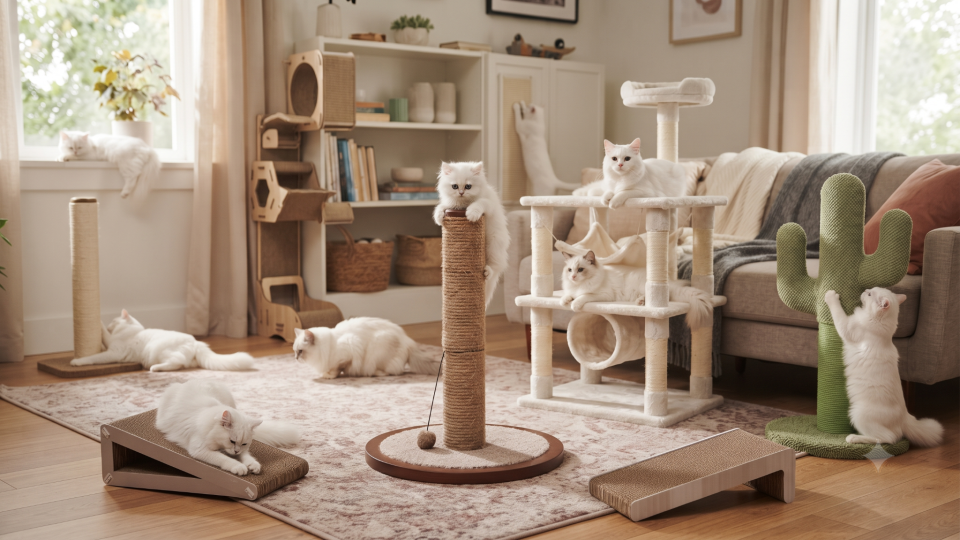
A cat scratching post can look perfect in your living room and still be completely ignored by your cat. Meanwhile, the sofa arm, hallway rug, or dining chair becomes the preferred scratching spot. Before buying another product, it helps to examine what those household surfaces offer: their position, texture, shape, and resistance when your cat pulls against them.
Choosing a suitable scratcher starts with observing your cat and comparing those observations with the product’s actual dimensions and construction. This guide explains how to assess scratching posts, floor scratchers, and wall panels, where to position them, and how to introduce a new scratching surface without forcing your cat to use it.
The Short Answer
Choose a cat scratching post that matches your cat’s preferred scratching direction and texture, stays stable during use, and provides enough usable surface for a comfortable stretch. Position it where scratching already happens, then encourage voluntary use with rewards. A simple scratcher that fits your cat’s habits can be a better purchase than a large, elaborate model with an unsuitable scratching area.
Why Do Cats Need a Scratching Post?
Scratching is a normal feline behavior that supports claw maintenance and communication. Cats leave both visible marks and scent on scratched surfaces; providing an appropriate outlet allows them to perform this behavior in your home. Cats Protection explains these functions in its guide to scratching. Cats Protection
A useful shopping question is: “What would make this product a good alternative to the surface my cat already chooses?”
If your cat uses a vertical chair leg, a small floor pad may offer a different experience. If your cat scratches a hallway rug, an upright post alone may miss the preferred orientation.
Observe several scratching sessions before choosing. Note the surface, direction, location, and whether the cat reaches upward or remains close to the floor. These observations give you a practical buying brief.
What Makes a Good Cat Scratching Post?
A good scratching post combines appropriate dimensions, stable construction, accessible placement, and a surface your cat wants to use. Cornell’s Feline Health Center recommends matching the cat’s material and orientation preferences and choosing a sturdy post tall enough for an extended standing stretch. vet.cornell.edu
Usable Scratching Height
Check the height of the scratching section, not just the total product height. A tall model might include a decorative top, a perch, or several short sections separated by platforms. Those features do not necessarily provide a continuous surface for scratching.
Look at the dimension drawing and photographs together. Can your cat reach upward while keeping its hind paws on the floor? Is there clear space in front of the post? Would a low platform interrupt the position your cat usually adopts?
For a kitten, consider whether the product will remain useful as the cat grows. Buying a compact kitten model may be reasonable for a temporary setup, but include the likely replacement in your budget.
Base and Connections
Examine the base dimensions, assembly method, and connection between the post and base. A broad-looking base in a photograph may be smaller than expected, especially when the image lacks scale.
After assembly, follow the manufacturer’s stability checks and inspect the joints. If the post moves at its connection, determine whether a fastener needs tightening or a component is defective before offering it to your cat.
Product reviews are particularly useful when they describe a problem precisely. “Moves across tile when scratched” tells you more than “poor quality.” Look for accounts from owners with cats of a similar size and a similar floor surface.
Accessible Surface Area
For a horizontal scratcher, assess both length and width. A narrow decorative pad may provide less room than its overall footprint suggests. For a curved model, consider which sections your cat can comfortably reach.
A product designed for scratching and lounging needs to suit both uses separately. A broad resting area does not automatically mean there is enough accessible scratching surface.
Which Scratching Material Should You Choose?
There is no single material that every cat prefers. The ASPCA recommends offering different surfaces and orientations to identify individual preferences. ASPCA
From a purchasing perspective, the material also affects replacement options and the cleanup you will need to plan for.
Sisal Rope
Check how the rope is attached and whether the manufacturer supplies replacement sections. Ask whether repairs are supported rather than assuming any loose rope can be safely rewound.
Inspect product photographs for gaps in the wrapping. When evaluating the delivered item, check for exposed fasteners or sections that are already coming away.
Sisal Fabric
Woven sisal gives you a different construction to compare with rope. Look at how the fabric edges are secured and whether the panel can be replaced independently of the frame.
If two products use sisal, compare their design as well as the material name. A well-sized panel and a short wrapped pole offer very different usable surfaces.
Corrugated Cardboard
Cardboard scratchers can be useful for trying a new shape without buying a large piece of furniture. Compare the price of replacement inserts, whether the insert is reversible, and whether the holder is included.
Also consider where debris will fall. A scratcher beside a doorway may require a different cleanup routine from one on an easy-to-vacuum patch of floor. For a cat that chews or swallows pieces, discuss suitability with your veterinarian.
Carpet
Check the specific carpet construction rather than relying on a generic “carpet-covered” description. Inspect loose edges and any loops that could catch a claw.
If your cat already scratches carpet, that preference is relevant, but the product still needs to work in the chosen position and remain secure during use.
Where Should You Put a Cat Scratching Post?
Place the scratcher close to a location your cat already uses, with enough space to approach and scratch comfortably. Cats Protection also suggests placement near sleeping areas and separate scratching resources for cats sharing a home. Cats Protection
Use the room layout to identify a workable position. A post beside the sofa should not block the path into the room. A floor scratcher should not sit where a door swings over it. Leave access to the scratching face rather than wedging it behind furniture.
If you plan to move the scratcher later, begin with a position that makes it relevant to your cat. Once the cat uses it consistently, move it gradually rather than making an abrupt change to another room.
In a small apartment, measure the full footprint before ordering. Use paper or removable markers to outline the base on the floor. This makes it easier to judge whether you can live with the placement before assembling a bulky product.
How Can You Encourage Your Cat to Use a New Scratcher?
Give your cat opportunities to investigate voluntarily. VCA’s guidance on scratching behavior describes rewarding appropriate scratching and positioning suitable surfaces near existing scratching locations. VCA Animal Hospitals
When your cat uses the new scratcher, offer a small reward your cat enjoys. Keep the interaction calm. Avoid turning every approach into a handling session that interrupts exploration.
Catnip may help some cats investigate, but a lack of response does not tell you whether the scratcher is suitable. Evaluate the product’s position, texture, and shape before adding more attractants.
Do not hold your cat’s paws and drag them down the post. The ASPCA cautions that forced scratching can frighten a cat and lead to avoidance. ASPCA
For troubleshooting, keep a short observation log: where the cat scratched, which surface was used, and whether the new product shifted. Change one feature at a time so you can learn whether repositioning or a different orientation helped.
Quick Comparison
These are practical buying trade-offs, rather than a ranking of products or a guarantee of cat preference.
Scratcher typeWhat to assessPractical advantageMain trade-offFreestanding vertical post | Continuous scratching height, base, joints | Provides a dedicated upright surface | Requires floor space and careful stability checks
Horizontal cardboard scratcher | Pad dimensions, holder, refill availability | Easy way to try a floor-level format | Inserts need replacement and debris needs cleanup
Angled scratcher | Angle, access, frame security | Offers another scratching position | The slope may not match your cat’s preference
Wall-mounted panel | Mounting surface, hardware, installation height | Keeps the main scratching surface off the floor | Requires suitable installation and permission where applicable
Cat tree with scratching sections | Accessible post lengths, platform layout, anchoring | Combines scratching with other furniture functions | Overall height may hide short scratching sections
For an upright scratcher, give priority to the usable post rather than accessories. For a floor model, focus on pad dimensions and replacement costs. For a cat tree, decide whether the climbing and resting features justify the larger footprint independently of its scratching function.
How to Choose
- Observe current habits: Identify your cat’s preferred scratching direction, texture, and location.
- Measure carefully: Check the usable scratching surface and the space available at home.
- Assess construction: Examine base dimensions, joints, and any required mounting or anchoring.
- Compare maintenance costs: Check replacement parts and consumables before comparing appearance.
- Read relevant reviews: Focus on experiences involving similar cat sizes and flooring.
- Check return conditions: Confirm whether assembled or used products can be returned.
- Plan the placement: Choose a product you can position where your cat is likely to encounter it.
- Evaluate actual use: Adjust the setup based on what your cat does after introduction.
Budget for the Whole Product
A low purchase price is only one part of the decision. Compare the frame, replacement inserts, shipping, mounting hardware, and expected maintenance.
For example, a holder with available refills may be easier to keep in service than a model that requires replacing the whole unit. However, that advantage matters only if the refills remain available in your market.
Avoid treating price as evidence of suitability. An expensive design can still have the wrong orientation or insufficient usable height.
Check What You Can Verify Before Buying
A strong product listing should let you establish dimensions, materials, assembly requirements, and cleaning instructions. If a listing emphasizes lifestyle photographs but omits basic measurements, request those details before ordering.
Claims such as “perfect for all cats” provide little help. A better decision comes from matching specific product features to your observations.
Important Safety Considerations
Inspect the Delivered Product and Continue Checking It
Before use, examine the scratcher for exposed screws, staples, sharp edges, loose parts, and unstable connections. Assemble and anchor it according to the manufacturer’s instructions.
During cleaning, look for changes at the joints and scratching surface. Cosmetic wear alone does not mean a favorite scratcher must be discarded, but structural damage or accessible sharp components require repair or replacement.
Review Attached Toys Separately
A dangling toy is an accessory, not a reason to overlook the scratcher’s construction. Inspect cords, loops, and detachable pieces, and follow supervision instructions. Remove damaged accessories.
Account for Mobility and Comfort
A cat that has difficulty stretching upward may need a different arrangement. International Cat Care’s home modification guidance notes that a horizontal scratching surface can be useful when using a tall vertical post is painful. icatcare.org
Ask your veterinarian about a new change in movement, reluctance to stretch, or signs of discomfort rather than assuming the cat is simply rejecting a product.
Avoid Punishment and Seek Help When Needed
Cornell warns that punishment can make a cat fearful and does not reliably teach the desired alternative. Provide suitable surfaces and reward their use. vet.cornell.edu
If scratching increases alongside tension between cats or other signs of distress, the problem may require changes beyond buying a post. A veterinarian or qualified feline behavior professional can help assess the situation.
Declawing should not be used as a furniture-protection strategy. The ASPCA opposes its use as a behavioral remedy. ASPCA
Frequently Asked Questions
Is a Taller Scratching Post Always Better?
No. A vertical post needs sufficient usable height for your cat, but extra height does not compensate for a weak base, obstructed access, or the wrong orientation. Compare the continuous scratching section with your cat’s natural reach.
Should I Buy a Post or a Floor Scratcher First?
Start with the orientation your cat already uses. If you are uncertain, a small trial of different formats can inform the next purchase. Keep the trial products stable and appropriately sized.
Why Does My Cat Use the Sofa Even Though a Post Is Nearby?
“Nearby” may still mean the scratching face is difficult to reach or the post offers a different texture or orientation. Compare the two surfaces directly and inspect whether the post shifts. Adjust one feature before deciding the whole product has failed.
Can a Cat Tree Replace a Separate Scratching Post?
It can provide a suitable scratching outlet if its accessible scratching sections meet your cat’s needs. Check the actual post lengths and surrounding platforms. A tall tree with several short poles should be evaluated differently from a continuous upright post.
How Often Should I Replace a Scratcher?
Use condition and safety rather than a fixed calendar. Check whether the frame remains secure and the surface remains usable. For refill models, follow the replacement instructions. Keep familiar, safe surfaces available while introducing a replacement.
Is One Scratcher Enough for Multiple Cats?
One shared product may not provide convenient access for every cat. Consider individual preferences and distribute scratching resources rather than concentrating everything in one location.
What If My Cat Ignores Every Scratcher I Offer?
Review your observations, placement, and product dimensions before buying more. If avoidance is new or accompanied by discomfort or broader behavior changes, seek veterinary advice. Persistent difficulties may benefit from an individual behavior assessment.
The Bottom Line
Start with your cat’s existing scratching habits, then choose a product whose usable surface, construction, and position fit those habits. Spend on features you can verify, introduce the scratcher calmly, and let actual use guide adjustments. The most useful purchase is one your cat can comfortably use and you can safely maintain.