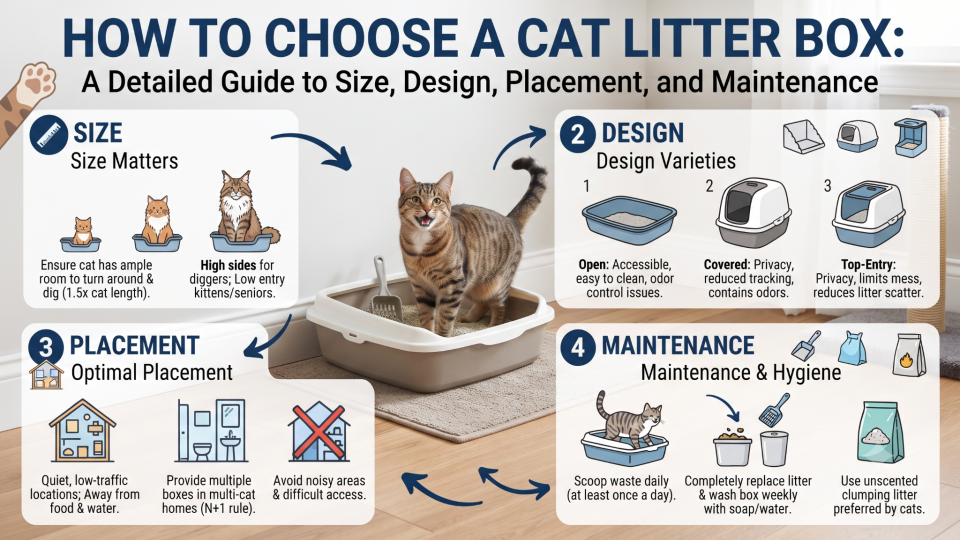
How to Choose a Cat Litter Box: A Detailed Guide to Size, Design, Placement, and Maintenance
Choosing a cat litter box can seem like a straightforward purchase until you begin comparing the options. Some trays have high walls and low entrances. Others have covers, elevated openings, decorative cabinets, or automatic cleaning systems. Product descriptions often emphasize convenience, appearance, and odor control, while the measurements that determine everyday usability receive less attention.
The most useful question is whether the complete setup will work for your cat and your household. Your cat needs comfortable access and adequate usable space. You need to inspect, clean, and maintain the arrangement consistently.
A box can fit into a room yet be inconvenient to remove for washing. A cover can look tidy while making inspection more difficult. An automatic system can offer useful features while introducing additional tasks, consumables, and operating requirements.
This guide explains how to compare those tradeoffs. It begins with the cat’s needs, then considers the location, maintenance routine, and optional features. The goal is to help you make a considered purchase and avoid paying for features that do not address your situation.
The Short Answer
Choose a litter box with enough usable room for your cat to enter, turn around, dig, and leave comfortably. A spacious open tray with an accessible entrance is a useful starting point when you do not yet know your cat’s preferences. Evaluate the number of trays, their locations, and your cleaning routine alongside the design.
What Should You Consider Before Comparing Litter Boxes?
Begin by identifying the problem you want the purchase to solve.
If this is your first cat, you are building an initial setup. If you already have a working arrangement, write down what needs improvement before browsing products.
Possible concerns include:
- The tray is difficult to clean.
- The usable interior seems cramped.
- The entrance is awkward.
- Litter frequently scatters beyond the tray.
- The box is difficult to inspect in its current location.
- Replacement parts or consumables are inconvenient to obtain.
- You need additional trays in other parts of the home.
This step keeps the buying decision specific. Without it, an attractive product may encourage you to replace an arrangement that works.
For example, if your main concern is cleaning access, look closely at removable components and reachable surfaces. If the main concern is space, compare internal dimensions before assessing colors, covers, or electronic features.
You can also create a simple purchase checklist:
Essential requirements: Features the setup must have.
Useful improvements: Features that would solve a documented inconvenience.
Optional preferences: Appearance or convenience features you would enjoy but do not need.
This makes it easier to compare products without allowing every advertised feature to become a requirement.
What Size Litter Box Does Your Cat Need?
Use your cat’s size and the box’s internal measurements as the basis for comparison.
The RSPCA recommends a large open tray at least one and a half times the cat’s length as a starting point. kb.rspca.org.au
Read product measurements carefully. The exterior length may include a broad rim, handles, a step, or an attached compartment. Those components increase the footprint without necessarily increasing usable floor space.
For a covered model, internal height also matters. A long base does not fully describe the experience if the hood slopes sharply or the entrance takes up part of the interior.
Check the following measurements:
- Internal base length.
- Internal base width.
- Entrance height.
- Internal headroom.
- Exterior footprint.
- Clearance needed to open or remove components.
If a listing provides only exterior dimensions, look for the manufacturer’s instructions or ask the seller for internal measurements.
You can test the proposed footprint at home with removable tape. Mark the area where the box would sit, then check nearby doors, cupboards, and walking routes.
Next, imagine the maintenance process. Can you lift the box out? Can you remove the cover? Will you need to tilt a tray containing litter to get it through a cabinet opening?
These checks help you assess the real installation rather than the isolated product.
Is an Open or Covered Litter Box Better?
Choose between them by considering your cat’s preferences, usable space, and cleaning access.
An open tray is simple to inspect. Waste is visible, and the design usually involves fewer components. This can make it easier to understand what needs cleaning.
A covered tray conceals the contents from view, but the cover should be assessed as part of the usable environment. Check how much room remains inside, how the entrance works, and how easily you can remove the hood.
Cats Protection explains that preferences vary. Some cats may appreciate a hooded tray, while an entrance flap can discourage use. www.cats.org.uk
When assessing a covered model, ask:
- Is the interior spacious enough?
- Is the doorway comfortably accessible?
- Can the flap be removed if necessary?
- Does the hood detach without difficulty?
- Are the corners and seams reachable?
- Will the design encourage you to inspect the tray regularly?
Consider your own routine honestly. If you are likely to forget to check a concealed tray, visibility may be a useful feature.
If you already have a successful arrangement, treat that experience as valuable evidence. You do not need to change the design solely because another option looks more advanced.
How Important Is Entrance Height?
Entrance height matters because it affects how the cat enters and leaves the box.
Cornell notes that kittens and elderly cats may need boxes with lower sides. www.vet.cornell.edu
Distinguish between the height of the walls and the height of the doorway. A tray can have tall walls with a lower entry cutout. That combination is different from a design requiring the cat to cross a high edge on every visit.
Product photographs may not show this clearly. Find an actual measurement rather than judging the entrance from the image.
Also assess the surface around the entrance. Check whether a mat, step, or cabinet opening introduces an additional obstacle.
Think about the full route:
- Where does your cat usually rest?
- How far away is the tray?
- Are there stairs?
- Does access depend on an open door?
- Can another animal occupy the approach?
The box’s entrance is one part of accessibility. Its location and surrounding arrangement complete the picture.
Are High-Sided Litter Boxes a Useful Choice?
High-sided trays can be worth considering when litter frequently goes over the edge, provided access remains comfortable.
Examine the entrance separately from the side walls. A lower doorway may provide easier access, but it may also be the place where litter escapes.
Look at the tray’s shape. A model may appear deep because of tall walls while offering a relatively small floor area. Compare the base measurements rather than assuming that height means overall spaciousness.
For cleaning, check whether the walls curve inward, whether the rim traps debris, and whether the tray is manageable to lift.
A high-sided design should solve a specific issue without creating a new one. If the existing tray works well apart from occasional scattered litter, consider the surrounding cleanup arrangement as well as the replacement box.
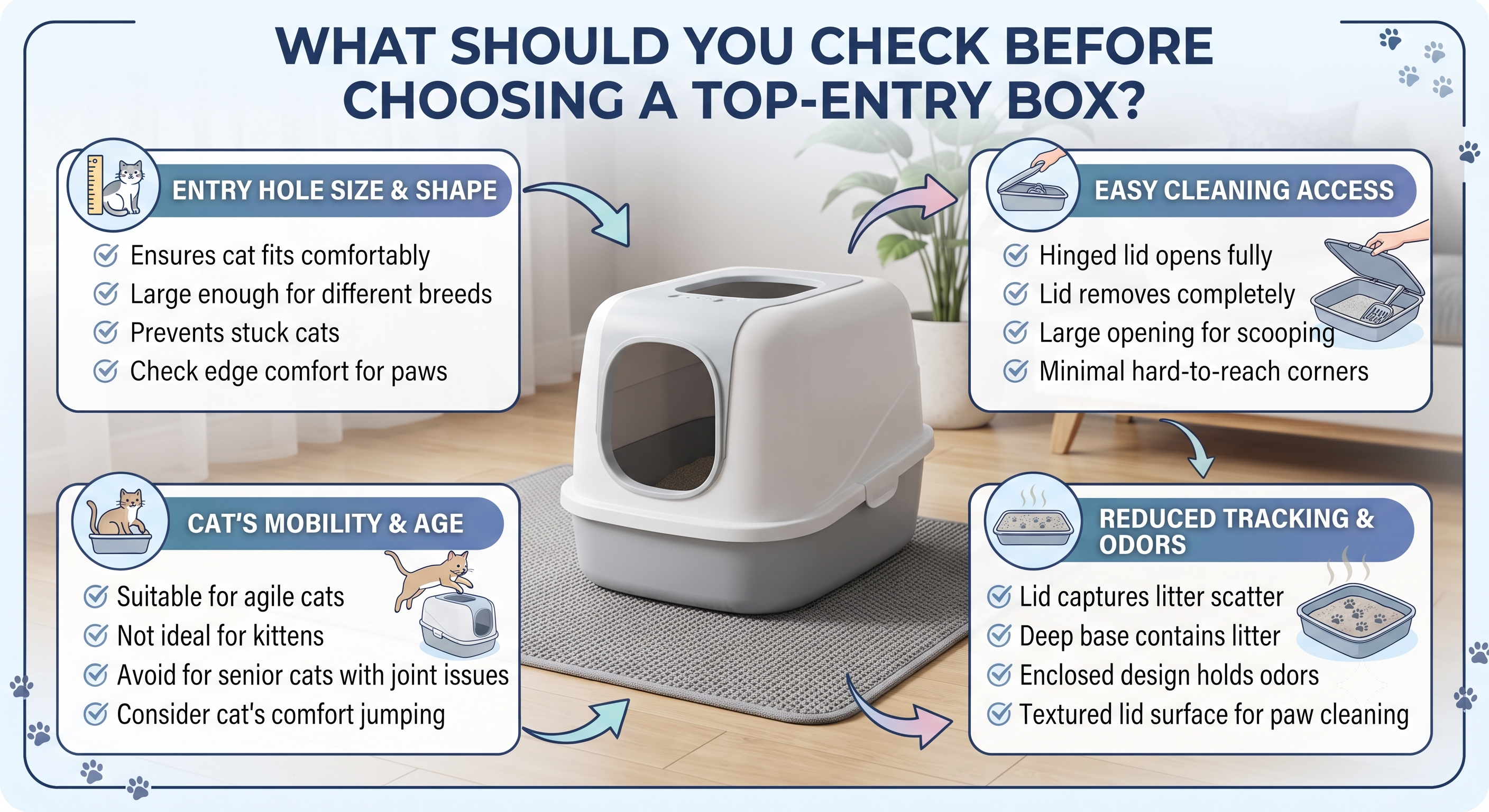
What Should You Check Before Choosing a Top-Entry Box?
Assess the movement required to use the opening and the space available inside.
Top-entry designs vary. Some have wide openings and removable lids; others have more limited access.
Check:
- The height of the upper opening.
- The opening’s dimensions.
- The stability of the lid.
- The surface around the opening.
- Internal space.
- The method for removing the lid.
- How the box will be cleaned.
Do not assume that acceptance of one enclosed box predicts acceptance of every other design. A side entrance and an elevated opening require different movements.
If you are evaluating a product for a blog review, document the opening and entry process with measurements and original photographs. These details are more useful than a general statement that the design is “comfortable.”
How Many Litter Boxes Should You Plan For?
Use one tray per cat plus one additional tray as a starting arrangement.
The RSPCA recommends two physically separated trays for one cat and the same cats-plus-one approach in multi-cat homes. kb.rspca.org.au
For budgeting purposes:
- One cat means planning for two trays.
- Two cats means planning for three.
- Three cats means planning for four.
Consider the complete arrangement before purchasing a premium model. The budget needs to cover the number of suitable trays, not only the most elaborate individual product.
Make a list of possible locations. Then assess each for access, cleaning, noise, and the space around the box.
This process may lead you to choose different designs for different locations. Matching appearances can be convenient, but each position still needs to work.
Where Should You Put the Litter Box?
Choose a quiet, accessible location away from food and water.
The RSPCA advises private but easily accessible areas and discourages frequent unnecessary moves. kb.rspca.org.au
Inspect a location during normal household activity. A utility room may seem peaceful when the appliances are off. A spare room may be inaccessible when guests close the door.
Evaluate the following:
Access:
Will the cat be able to reach the tray throughout the day?
Household activity:
Do people regularly pass close to the entrance?
Other pets:
Could another animal block the approach?
Maintenance:
Can you inspect and remove the tray easily?
Surrounding space:
Can the cat approach without squeezing between stored objects?
Long-term practicality:
Will the location remain usable when furniture or household routines change?
Avoid choosing a location solely because it hides the tray. A concealed arrangement still needs to provide reliable access and manageable cleaning.
Are Decorative Litter Box Cabinets Worth Considering?
They may suit your room, but assess the cabinet and tray as one system.
Start with the cabinet’s usable interior. A tray that fits inside may leave little room around its doorway. Shelves, partitions, or storage compartments can further reduce the available space.
Check whether:
- The tray fits without being forced into position.
- The cabinet entrance aligns sensibly with the tray entrance.
- You can open the cabinet fully.
- The tray can be removed without tilting.
- Interior surfaces are accessible.
- The construction materials have suitable cleaning instructions.
- You can inspect the contents conveniently.
Do not purchase the furniture first and assume any tray will work inside it. Select the tray according to your cat’s needs, then verify that the cabinet accommodates the complete arrangement.
For a review article, photograph the setup with the tray installed. An empty cabinet image does not show the usable space once equipment is inside.
What Should You Verify Before Buying an Automatic Litter Box?
Read the exact model’s instructions and compare its operating requirements with your household.
Automatic systems differ in construction, cleaning movement, sensing, and maintenance. Features described for one model should not be assumed to exist in another.
Verify:
- Minimum pet age and weight.
- Compatible litter.
- Usable interior dimensions.
- Entry height.
- Sensor operation.
- Cleaning-cycle instructions.
- Waste-container access.
- Power-failure behavior.
- Required inspection and cleaning.
- Replacement-part availability.
- Warranty and repair arrangements.
Consider the remaining manual work. Who will empty the waste container, clean internal surfaces, inspect components, and monitor normal use?
Calculate ongoing costs. Include required consumables and replacement components where applicable. Check whether supplies are readily available in your country.
Plan for interruptions. If the system requires repair, you need a practical alternative.
When writing a review, explain what you verified in documentation and what you observed directly. An untested feature should remain an advertised specification rather than a confirmed performance claim.
How Should You Evaluate Cleaning Requirements?
Imagine the entire cleaning process before buying.
Start with everyday inspection and waste removal. Then consider the less frequent tasks that require emptying, separating, washing, drying, and reassembling components.
Look for:
- Surfaces that are easy to reach.
- Covers that detach conveniently.
- Manageable component weight.
- Clear cleaning instructions.
- Simple reassembly.
- Replacement parts that can be obtained if needed.
Check where you will carry out the cleaning. A large tray may be comfortable in use but awkward to wash in a small household space.
If several people share care duties, choose an arrangement they can all maintain. Explain the routine clearly and keep relevant instructions accessible.
For hands-on content, describe specific maintenance tasks. “The lid takes several steps to remove” is more informative than “cleaning is inconvenient.” Likewise, photographs of seams and removable components help readers assess the design themselves.
How Can You Compare Value Without Focusing Only on Price?
Compare the cost of meeting your actual requirements.
A lower purchase price may be attractive, but verify that the dimensions and access are suitable. A higher price may bring useful convenience, but determine whether that convenience addresses a problem you have.
Include:
- The cost of all required trays.
- Accessories you genuinely need.
- Required consumables.
- Replacement components.
- Delivery costs.
- Maintenance time.
- Repair or replacement arrangements.
Avoid treating appearance, automation, or branding as evidence of suitability.
Before paying for an additional feature, complete this sentence:
“This feature is useful in my home because…”
If the explanation is unclear, the feature may be optional rather than essential.
Quick Comparison
Open Litter Trays
Open trays offer straightforward inspection and generally simple access to the interior.
They are worth considering when you want a uncomplicated setup with fewer components to maintain.
Main benefit: Visible contents and simple cleaning access.
Main limitation: Scattered litter remains visible around the tray.
Before choosing: Check internal dimensions, entrance height, stability, and placement.
Covered Litter Boxes
Covered boxes conceal the tray’s contents and introduce a hood and doorway to the arrangement.
Their suitability depends on the usable interior, your cat’s response, and maintenance access.
Main benefit: A concealed appearance.
Main limitation: Additional surfaces and components to inspect and clean.
Before choosing: Check headroom, doorway dimensions, removable parts, and internal access.
High-Sided Trays With a Lower Entrance
These combine taller walls with a defined entry point.
They may address some litter scattering while retaining a lower doorway, depending on the design.
Main benefit: Taller edges around much of the tray.
Main limitation: The entrance remains a lower section, and the base may still be small.
Before choosing: Verify the entry height and internal floor measurements.
Top-Entry Boxes
These use an elevated opening rather than a conventional side doorway.
Assess the required movement and the opening before selecting one.
Main benefit: A different containment arrangement that may suit some households.
Main limitation: Elevated access adds a physical requirement.
Before choosing: Check the opening, lid stability, entry height, and usable interior.
Low-Entry Trays
Low-entry trays prioritize access.
They are useful to evaluate when crossing a higher edge is a concern.
Main benefit: A lower threshold.
Main limitation: Lower sections may offer less containment.
Before choosing: Check dimensions, doorway shape, and the surrounding floor arrangement.
Automatic Systems
Automatic systems mechanize part of waste handling.
Evaluate them through exact model documentation and the work that remains manual.
Main benefit: Additional convenience when the system suits the household.
Main limitation: More operating requirements, components, and potential ongoing costs.
Before choosing: Verify restrictions, sensors, maintenance, consumables, and service support.
How to Choose
- Define the need. Write down the problem the purchase should solve.
- Assess your cat. Consider size, access, and existing preferences.
- Measure the interior. Use actual dimensions rather than product labels.
- Check the entrance. Confirm that access is practical.
- Plan enough locations. Budget for the full arrangement.
- Evaluate cleaning. Imagine removing, washing, and reassembling the product.
- Verify specifications. Use official model documentation where available.
- Calculate ongoing costs. Include necessary consumables and parts.
- Consider keeping the current box. A successful arrangement may only need a practical adjustment.
Important Safety Considerations
A litter box is part of the cat’s environment. It cannot establish why toileting behavior has changed.
Cornell explains that medical problems can lead to elimination outside the box, even when a cat does not otherwise appear ill. Contact your veterinarian if a previously reliable routine changes. www.vet.cornell.edu
Repeated attempts to urinate with little or no urine, straining, or increasing distress require immediate veterinary attention. Urinary obstruction is an emergency. Do not delay while trying a different tray or litter. www.vet.cornell.edu
Follow cleaning-product instructions and never mix cleaning chemicals. For powered equipment, follow the exact model’s assembly, placement, operating, and inspection requirements.
Cats Protection advises against punishing a cat for toileting outside the tray. Investigate the cause and seek appropriate help. www.cats.org.uk
Frequently Asked Questions
Should I Replace a Litter Box That Already Works Well?
You may not need to.
Assess its condition, usable space, access, and maintenance. Replacement makes sense when damage, changing needs, or a specific practical problem justifies it.
Is the Most Expensive Box Usually the Best Choice?
Price alone does not answer that question.
A useful purchase meets your requirements and fits the complete household arrangement. Evaluate optional features only after checking the essentials.
Should All My Litter Boxes Be Identical?
They do not have to be.
Matching designs can simplify maintenance, but each location needs an appropriate setup. Base the decision on dimensions, access, and actual use.
Is Unscented Litter a Reasonable Starting Point?
Yes. Unscented litter is included in the RSPCA’s suggested starting arrangement. Consider what your cat already uses successfully when deciding whether to make a change. kb.rspca.org.au
What If the Product Listing Does Not Show Internal Measurements?
Look for official documentation or ask the seller.
Do not assume that exterior measurements describe the usable space. If the essential dimensions remain unclear, compare an option with more complete information.
What Should I Do if My Cat Refuses a New Box?
Keep an accessible familiar option and review what changed.
Consider the entrance, location, cover, litter, and routine. Seek veterinary advice for sudden toileting changes rather than assuming the design is the only cause.
Are Automatic Systems Maintenance-Free?
Check the model’s instructions for the tasks that remain necessary.
When comparing systems, identify the required waste removal, cleaning, inspection, consumables, and replacement components. Include that work in your purchasing decision.
What Should a Trustworthy Review Include?
It should identify the exact product and explain the basis for its conclusions.
Useful details include measurements, documented testing conditions, original photographs, maintenance observations, and limitations. It should distinguish personal observations from advertised claims.
The Bottom Line
Choose the litter-box setup by starting with your cat’s access and usable space, then checking placement and maintenance.
Before shopping, measure the proposed locations and write down the essential requirements. Use that list to evaluate each design and decide whether additional features solve a practical problem.