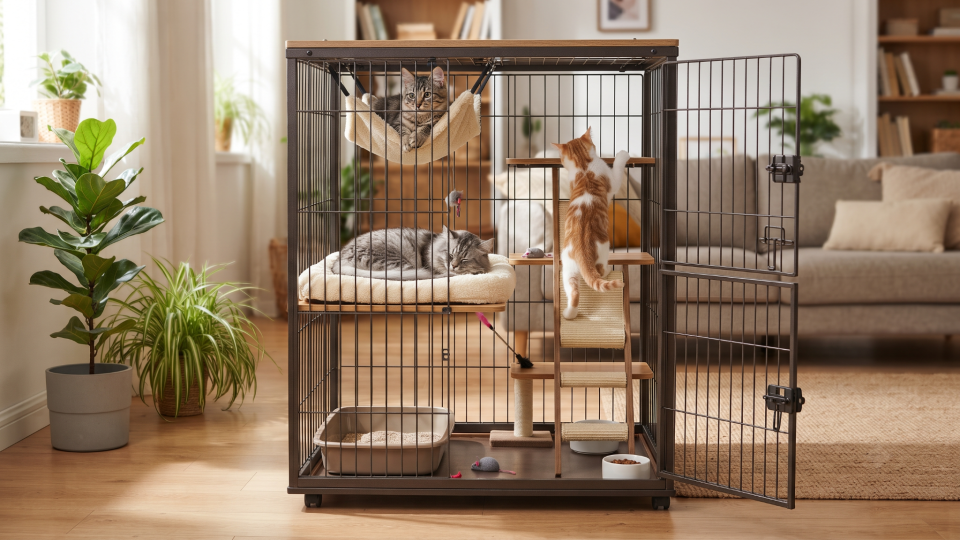
Choosing a cat cage can seem straightforward until you start comparing products. Some models are tall and narrow, others offer a wide floor area, and many advertise multiple shelves, hammocks, or removable trays. Product photographs often make every option look spacious and convenient.
The real question is how the enclosure will work once your cat’s belongings are inside. A litter box, bed, water bowl, and hiding place can occupy much more room than expected. Doors that look generous in a listing may be too small to remove a litter tray without tilting it.
Your reason for buying also matters. An enclosure for temporary household management serves a different purpose from a veterinarian-directed recovery space or an outdoor catio.
This guide explains how to assess cat cages and enclosures, compare common designs, plan the interior, and recognize when another arrangement would better meet your cat’s needs.
The Short Answer
Choose a cat cage according to its purpose, usable interior space, security, accessibility, and ease of cleaning. It should accommodate necessary resources while allowing comfortable movement and separation between resting, feeding, and toileting areas. A small cage should not serve as a healthy cat’s permanent living environment; medical confinement requires a setup and schedule approved by the treating veterinarian.
When Is a Cat Cage Useful?
A cat cage can be useful for specific, temporary situations when its design and use match the cat’s needs. Before buying, identify the problem you need to solve.
Temporary Household Management
You may need a secure area while workers enter and leave the home, during an emergency, or when a young kitten cannot safely explore unsupervised.
Sometimes a suitably prepared room provides a more practical solution. It can offer more movement, easier resource separation, and greater choice of resting places.
VCA describes confinement as a management tool and emphasizes that cats still need daily interaction and physical and mental activity. Extended confinement is not a substitute for an appropriate everyday environment. VCA Animal Hospitals
Veterinary-Directed Recovery
A veterinarian may prescribe restricted movement after an injury or procedure.
Ask for instructions before purchasing an enclosure:
- What movement must be restricted?
- Are shelves, ramps, or climbing surfaces permitted?
- What floor space and entrance height are appropriate?
- How should the litter tray be arranged?
- What activities are allowed?
- How long will the restriction last?
A tall enclosure with climbing platforms may be useful in one situation and unsuitable for a recovery plan that limits jumping.
Outdoor Access
An outdoor enclosure, often called a catio, provides a contained space outside the home.
This involves additional purchasing decisions, including weather protection, anchoring, secure connections to the house, and access for cleaning. An indoor cage should not be assumed suitable for outdoor use.
Transport
A household enclosure and a transport carrier have different functions.
Check the manufacturer’s intended use. A large cage with shelves and wheels should not be treated as a vehicle restraint simply because your cat fits inside it.
How Big Should a Cat Cage Be?
Assess the usable space after adding essential items, rather than relying on labels such as “large” or “deluxe.”
There is no single measurement that answers every situation. Your cat’s size, mobility, the enclosure’s purpose, and the planned duration of use all affect the decision.
Start With the Interior Layout
Measure the items you intend to use:
- Litter tray.
- Bed or resting mat.
- Food and water bowls.
- Hiding box.
- Any permitted accessories.
Then draw a simple plan using the enclosure’s internal dimensions.
Ask whether your cat can move between these items without stepping through bowls or squeezing around furniture. Check whether the bed remains usable when the litter tray is in place.
Shelter-housing guidance from the University of Wisconsin highlights how small cages can become inadequate once basic resources are added. Its institutional context differs from home use, but it illustrates why an empty-cage photograph can be misleading. sheltermedicine.wisc.edu
Evaluate Width and Depth Separately From Height
Height adds opportunities for elevated resting when appropriate, but it does not automatically provide a useful ground-level layout.
A tall enclosure may still leave insufficient room for a suitably sized litter tray and comfortable resting area.
Check:
- Internal width and depth.
- Space lost to supports and door frames.
- Clearance beneath shelves.
- Platform dimensions.
- Routes between levels.
Check the Door Opening
The door should accommodate both daily care and the items you need to remove.
Compare its opening with your litter tray’s dimensions. Consider how you would reach a bowl at the back, replace bedding, or access your cat without awkward handling.
A large enclosure with poorly positioned doors can be harder to maintain than a simpler design with generous access.
Which Features Matter Most When Comparing Cat Cages?
Prioritize secure construction, a practical floor, accessible doors, and components you can inspect and maintain.
Secure Panels and Closures
Review close-up photographs and assembly instructions before ordering.
Look for clear information about:
- How panels connect.
- How doors latch.
- Whether trays are secured.
- Whether removable sections can shift.
- Replacement clips and hardware.
- Recommended inspection or tightening.
Inspect the assembled enclosure for sharp edges, protruding wire, incomplete connections, and unexpected openings.
Appropriate Mesh or Bar Spacing
Check every opening in the assembled structure, including corners and the spaces around doors and trays.
Kittens and smaller cats may require different spacing from adult cats. Do not assume that a cage marketed for several species is suitable for your particular cat.
If a listing omits spacing measurements, request them before buying.
A Comfortable, Practical Floor
Examine the surface your cat will stand and rest on.
For everyday usability, look for a stable, continuous floor that accommodates bedding and can be cleaned easily. Avoid relying on a loose fabric cover to correct an unsuitable floor design.
Check whether the floor:
- Flexes under weight.
- Has accessible gaps.
- Becomes slippery when wet.
- Can be removed safely.
- Fits securely after cleaning.
Accessible Shelves
When shelves are appropriate, assess their dimensions and attachment points.
A platform should offer useful space rather than simply increase the advertised number of levels. Check how it is reached and whether its surface can be maintained.
For cats with mobility limitations or prescribed movement restrictions, ask your veterinarian which arrangement is appropriate.
Wheels and Stability
Wheels can help with cleaning, but they introduce another component to evaluate.
Check for brakes, manufacturer instructions, and whether the enclosure remains stable with accessories installed. Plan where it will stand so doors can open fully without blocking a walkway.
Replaceable Parts
Before purchasing, search for replacement trays, shelf attachments, fasteners, and bedding covers.
A replaceable component can make maintenance easier, but only if the correct part is actually available.
How Should You Set Up the Inside of a Cat Cage?
Plan distinct areas for rest, toileting, food, and water while preserving a clear route between them. The available space should determine how many accessories you add.
Provide a Comfortable Resting Area
Choose bedding that fits without bunching against the litter tray or blocking a door.
For practical maintenance, consider:
- Washable material.
- Clear care instructions.
- A spare cover or mat.
- A stable position on the floor or approved platform.
Avoid filling the enclosure with bulky cushions simply because they appear comfortable in product photographs.
Include a Hiding Place
A retreat can help a cat feel less exposed.
ASPCApro discusses research showing that hiding opportunities can reduce stress in shelter cats. Although a home enclosure presents a different setting, the findings support giving cats access to a retreat. ASPCApro
A hiding box should fit without obstructing essential resources. Position it so you can check on the cat without routinely dismantling the setup.
Allow Room for an Appropriate Litter Tray
Do not choose an impractically small tray merely to make the enclosure look spacious.
Ohio State University’s guidance for confined cats emphasizes suitable litter-box dimensions, familiar litter where possible, and frequent scooping. It also addresses the importance of bedding, hiding opportunities, and environmental comfort. indoorpet.osu.edu
Check that the tray can be entered comfortably and removed through the door.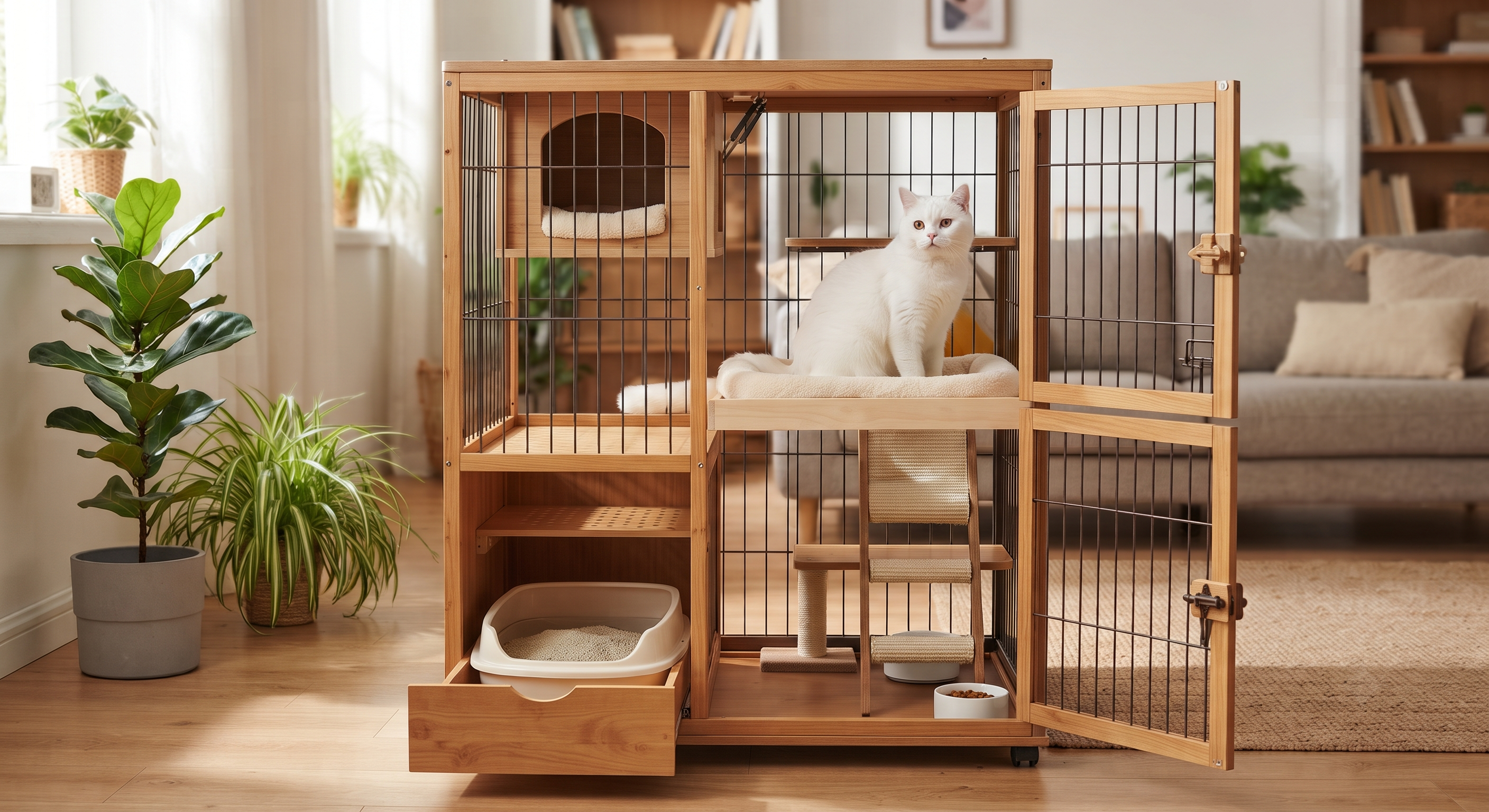
Separate Resources as Much as the Layout Allows
Keep the toileting area apart from food, water, and bedding.
International Cat Care’s pen-and-cage guidance emphasizes appropriate resources and thoughtful distribution. For shared housing, it also stresses compatibility between cats and sufficient resources to reduce competition. International Cat Care
If the enclosure cannot accommodate a workable arrangement, reconsider its size or the choice to use a cage.
Keep Accessories Purposeful
Every accessory should have a clear function.
Before adding an item, ask:
- Does it improve comfort or access?
- Is it appropriate for this cat?
- Does it leave enough movement space?
- Can I inspect and clean it?
- Is it compatible with any veterinary restrictions?
An uncluttered layout is easier to assess and maintain.
Where Should You Place a Cat Cage?
Choose a location that is comfortable, observable, and suitable for the intended use.
Walk through your daily routine before deciding where it will stand.
Check whether:
- Doors and windows can open safely.
- People can pass without striking the enclosure.
- Cleaning equipment can reach the surrounding floor.
- Other animals can approach or disturb the cat.
- The location becomes hot in direct sunlight.
- A person can sit nearby when needed.
Also check how the location changes throughout the day. A comfortable morning position may receive strong afternoon sun.
If you partially cover an enclosure to provide privacy, preserve ventilation and access for observation. A cover should not compensate for an unsuitable location.
Quick Comparison
Metal Wire Cat Cages
Metal wire models commonly offer visibility, airflow, and removable trays. Some also fold for storage.
Compare panel connections, latch design, coating condition, floor construction, and the availability of replacement hardware. Check whether the assembled unit can be cleaned without repeatedly removing large sections.
Multi-Level Cat Enclosures
These designs add platforms and vertical space.
Their value depends on usable shelf dimensions and accessible routes. A high level count does not tell you whether the ground floor accommodates essential resources or whether the layout suits your cat.
Soft-Sided Cat Playpens
Fabric-and-mesh playpens are often lightweight and compact when folded.
Assess zipper security, seams, floor construction, cleaning instructions, and the manufacturer’s supervision guidance. Their suitability depends on the individual cat and intended situation.
Outdoor Catios
Outdoor enclosures offer a different environment and require a more detailed installation plan.
Compare roofing, shade, anchoring, weather resistance, door access, and the security of any connection to the house. Confirm that all included materials are intended for outdoor exposure.
A Dedicated Cat Room
A prepared room may offer more flexibility for temporary household separation.
It still needs careful preparation: secure windows, inaccessible hazards, suitable resources, and arrangements for interaction. For medical recovery, confirm whether a room allows too much activity under the prescribed restrictions.
How to Choose
- Define the purpose first: Temporary management, recovery, outdoor access, and transport require different designs.
- Measure the usable interior: Account for the litter tray, bedding, bowls, and retreat.
- Check access: Make sure doors accommodate cleaning and safe handling.
- Inspect security details: Review spacing, latches, tray retention, and panel connections.
- Match the layout to mobility: Shelves and ramps must suit the individual cat.
- Read maintenance instructions: Consider drying time, removable parts, and replacement components.
- Plan the location: Check sunlight, ventilation, household traffic, and access.
- Evaluate the whole routine: Include care, observation, interaction, and time outside confinement where appropriate.
- Get recovery requirements in writing: Confirm the setup before using it for medical rest.
Important Safety Considerations
Avoid Using a Small Cage as Permanent Housing
A healthy cat needs opportunities to move, explore, scratch, interact, and make choices about their surroundings.
If you are considering routine all-day confinement because of damage, conflict, or supervision difficulties, discuss a broader environmental or behavior plan with a veterinarian.
Respond to Distress
Watch for persistent vocalization, frantic escape attempts, or inability to settle. VCA advises seeking veterinary guidance when a cat shows significant distress during confinement training. VCA Animal Hospitals
For medically required confinement, contact the treating clinic promptly about difficulties so the plan can be adjusted safely.
Reassess Shared Housing
Two cats that coexist in a house may not be comfortable sharing a confined space.
Consider whether each can reach resources and move away from the other. Separate arrangements may be necessary, particularly when health status or relationships are uncertain.
Inspect the Enclosure Regularly
Recheck fastenings after assembly, moving, and cleaning. Remove damaged accessories and follow the manufacturer’s repair guidance.
For outdoor structures, inspect connections and surfaces after severe weather as well as during routine maintenance.
Follow Veterinary Restrictions Precisely
Do not add exercise, climbing, or interactive activities to a recovery setup without checking that they fit the treatment plan.
The appropriate arrangement can change during recovery, so ask when reassessment is needed.
Frequently Asked Questions
Is a Cat Cage Necessary for Every Home?
No. Many households can meet their cat’s needs without a cage.
Buy one when there is a clear purpose and a suitable plan for using it. A prepared room may be more appropriate for some temporary management needs.
Can I Keep My Cat in a Cage While I Am at Work?
Routine confinement for an entire workday should prompt a review of the cat’s environment and care arrangements.
Consider a prepared room, household changes, or professional behavior advice. Medical confinement is a separate situation that should follow veterinary instructions.
Can a Dog Crate Be Used for a Cat?
Possibly, but the species label does not establish suitability.
Check interior space, openings, doors, flooring, latches, and the intended use. For recovery, ask your veterinarian to assess the proposed arrangement.
Is a Taller Cage Always Better?
No. Height can add useful space, but it cannot replace an adequate floor layout.
It may also be unsuitable when jumping or climbing must be restricted.
Should I Put a Litter Box Inside?
If the cat will need to toilet during confinement, the setup must provide suitable access.
Plan for the tray from the beginning rather than trying to fit it into leftover space.
How Do I Introduce a New Cage?
For nonurgent use, begin with voluntary exploration in a secure room and build familiarity gradually.
Observe your cat’s response and seek help if confinement causes distress. If medical rest is urgent, ask the veterinary team how to manage the transition.
How Often Should I Clean It?
Remove waste and spills promptly, inspect bedding daily, and clean components as needed using suitable products and manufacturer instructions.
Medical or infection-control situations may require a different cleaning plan from your veterinarian.
What Matters Most When Buying on a Budget?
Prioritize usable space, secure construction, practical access, and maintainable surfaces.
Decorative finishes and extra platforms have less value if the basic layout does not work.
The Bottom Line
Choose a cat cage around a specific purpose and a realistic interior layout. Check how it works with the litter tray, bed, bowls, and retreat in place, then assess access, security, and maintenance.
For veterinary recovery, confirm the design with the treating clinic. For everyday household management, consider whether a prepared room would offer a better arrangement.
Editorial Sources
- International Cat Care: Pen and Cage Setup
- VCA Animal Hospitals: Crate Training and Confinement for Kittens and Cats
- The Ohio State University: Environmental Enrichment for Confined Cats
- ASPCApro: Hiding Places Mean Happier Cats
- University of Wisconsin: Feline Housing Considerations