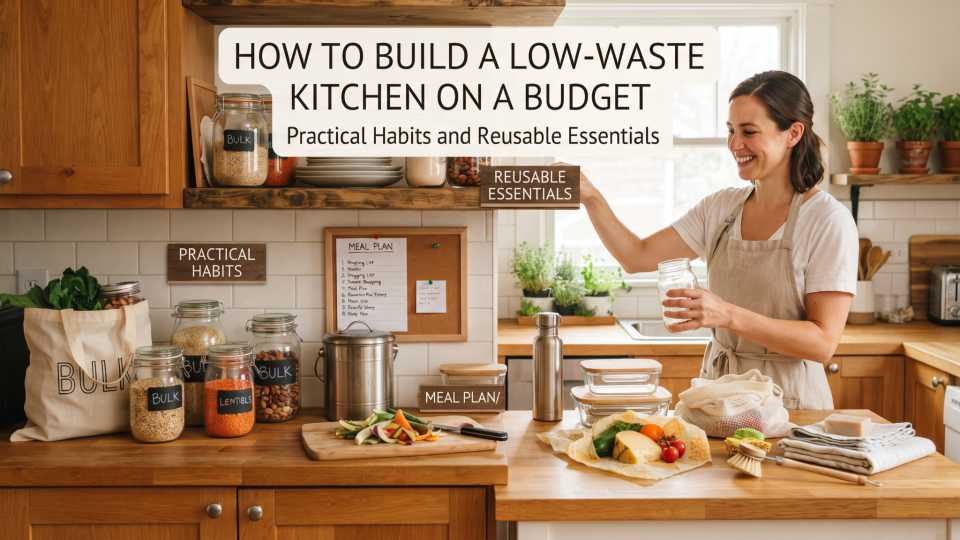
A low-waste kitchen does not require matching glass jars, expensive storage systems, or a complete collection of products marketed as sustainable. It starts with understanding what you throw away, why it happens, and which small changes would make your everyday routine work better.
Perhaps vegetables disappear behind other food in the refrigerator. Maybe you regularly buy ingredients you already own. You might use disposable bags because your reusable containers are difficult to find, or reach for paper towels because there is nowhere convenient to keep cleaning cloths.
These problems are often easier to solve through organization and habits than through shopping.
The most useful approach is to work with your existing kitchen, address one recurring source of waste at a time, and purchase products only when they solve a specific problem. This guide explains how to do that without creating unnecessary expense or an overwhelming list of household rules.
The Short Answer
To build a low-waste kitchen on a budget, start by tracking discarded food and disposable items, then improve shopping, storage, and reuse habits using what you already own. Add reusable products gradually when they address a frequent need and fit your cleaning routine. Prioritize changes you can maintain consistently rather than replacing everything at once.
What Should You Change First in a Low-Waste Kitchen?
Start with the waste that appears most often in your household.
A kitchen that throws away uneaten meals needs a different solution from one that uses large numbers of disposable drink cups. Likewise, a household that already reuses containers may benefit more from better shopping habits than from additional storage products.
Conduct a simple seven-day waste audit
For one week, record what you discard. You do not need to handle rubbish or sort through a full bin; write down items as you throw them away.
Useful categories include:
- Uneaten leftovers.
- Spoiled produce.
- Bread or other food that was not used.
- Disposable food-storage bags.
- Paper towels and napkins.
- Takeaway containers.
- Packaging from frequently purchased products.
For each item, add a short explanation.
Examples:
- “Bought more salad than we needed.”
- “Forgot the leftovers.”
- “Could not find a container with a matching lid.”
- “Used paper towels because the cloths were still wet.”
- “Ordered takeaway after an unexpected late finish at work.”
The explanation matters because it points toward a solution.
EPA resources support tracking wasted food and packaging to identify prevention opportunities. A small household log can turn a vague goal into a manageable action plan. US EPA
Choose one recurring problem
After a week, select the issue that seems easiest to improve.
If forgotten leftovers are common, create a visible storage area. If disposable bags are the main problem, organize existing containers. If fresh ingredients spoil regularly, adjust purchase quantities.
Avoid changing every routine simultaneously. One successful habit gives you a practical foundation for the next.
How Can You Reduce Food Waste Without Buying New Products?
Make food easier to see, plan purchases around what you already have, and give leftovers a clear purpose.
The EPA’s household food-waste guidance recommends practical measures involving planning, storage, and preparation. These provide a useful starting point before investing in specialized kitchen equipment. US EPA
Check your kitchen before shopping
Before writing a shopping list, look through the refrigerator, freezer, and cupboards.
Identify:
- Ingredients that need using soon.
- Open packages.
- Frozen meals or portions.
- Foods you tend to buy repeatedly.
- Ingredients left from a previous recipe.
Then plan a few meals around those items.
For example, if you already have rice, frozen vegetables, and eggs, you may only need one or two additional ingredients to complete several meals. A shopping list based on existing food is often more useful than a list built entirely around new recipes.
Plan for your actual week
An ambitious meal plan can create waste when it assumes you will cook every evening.
Before shopping, consider your schedule:
- How many meals will you realistically prepare?
- Are there evenings when you will arrive home late?
- Will you eat away from home?
- Can one meal provide a suitable portion for the following day?
- Would a simple freezer meal help on a busy evening?
Leave some flexibility. Purchasing ingredients for seven elaborate dinners may be unnecessary if your household typically cooks four.
Create an “eat first” area
Choose a visible refrigerator location for food that should be used soon. An existing tray or clearly designated shelf is enough.
Use it for appropriately stored leftovers and ingredients that fit the refrigerator’s safe storage arrangement. Keep raw foods separated as required.
The purpose is visibility: food should not disappear behind larger containers.
Pair the area with a short note, such as:
- Cooked rice: use for tomorrow’s lunch.
- Open tomato sauce: use in the next meal.
- Remaining vegetables: include in Thursday’s dinner.
Do not move food into this area as a substitute for checking whether it is still safe.
Give leftovers a destination
When putting food away, decide what it will become.
“Lunch tomorrow” is a clearer plan than “save for later.”
Depending on the food, your plan might be:
- Eat it at the next meal.
- Incorporate it into a planned dish.
- Freeze a suitable portion.
- Share it with another household member who will use it.
The more specific the plan, the less likely the container is to remain untouched.
Which Reusable Kitchen Products Are Worth Considering?
Consider products that replace a disposable item you use frequently and are easy enough to maintain.
You do not need all the products below. Treat them as options for solving particular problems.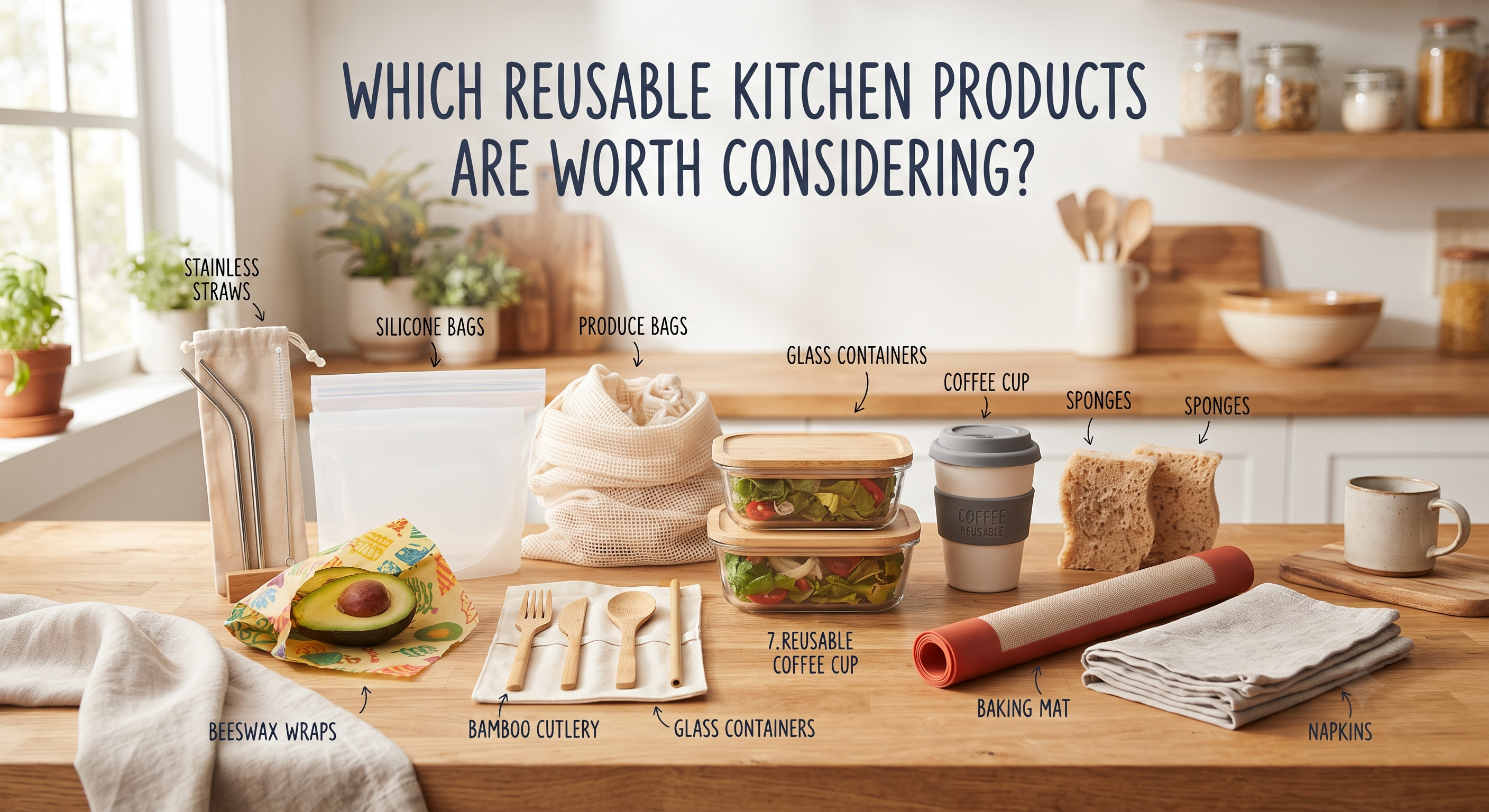
Reusable food containers
Containers are useful when you regularly store leftovers, prepare lunches, or transport food.
Before purchasing, organize the ones you already own:
- Match containers with lids.
- Remove unsuitable or damaged items according to their condition and instructions.
- Keep frequently used sizes accessible.
- Store rarely used pieces separately.
If you still need additional containers, select sizes that suit your usual portions. A large matching set may be less useful than two containers you use every week.
Check product-specific instructions for freezing, heating, washing, and food contact.
Washable cleaning cloths
Washable cloths can be convenient for routine wiping when you have a clear system for keeping them clean.
The practical challenge is the routine:
- Where are clean cloths stored?
- Where do used cloths go?
- How are they washed?
- Can they dry properly?
- How will you distinguish cloths used for different tasks?
Begin with a small number and observe whether the system works. Buying a large collection before establishing a washing routine can create clutter.
Reserve appropriate cleaning methods for situations involving raw-food contamination or other hygiene concerns.
Reusable shopping bags
A reusable shopping bag is useful only when it accompanies you.
Place bags where your shopping trips begin: near your keys, inside your everyday bag, or in another convenient location.
Before buying more, gather the bags you already own. You may discover that availability is not the issue; remembering them is.
The EPA recommends bringing reusable bags and considering products with less packaging as practical ways to reduce plastic waste. US EPA
A refillable bottle or reusable cup
These products may suit people who regularly purchase drinks while travelling or working.
Look for practical features:
- Comfortable size and weight.
- An opening you can clean thoroughly.
- A lid suitable for your intended use.
- Clear instructions for hot or cold drinks.
- Replacement components, where relevant.
Avoid buying several versions before you know which one fits your routine.
Reusable covers and storage bags
These may help when you frequently use disposable wrapping or bags.
First, check whether your existing containers or suitable lids already solve the problem. If you need a new product, consider how easily it can be cleaned and dried, whether it fits your food-storage habits, and how you will organize it.
A product that is inconvenient to maintain may remain unused even if its intended purpose is sensible.
How Can You Organize a Kitchen to Make Reuse Easier?
Place reusable items where you need them and make the next action obvious.
A kitchen can contain plenty of reusable products while still encouraging disposable habits. If containers are buried, lids are missing, and cloths are inconveniently stored, the fastest option often wins.
Put containers near the food-preparation area
Store frequently used containers within easy reach of where you portion or put away food.
Keep lids in a predictable place. If finding the correct lid takes several minutes, the system needs simplifying.
Create a drying space
Reusable products need somewhere to dry after washing.
Use an existing rack or another suitable arrangement. Avoid purchasing specialist organizers unless you have identified a genuine space problem.
If your drying area is consistently overcrowded, you may have too many items in circulation.
Keep clean and used items separate
Make it easy for household members to identify:
- Clean food containers.
- Containers awaiting washing.
- Clean cloths.
- Used cloths awaiting laundering.
Clear separation reduces confusion and makes upkeep more manageable.
Use simple labels
Labels can help with food identification and household routines.
A basic label might include:
- Food name.
- Preparation or freezing date.
- Intended meal.
You do not need a dedicated labeling device. Choose a method that remains readable and suits the container.
Is Buying in Bulk Always a Good Idea?
No. Bulk purchasing is useful when the quantity matches your consumption, storage space, and ability to use the product.
A lower unit price does not help if a substantial portion is discarded.
Check your usage before purchasing
Ask:
- How often do we use this ingredient?
- How much do we normally finish?
- Can we store it appropriately?
- Will buying a large quantity duplicate existing supplies?
- Is the offer encouraging us to buy something we rarely use?
For a familiar staple, a larger package may be convenient. For an ingredient you are trying for the first time, a smaller quantity may be more sensible.
Start small with unfamiliar foods
A recipe may require an ingredient you have never used before. Buy an appropriate amount, try it, and decide whether it belongs in your regular shopping routine.
This reduces the chance of filling cupboards with products purchased for one meal.
Evaluate refill shopping practically
When refill shopping is available, confirm the retailer’s container policy, hygiene instructions, product price, and suitability for your routine.
Account for travel and time as well as the purchase price. A shopping system should work for your circumstances.
How Can You Save Money While Building a Low-Waste Kitchen?
Set a limited budget, solve frequent problems first, and review whether each purchase changed your habits.
Delay purchases until you identify a need
Keep a short list of possible products, but do not buy them immediately.
For each item, write the problem it would solve:
- “Need a reliable container for lunch three days a week.”
- “Need a replacement lid for an existing container.”
- “Need a washable cloth system for routine spills.”
If you cannot identify a recurring use, postpone the purchase.
Repair or replace components when appropriate
Check whether a manufacturer offers compatible lids, seals, or other parts.
Replacing a missing component may be more useful than buying a full set. Confirm compatibility and follow the manufacturer’s guidance.
Review total cost
For a reusable product, consider:
- Purchase price.
- Cleaning requirements.
- Replacement components.
- Storage needs.
- Whether it will actually replace another purchase.
You can estimate financial savings using your own spending records. Keep that separate from environmental claims, which need different evidence.
Measure progress simply
Once a month, review a few practical indicators:
- How often you purchased disposable bags.
- Whether forgotten leftovers decreased.
- Whether new reusable items were used.
- Whether grocery purchases matched your meal plans.
You do not need perfect records. The aim is to see which changes help.
How to Choose
- Choose for a frequent task. Prioritize products with a clear role in your everyday kitchen.
- Use existing items first. Organize before shopping.
- Check maintenance requirements. Select items you can clean, dry, and store conveniently.
- Read product instructions. Verify suitability for food, heat, freezing, and washing.
- Buy a small quantity initially. Test whether the product fits your routine.
- Look for replaceable parts. Check compatibility and availability.
- Consider everyone using the kitchen. Make the system understandable for the whole household.
- Set a spending limit. Avoid turning waste reduction into an ongoing shopping project.
- Check local disposal instructions. Plan for eventual replacement.
What Can You Do During Your First Four Weeks?
Use the following schedule as a flexible starting plan.
Week 1: Observe and organize
Track discarded food and disposable items. Match existing containers and lids, check your supplies, and choose one recurring problem.
Avoid major purchases during this stage.
Week 2: Improve shopping and food visibility
Check supplies before shopping, plan around your actual schedule, and create a visible area for food that should be used soon.
Give leftovers a specific destination.
Week 3: Try one reusable solution
Introduce one product or routine that addresses your chosen problem.
For example, use an existing container for packed lunches or establish a small cloth-washing system. Observe what makes the habit easy or difficult.
Week 4: Review and adjust
Ask:
- Did the change reduce the problem?
- Was maintenance manageable?
- Did everyone understand the routine?
- Is another purchase necessary?
- What should we improve next?
Keep successful habits and simplify inconvenient ones.
Important Safety Considerations
Keep food safety ahead of waste-reduction goals
Do not keep questionable food simply to avoid discarding it.
FoodSafety.gov recommends keeping refrigerators at 40°F (4°C) or below and freezers at 0°F (-18°C) or below. Perishable food should generally be refrigerated within two hours, or within one hour when exposed to temperatures above 90°F (32°C). FoodSafety.gov
Store leftovers promptly
Use appropriate containers and safe cooling practices. FoodSafety.gov recommends small, shallow containers for storing leftovers. Its storage chart lists many cooked leftovers, including cooked meat and poultry, for three to four days in the refrigerator; check guidance for the particular food. FoodSafety.gov
Reuse containers only for suitable purposes
Do not assume every container is designed for repeated food storage, reheating, or freezing. Follow its instructions and avoid using containers that previously held non-food chemicals for food.
Maintain cleaning tools
Wash reusable cloths appropriately, allow them to dry, and use suitable hygiene procedures when cleaning contamination from raw foods.
For food businesses or specialized settings, consult a qualified food-safety professional before changing cleaning and storage systems.
Frequently Asked Questions
Do I need to replace all plastic containers?
No. Assess the condition and intended use of each container and follow its instructions. Replacing an entire collection is unnecessary when suitable existing items meet your needs.
What is the cheapest place to start?
Start with checking food supplies before shopping, organizing containers, and planning how to use leftovers. These changes can begin without purchasing new products.
Should I buy a complete reusable kitchen set?
Only if you have a clear use for its contents. Buying individual items gradually makes it easier to identify what your household actually needs.
Can a small apartment have a low-waste kitchen?
Yes. Focus on habits and a small collection of useful items. Limited space makes careful purchasing and simple storage particularly valuable.
What if my family forgets to use reusable products?
Improve their location and convenience. Keep bags near the exit, containers near the preparation area, and clean cloths within reach. Change the setup before adding more rules.
Is a low-waste kitchen possible without composting?
Yes. You can work on shopping, food storage, reuse, and avoiding unnecessary disposable items regardless of whether composting is available.
How quickly will I notice a difference?
Some changes may become visible within a few shopping cycles, but results depend on your starting habits. Track one or two recurring problems rather than expecting an immediate transformation.
The Bottom Line
Begin with one problem your kitchen produces regularly, then make its solution easy to repeat. Better organization, realistic shopping, and suitable existing containers are useful starting points. Purchase reusable products gradually, guided by what you will actually use and maintain.