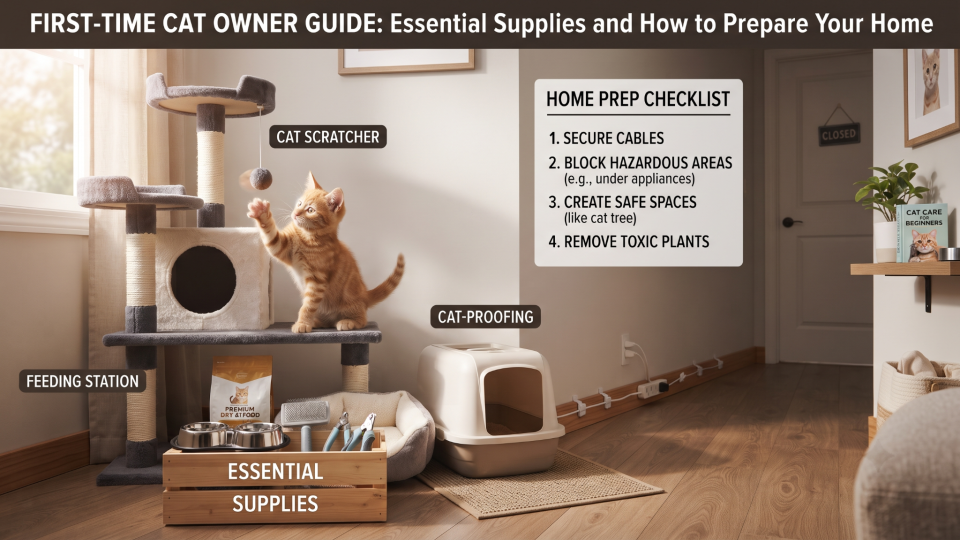
Bringing home your first cat is exciting, but it also introduces practical questions. Which supplies do you need immediately? Where should the litter tray go? Should you buy a cat tree, a water fountain, or an automatic feeder? And how can you help your cat feel comfortable in an unfamiliar environment?
A successful beginning depends on more than a shopping list. Your cat needs accessible resources, a secure place to retreat, and opportunities to explore and interact at a comfortable pace. Your household also needs a routine that makes feeding, cleaning, play, and observation manageable.
This guide focuses on preparing for a newly adopted, independently eating kitten or adult cat. Very young kittens, cats with medical conditions, and cats with specific behavioral needs may require an individual plan from a veterinarian or the organization caring for them.
You will learn what to buy first, how to arrange your home, how to evaluate optional products, and what to observe during the early days.
The Short Answer
Before bringing a cat home, prepare a quiet starting area with suitable food, fresh water, litter facilities, a hiding place, bedding, and scratching opportunities, plus a secure carrier for transport. Choose supplies around the cat’s size, age, mobility, and previous routine rather than buying a large matching collection. Introduce the home gradually and arrange veterinary care based on the cat’s history and needs.
What Should You Find Out Before Bringing Your Cat Home?
Ask the shelter, rescue organization, breeder, or previous caregiver about the cat’s existing routine. This information helps you prepare a familiar starting point and avoid unnecessary changes during arrival.
Keep a written record so that you can share relevant details with your veterinarian.
Food and Feeding Routine
Find out the exact food the cat currently eats, including the product name, format, approximate amount, and feeding schedule.
Ask whether the cat has a prescribed diet, known food-related concerns, or instructions that must continue. Do not replace an established medical feeding plan with a general product recommendation.
Knowing the existing routine also helps you distinguish a new behavior from a longstanding preference.
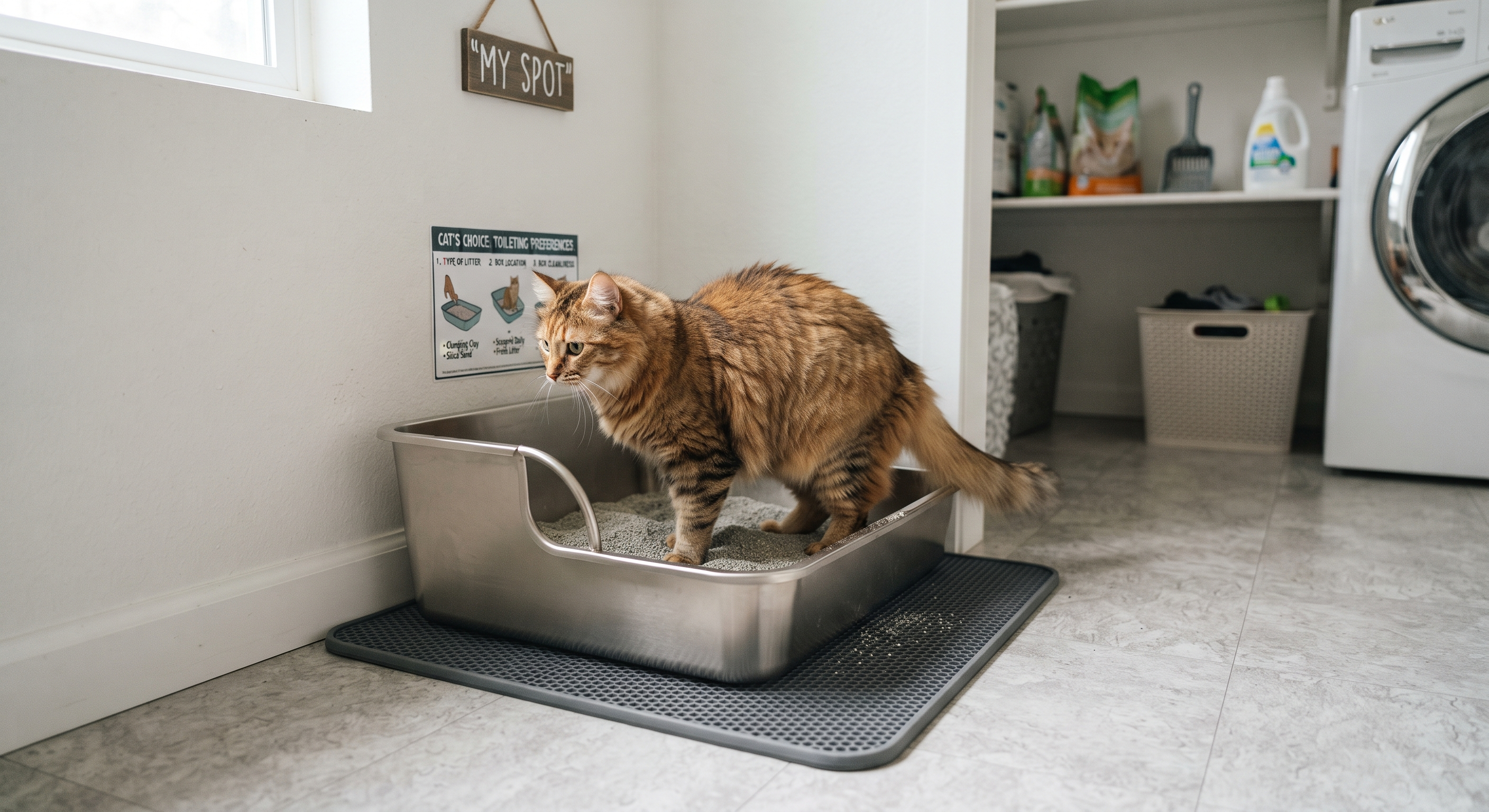
Litter and Toileting Preferences
Ask which litter and tray style the cat uses.
If the cat has a known preference, prepare a similar setup initially where practical. You can evaluate other options later, after the cat has settled and you have a clearer understanding of its needs.
Also ask about any history of toileting problems. That information should inform your setup and veterinary discussion.
Health Records and Ongoing Care
Request available records concerning vaccinations, parasite treatment, microchipping, neutering, previous illnesses, and current medication.
Check whether follow-up appointments are already recommended. Confirm the microchip registration process and any transfer requirements that apply where you live.
Temperament and Previous Living Conditions
Ask what helps the cat feel comfortable.
Does it prefer a covered hiding place? Is it accustomed to children, dogs, or other cats? Does it enjoy interaction, or does it need more time before approaching people?
Previous experience does not guarantee a particular response in your home, but it can help you prepare realistic expectations.
Which Cat Supplies Do You Need Before Arrival?
Focus first on supplies that meet everyday needs. Cornell’s guidance identifies food, a litter box, and scratching provision among the basic preparations for a new cat. vet.cornell.edu
The essential collection can be straightforward. Its usefulness depends on suitable design, placement, and maintenance.
A Secure Cat Carrier
Have the carrier ready before collecting your cat. It is also an essential item for veterinary visits and other necessary journeys.
Look for secure fastenings, ventilation, sufficient space, and surfaces you can clean. Check the manufacturer’s size guidance and ensure the cat cannot escape through openings or faulty closures.
Consider how you will place the cat inside and how you will clean the carrier afterward. Some designs have additional openings or removable sections that may make handling easier.
For transport, use the carrier according to its instructions. Do not rely on holding the cat in your arms or allowing it to move freely inside a vehicle.
Suitable Food and Food Bowls
Purchase the cat’s current food where possible and follow any existing professional instructions.
Choose bowls that remain stable during use and are easy to wash. Inspect the finish and edges, and consider whether replacement bowls are readily available.
A specialized feeder is optional. Start by learning how the cat eats and what your household schedule requires.
Water Bowls
Provide fresh water in accessible locations.
Select bowls that are stable and easy to clean, and keep a routine for checking them. Placement should be convenient for the cat without exposing the bowl to frequent disturbance.
A fountain can be considered later if it suits your cat and you can maintain it properly. It should not distract from the basic requirement to provide reliable access to water.
Litter Facilities
Choose a tray the cat can enter, turn around in, and use comfortably.
For a small kitten or a cat with limited mobility, entry height deserves particular attention. For a larger cat, usable internal space matters more than the product’s external dimensions.
Keep a scoop and suitable cleaning supplies nearby. Plan where used litter will go according to local disposal instructions.
A Hiding Place and Resting Area
A resting area does not need to be expensive.
A suitable bed, washable blanket, or stable cardboard box with a comfortable lining may provide a useful starting option. Remove handles, staples, loose pieces, or other hazards from improvised items.
Give the cat a choice between a more sheltered retreat and a place where it can observe the room.
Scratching Equipment
Provide an appropriate surface for scratching from the beginning.
Look for stability and enough usable space for the cat’s preferred posture. A vertical post, horizontal scratcher, or another suitable design may meet different preferences.
Position matters too. A product placed in an inaccessible corner may receive little attention.
A Small Selection of Toys
Begin with a few different types rather than buying a large collection.
You can evaluate what the cat enjoys and expand gradually. Check toys for detachable parts and inspect them during use. Store interactive toys with strings or similar components safely after supervised sessions.
How Should You Prepare a Quiet Starting Area?
Choose a secure, calm area where the cat can begin learning the sounds, smells, and routines of your home.
Battersea recommends a comfortable settling space and gradually opening more of the home once the cat is comfortable there. Battersea Dogs & Cats Home
A spare room may work well, but the best option depends on your home. Assess the space for safety, temperature, access, noise, and the ability to arrange resources appropriately.
Arrange Resources as Separate Areas
Avoid clustering every item into one small corner.
Provide distinct places for toileting, eating, drinking, and resting. Cats Protection advises keeping litter facilities away from food and water areas. Cats Protection
Think about the route between resources. The cat should not have to pass a noisy appliance, squeeze behind furniture, or approach a busy doorway to reach an essential item.
Provide an Accessible Retreat
A hiding place should offer privacy while remaining safe.
Block access to spaces where the cat could become trapped or where you could not reach it in an emergency. Offer a suitable alternative before doing so.
Avoid removing every hiding opportunity in an attempt to encourage interaction. A retreat can remain part of the room as the cat becomes more confident.
Reduce Disturbance
Keep arrival day calm.
Delay gatherings and introductions to several people at once. Make sure household members understand how to enter the room quietly and respect the cat’s retreat.
Where practical, coordinate cleaning and other noisy activities so that the starting area remains predictable.
Inspect the Room from a Cat’s Perspective
Look below furniture and behind appliances. Check shelves, cords, small objects, open containers, and escape routes.
A room that appears tidy at standing height may still contain hazards at floor level or on climbable surfaces.
What Should You Do When Your Cat Arrives?
Bring the carrier into the prepared area and make sure doors and windows are secure before opening it.
Allow the cat to emerge rather than pulling it out for an introduction. Keep your movements calm and give it room to investigate.
Cats Protection recommends letting the cat approach you and introducing family members gradually once it becomes more confident. Cats Protection
Keep the First Interaction Simple
Sit quietly at a comfortable distance. You do not need to fill the time with handling, toys, or repeated attempts to attract attention.
A cat may investigate immediately, remain in the carrier, or move to a hiding place. Observe what it does and avoid imposing a fixed expectation.
Maintain a Predictable Routine
Use consistent locations for resources and establish manageable times for feeding, cleaning, and interaction.
Predictability also helps you notice changes. If you know what food was offered and when the tray was cleaned, your observations become more useful.
Observe Basic Activities
Keep track of eating, drinking, toileting, movement, and interaction.
You do not need to monitor constantly, but you should know whether basic needs are being met. Do not automatically attribute every concerning sign to the move.
Expand Access Gradually
Once the cat appears comfortable in its starting area, consider allowing exploration of another prepared space.
Keep the original resources accessible during this process. Check each new area before opening it and continue to prevent accidental escape.
There is no single schedule that suits every cat. Follow the cat’s behavior and the advice provided by its caregiver or veterinarian.
How Do You Choose the Right Litter Setup?
Choose a setup the cat can use comfortably and that you can keep clean consistently.
The best product for your home still needs to work for the cat. A compact tray that fits neatly inside a cupboard may offer inadequate space, while an elaborate unit may create cleaning demands you cannot maintain.
Consider Usable Space and Entry
Evaluate the internal area, entrance, and any cover.
For cats with mobility limitations, ask your veterinarian about appropriate access. For kittens, choose a setup suited to their current size while planning for growth.
Keep the Location Accessible
Avoid placing the tray somewhere that is frequently closed off or difficult to reach.
Consider noise, foot traffic, and whether another animal could obstruct access. A location that seems convenient for cleaning may still be unsuitable for daily use.
Provide Enough Resources
Cats Protection recommends one litter tray per cat plus an additional tray as a general household guideline. Placement and access remain important, especially when several cats share a home. Cats Protection LearnOnline
Do not assume several trays placed side by side resolve every access problem. Consider how each cat moves through the home and whether resources can be used without conflict.
Make Changes Thoughtfully
If you decide to change litter or tray design, avoid changing several features at once without a reason.
A familiar option can help you assess the response to a new one. Persistent toileting problems warrant veterinary advice rather than repeated purchases alone.
How Can You Provide Scratching and Play Opportunities?
Build opportunities around what the cat actually does.
Cats Protection describes several scratching options and emphasizes observing the cat’s preferred surfaces and positions. cats.org.uk
Watch the Scratching Posture
Notice whether the cat stretches upward, scratches along the floor, or uses an angled surface.
Use those observations to evaluate equipment. Check whether the product remains stable and offers enough usable area.
You may need more than one suitable option in different places as the cat gains access to the home.
Evaluate Placement
Put scratching equipment where it can be used conveniently.
If the cat repeatedly scratches near a particular resting area, an appropriate surface nearby may be more practical than one hidden elsewhere.
Use Interactive Toys with Attention
Interactive play gives you an opportunity to learn the cat’s preferences.
Keep movements manageable, allow pauses, and watch whether the cat remains interested. Use toys as intended rather than turning hands or feet into play targets.
End the session and store equipment safely when supervision stops.
Rotate a Small Collection
Keep some toys available and exchange them periodically according to the cat’s response.
Rotation can also make inspection easier. Check seams, attachments, and surfaces before returning a toy to use.
Quick Comparison
Optional products are easiest to evaluate once you understand your cat’s routine. The following comparisons focus on practical features rather than declaring one choice best for every household.
Open Litter Trays and Covered Litter Trays
An open tray allows you to see the interior and inspect it easily. Check side height, stability, and usable space.
A covered tray provides an enclosed design, but you need to examine the entrance, internal dimensions, and cleaning access. Its external size may not reflect the space available to the cat.
Start with known preferences where possible and assess actual use.
Standard Water Bowls and Water Fountains
A bowl offers a simple arrangement with relatively few parts.
A fountain adds moving water and usually introduces a pump, filters, and additional cleaning requirements. Check how completely it can be disassembled and whether replacement parts are accessible.
Evaluate maintenance, reliability, and your cat’s response before treating a fountain as an essential purchase.
Basic Feeding Bowls and Automatic Feeders
A basic bowl makes feeding and cleaning straightforward.
An automatic feeder may support a particular schedule, but suitability depends on food compatibility, portion settings, cleaning, power supply, and the cat’s behavior.
Test any device while you are present. Automation still requires checks that food is being dispensed and eaten.
Scratching Posts and Horizontal Scratchers
A post offers an upright scratching surface. Stability, height, and surface quality are central features.
A horizontal scratcher provides a different posture and may suit a cat that prefers floor-level scratching.
Observe the cat before investing in a large structure based only on appearance.
Simple Resting Places and Cat Trees
A basic resting place can provide a comfortable starting option without taking much room.
A cat tree offers additional levels and surfaces, but it must fit the cat’s abilities and the available space. Check stability, platform dimensions, access, assembly, and maintenance.
A tall design is useful only if it can be used safely and comfortably.
How to Choose
Use these criteria when purchasing cat supplies:
- Start with a defined need. Identify what the product should help the cat do.
- Check size and access. Evaluate usable dimensions, entrances, and movement.
- Prioritize stability. Consider how the product behaves during ordinary use.
- Inspect materials and components. Look for loose parts, exposed fixings, or damage.
- Read cleaning instructions. Choose a maintenance routine you can follow.
- Investigate replacement supplies. Check filters, seals, covers, and other components.
- Consider location before purchase. Confirm where the item will fit.
- Buy gradually. Learn the cat’s preferences before purchasing duplicates.
- Keep ongoing care in the budget. Include food, litter, veterinary care, and maintenance.
For product reviews, seek information about actual dimensions, cleaning access, stability, and the conditions under which the reviewer used the item. An attractive photograph or high rating may leave those practical questions unanswered.
Important Safety Considerations
Prepare for foreseeable hazards and know how to obtain veterinary help. Product selection is only one part of making the home suitable.
Review Plants Before Arrival
Identify the plants and flowers in your home rather than relying on appearance or common names.
True lilies and daylilies are particularly dangerous to cats. ASPCA advises immediate veterinary contact if exposure is suspected; do not wait for symptoms before seeking help. ASPCA
Check new bouquets and gifts as well as existing plants.
Secure Household Hazards
Store medications, cleaning products, and small items away from access. Review cords, blinds, windows, balconies, and spaces behind appliances.
Before operating washing machines, dryers, or similar appliances, check that the cat is not inside.
Introduce each new area only after inspecting it.
Supervise Toys That Require It
Follow the manufacturer’s directions and remove damaged toys.
Store strings, ribbons, and interactive equipment safely after use. Do not leave a toy accessible simply because it was sold for cats.
Introduce Other Animals Gradually
Avoid an immediate face-to-face introduction.
Blue Cross recommends keeping the new cat in a separate starting area and using a gradual process that can include scent exchange before direct meetings. Adjust the process according to the animals’ responses. Blue Cross
Seek professional help if introductions are persistently difficult or unsafe.
Recognize Urinary Emergencies
Straining to urinate while passing little or no urine requires urgent veterinary attention. Cornell identifies urethral obstruction as an emergency needing immediate treatment. vet.cornell.edu
Do not assume repeated tray visits are simply difficulty adjusting to a new litter setup.
Arrange Veterinary Care
Contact a veterinarian to plan an initial assessment and review the cat’s records.
Ask for guidance tailored to its age, health, and history. Contact the clinic promptly about reduced eating or other concerning changes, and use emergency services for severe or rapidly worsening signs.
Save the details of both your regular clinic and an out-of-hours service before arrival.
Frequently Asked Questions
How Much Should I Buy Before My First Cat Arrives?
Buy enough to meet immediate needs: transport, food, water, toileting, rest, hiding, scratching, and suitable play.
Optional technology, large furniture, and extensive toy collections can wait until you understand the cat’s preferences.
Does My Cat Need an Expensive Bed?
Price does not tell you whether the cat will use a bed.
Consider size, location, washability, and the cat’s preferred resting style. Begin with a suitable option and observe before purchasing additional beds.
Should I Let My New Cat Explore the Whole House Immediately?
A prepared starting area makes the initial environment more manageable.
Expand access gradually after observing how comfortably the cat uses its resources and moves around. Check new spaces for hazards first.
Is Hiding Always a Sign That Something Is Wrong?
Hiding can occur during adjustment, but it should be assessed alongside eating, toileting, movement, and other behavior.
Do not use hiding alone to decide that everything is normal or that the cat is ill. Contact your veterinarian if it accompanies concerning changes or you are unsure.
Should I Buy an Automatic Litter Box First?
It is optional, and you should evaluate fit, entry, operation, cleaning, and manufacturer restrictions carefully.
A straightforward tray provides a starting option while you learn the cat’s habits. Any automatic system still requires supervision, maintenance, and observation.
Does Every Cat Need a Water Fountain?
A fountain is an optional product.
Reliable access to fresh water and a consistent cleaning routine are the starting priorities. If you try a fountain, evaluate whether the cat uses it and whether you can maintain it.
Can I Choose Supplies Based on Breed?
Breed alone is insufficient.
Evaluate the individual cat’s size, age, movement, habits, and medical needs. Product dimensions and practical fit are more useful than a broad breed label.
What Changes If I Adopt a Kitten?
Account for current size, growth, supervision, and age-appropriate feeding and veterinary care.
Check that entrances, toys, and other equipment are suitable for the kitten now. Reassess as it grows rather than assuming the original setup will remain appropriate.
Can My New Cat Share Everything with a Resident Cat?
Plan separate access to essential resources and a gradual introduction.
Cats Protection recommends providing sufficient feeding areas, water, litter facilities, resting places, scratching options, and retreats when introducing cats. Cats Protection
Watch whether either cat obstructs the other’s access.
What Is the Most Common Purchasing Mistake to Avoid?
Buying a large collection before understanding the cat’s needs.
Start with suitable essentials, observe how they are used, and let specific gaps guide later purchases. This makes the budget easier to manage and reduces unused items.
The Bottom Line
Prepare a secure starting area, gather the cat’s existing routine and records, and purchase supplies that make everyday needs easy to meet. Keep arrival calm and use your observations to guide gradual changes.
Before collection day, complete one final check: confirm the carrier, arrange the essential resources, inspect the room for hazards, and save veterinary contact details.