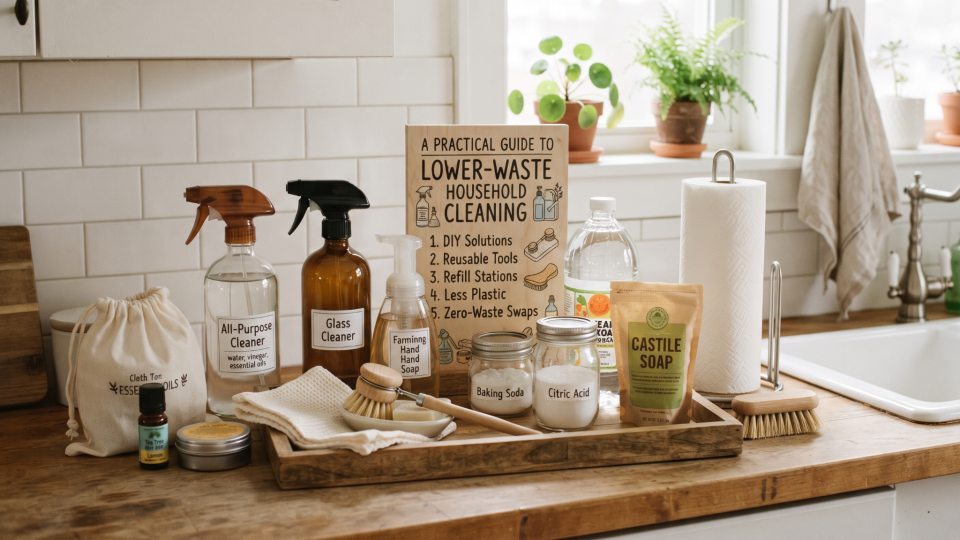
Household cleaning products often come with a familiar routine: buy a spray bottle, use the contents, and replace the entire package when it runs out. Refillable cleaning tablets offer a different approach. You keep a suitable bottle, add water and a measured tablet according to the instructions, and prepare another batch of cleaner at home.
The idea is appealing. Small refills take up less cupboard space, and keeping the same bottle can reduce the number of replacement bottles you purchase. However, convenience and environmental value depend on more than the tablet format.
A refill system needs to clean the surfaces you actually have, offer clear preparation instructions, and remain affordable after the starter kit is finished. Packaging claims, fragrance, bottle durability, and refill availability also deserve attention.
This guide explains how refillable cleaning tablets work, what to compare before buying, and how to decide whether they belong in your household cleaning routine.
The Short Answer
Refillable cleaning tablets can be worth buying if they clean effectively for your intended tasks, work with a durable bottle, and offer refills you can obtain at a reasonable total cost. They are most practical when you repeatedly use the same cleaner and are comfortable preparing it according to the label.
Choose by surface compatibility, cleaning performance, safety instructions, and cost per prepared bottle. Treat environmental claims as separate points to verify.
What Are Refillable Cleaning Tablets?
Refillable cleaning tablets are concentrated solid products designed to make a cleaning solution when combined with a specified amount of water.
This article focuses on tablets used to prepare household spray cleaners. Dishwasher tablets, laundry tablets, toilet-cleaning tablets, and hand-soap tablets have different purposes and should not be substituted for one another.
How Does the Refill Process Work?
The exact process varies by product, but it generally involves:
- Preparing the recommended bottle.
- Adding the stated amount of water.
- Adding the specified tablet.
- Waiting for it to dissolve as instructed.
- Attaching the sprayer and using the solution according to the label.
Follow the manufacturer’s order of preparation, water-temperature guidance, and instructions about when to close the bottle.
For example, Blueland sells a multi-surface refill tablet intended to prepare one 24-ounce bottle of cleaner. That volume is specific to the product; it should not be assumed to apply to other brands or tablet types.
Why Does the Water Measurement Matter?
The stated water volume determines the intended concentration.
Adding extra water to make the product last longer changes that concentration. Adding an extra tablet to make it “stronger” also changes the formula as used.
Use the specified dose rather than adjusting it by guesswork. If the prepared solution does not perform adequately, check the instructions and surface suitability before changing anything.
What Can Cleaning Tablets Be Used For?
The intended use depends on the formula.
Some products are designed for everyday multi-surface cleaning. Others target glass, mirrors, or particular bathroom surfaces. The fact that two products arrive as tablets does not make them interchangeable.
Everyday Surface Cleaning
A general-purpose cleaner may be suitable for routine dirt, spills, and light grease on approved surfaces.
Before purchasing, identify the surfaces you clean most often. Your needs may include kitchen worktops, cabinet fronts, tables, or appliance exteriors.
Then check whether the exact product covers those uses.
Glass and Mirrors
If streak-free glass cleaning is a priority, look for a product specifically intended for that task.
Evaluate the result using the recommended amount and a suitable clean cloth. Residue from a previously used cloth can make it difficult to judge the cleaner fairly.
Bathroom Cleaning
“Bathroom cleaner” can describe several different tasks: removing everyday dirt, addressing soap residue, treating mineral deposits, or disinfecting.
Check which task the product actually claims to perform. A tablet intended for routine surface cleaning should not be assumed to remove every type of bathroom buildup.
Specialized Surfaces
Take particular care with natural stone, unfinished wood, coated fixtures, screens, and other surfaces with specific maintenance requirements.
Check both the cleaner’s instructions and the surface manufacturer’s guidance. If either excludes the combination, choose another product.
Even a “multi-surface” description has limits. Blueland’s spray-cleaner guidance, for example, identifies sealed surfaces as the intended use for its multi-surface cleaner and distinguishes routine floor cleaning from spot cleaning.
Do Refillable Cleaning Tablets Work as Well as Conventional Sprays?
The format alone cannot answer that question.
A useful comparison considers the exact formula, type of dirt, surface, preparation, and wiping method. A ready-to-use spray is not automatically more effective, and a concentrated tablet is not automatically more powerful.
Define What “Works Well” Means
For your household, good performance might mean:
- Removing everyday marks without repeated applications.
- Leaving an acceptable finish.
- Being easy to wipe away.
- Producing a usable spray pattern.
- Requiring little preparation or extra effort.
Decide which results matter before comparing products.
For example, a cleaner that handles dining-table spills well may still be a poor choice for the heavy buildup you regularly encounter elsewhere.
Start With a Small Trial
A starter kit or small refill pack lets you assess the system before committing to a subscription.
Use it on approved surfaces through an ordinary cleaning cycle. Notice how often you reach for another product, how much solution you use, and whether the sprayer remains comfortable to operate.
This gives you a more useful basis for repurchasing than fragrance or packaging appearance alone.
Compare Under Similar Conditions
When comparing two cleaners, try to keep the task reasonably consistent.
Use clean cloths, follow each product’s instructions, and avoid comparing a fresh spill with an older dried deposit. Otherwise, differences in the task may be mistaken for differences in the formula.
A household trial is a practical purchasing aid. It should not be presented as laboratory proof of a broad performance claim.
Are Cleaning Tablets the Same as Disinfectants?
No. A product that cleans a surface should not automatically be treated as a disinfectant.
CDC distinguishes cleaning, which removes dirt and germs, from disinfecting, which kills remaining germs using appropriate products. CDC also notes that routine cleaning is sufficient in many household situations; disinfection may be needed in particular circumstances, including illness.
Look for an Explicit Disinfectant Claim
Do not infer disinfecting ability from a strong scent, foaming action, or language about freshness.
If you need disinfection, choose a product authorized for that purpose in your market and follow its label. Check the intended surfaces, preparation requirements, and application instructions.
Follow the Required Contact Time
For disinfectants, the time a surface must remain wet can be essential to correct use.
Spraying and immediately wiping may not follow the product’s directions. Check the label instead of applying the same routine to every cleaner.
Keep the distinction clear: visible cleanliness and a disinfectant claim answer different questions.
Are Refillable Cleaning Tablets Better for the Environment?
A refill system can reduce your purchases of replacement spray bottles when you continue using the same bottle.
That is a specific benefit you can observe. A claim about lower overall environmental impact requires a broader comparison.
Consider the Complete Refill System
Look at:
- The bottle and its expected service life.
- The sprayer and availability of replacements.
- Individual refill wrappers.
- Delivery packaging.
- Refill order sizes.
- Unused or wasted product.
- Actual cleaning performance.
A compact refill is only one part of the arrangement.
If the bottle fails early or the cleaner is unsuitable for your needs, the system may not deliver the practical benefits you expected.
Check What “Plastic-Free” Covers
A claim might refer to the tablet, its immediate wrapper, or a wider packaging system.
Read the scope rather than assuming it covers everything delivered to your door. Ask about any layers that are not explained.
Similarly, a compostable wrapper needs appropriate disposal instructions. Do not assume that its appearance tells you whether it belongs in home composting, commercial composting, or another waste stream.
Avoid Unsupported Carbon Claims
Replacing shipped liquid with a compact concentrate changes what is transported. However, a precise emissions claim needs evidence that accounts for the relevant manufacturing, packaging, transport, and use assumptions.
If a company publishes a percentage reduction, check what it was compared against and what the calculation includes.
Without that information, describe the refill format and packaging changes directly rather than assigning an environmental saving.
Keep Using the Bottle
Before buying, examine the part of the system you expect to retain.
Can you comfortably hold it? Does the trigger work well for you? Is the base stable? Can you identify the fill line easily?
A bottle that suits your routine is more likely to remain useful through repeated refills.
Quick Comparison
Cleaning Tablets vs. Ready-to-Use Sprays
Ready-to-use sprays avoid a preparation step. They may suit someone who wants to open a bottle and begin cleaning immediately.
Tablets require measuring water and allowing the product to dissolve. They may be convenient if you prefer storing compact refills and keeping the same spray bottle.
Compare the finished cleaning task, including preparation and refill availability.
Cleaning Tablets vs. Liquid Concentrates
Both formats can support refilling.
Tablets offer a premeasured solid dose when used with the correct water volume. Liquid concentrates may offer different dosing arrangements, depending on the product.
Look at cost per prepared volume, storage requirements, ease of measuring, and packaging. Neither format is universally the better choice.
Cleaning Tablets vs. Large Refill Containers
A large liquid refill can be a practical option when it is readily available and works with a bottle you already use.
Tablets may be easier to store in a small cupboard. Large refills avoid dissolution time but require space and may be awkward to pour.
Choose the system you can maintain consistently.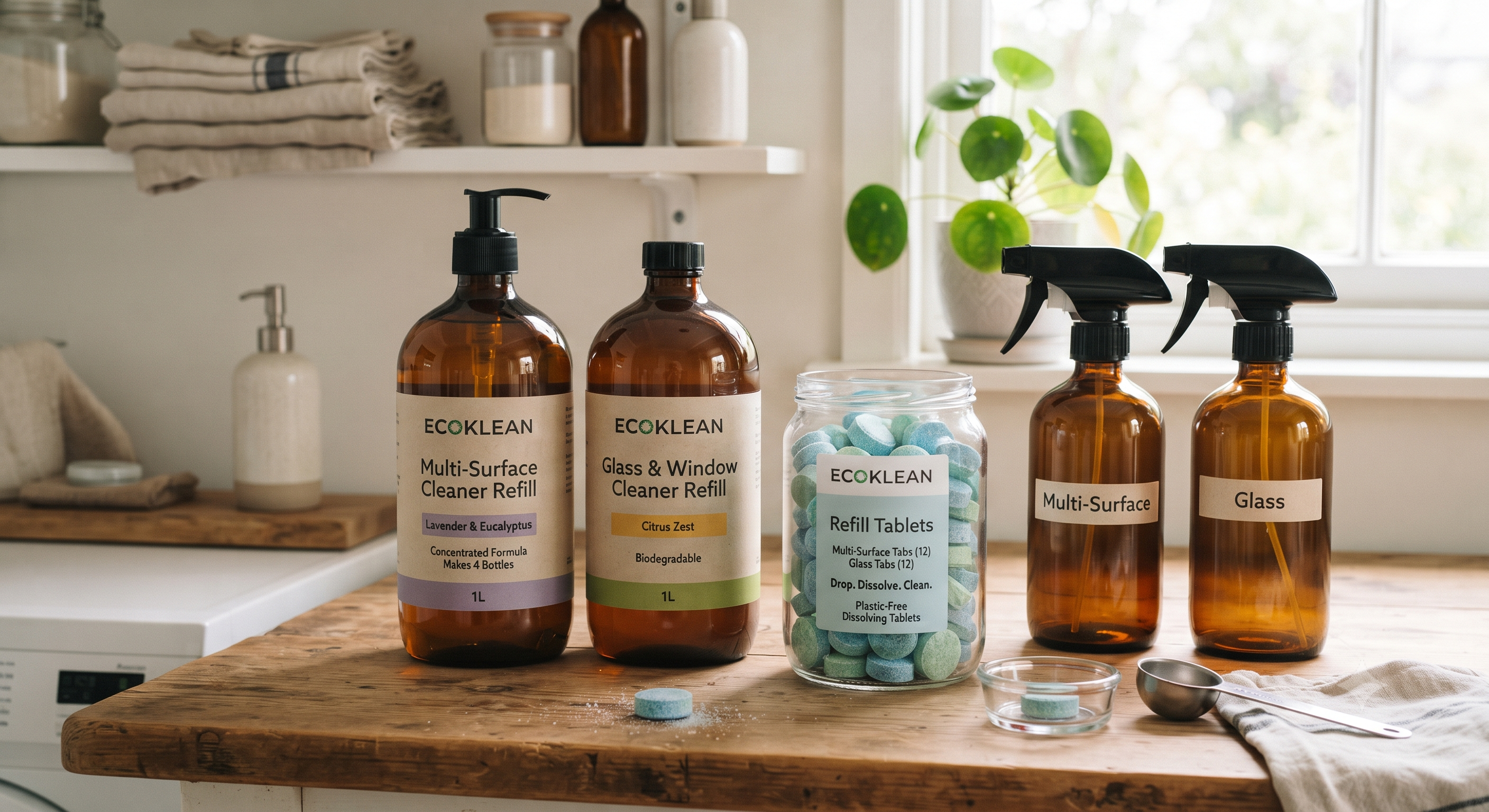
General-Purpose Tablets vs. Specialist Cleaners
A general-purpose cleaner may cover several routine tasks. Specialist products may still be appropriate for particular surfaces or deposits.
Avoid buying a separate formula for every room unless the tasks actually require it. At the same time, do not stretch a general-purpose product beyond its approved uses.
How to Choose
- List your main cleaning tasks. Identify the surfaces and types of dirt you deal with regularly.
- Check compatibility. Read exclusions as carefully as the list of approved uses.
- Separate cleaning from disinfection. Choose the function you actually need.
- Read preparation instructions. Confirm the water volume, dose, dissolution process, and bottle requirements.
- Compare refill costs. Include delivery charges and any required subscription.
- Assess the bottle. Consider grip, stability, trigger comfort, labeling, and replacement parts.
- Check ingredient and fragrance information. Look for clear disclosure rather than relying on broad “natural” language.
- Verify certifications. Search the relevant certifier’s database for the exact product.
- Start with a small purchase. Confirm performance before ordering a large supply.
In the United States, EPA provides a searchable list of products meeting its Safer Choice Standard. A listing can help you verify that specific certification claim; it does not replace the product’s use instructions.
How Much Do Refillable Cleaning Tablets Cost to Use?
Compare the cost of the prepared cleaner rather than the price of an individual tablet.
A low-priced tablet may make a smaller volume than a more expensive alternative. Delivery fees can also change the result.
Calculate the Refill Cost per Bottle
Use:
Refill cost per prepared bottle = Total refill order cost ÷ Number of bottles the order prepares
For example, suppose an order costs $18 including delivery and makes six bottles.
The refill cost is $3 per prepared bottle.
These figures are hypothetical and do not represent current pricing for a particular brand.
Include the Starter Kit
To estimate your early spending, include the bottle purchase.
Suppose a starter kit costs $20 and includes one prepared bottle’s worth of product. Five additional refills cost $10.
Your first six bottles would cost $30 in total, or $5 per bottle on average.
Later costs may differ if you retain the original bottle and only buy refills.
Check the Prepared Volume
Compare products using the same unit, such as cost per liter of prepared solution.
Also consider how the product performs. A cleaner you need to apply repeatedly may be less convenient than the price per bottle suggests.
Review Subscription Terms
Before subscribing, check delivery frequency, minimum orders, shipping thresholds, and cancellation arrangements.
Estimate your use from an initial trial. Ordering faster than you consume the product can create unnecessary stock.
How Should You Store and Maintain a Refill System?
Keep Tablets in Their Labeled Packaging
Retain the product identity, directions, and safety information.
Store refills according to the label, including any requirements to protect them from moisture.
Label the Prepared Bottle Clearly
The bottle should identify its contents. Keep preparation and safety instructions available, especially if several people use the cleaner.
Do not use a food or drink container for cleaning solution.
Follow Bottle-Cleaning Instructions
Check how the manufacturer recommends cleaning and preparing the bottle between batches.
Do not combine leftover solution from one product with a different refill formula. If you want to change products, confirm that the bottle is suitable and follow the relevant preparation guidance.
Check Storage Life
Look for separate guidance about unopened tablets and prepared solution.
Do not assume that a mixed product remains suitable indefinitely. Contact the manufacturer if storage-life information is unclear.
Important Safety Considerations
Never Mix Cleaning Products
Do not add bleach, vinegar, disinfectant, essential oils, or another cleaner to a prepared tablet solution.
CDC’s occupational safety guidance warns that mixing disinfectants with other cleaners or chemicals can create hazards, including toxic gases in some combinations.
Use each product according to its own instructions.
Store Refills Away From Children and Pets
Keep tablets and prepared solutions securely stored. A small solid refill is still a cleaning product and should never be treated like food or a toy.
Retain the packaging so the product can be identified if an exposure occurs.
Follow Protective Measures on the Label
Use ventilation, gloves, or other precautions when instructed.
An environmental certification or plant-derived ingredient claim does not make all forms of contact safe.
Check Food-Contact Surface Instructions
For kitchen counters, tables, and other food-contact surfaces, follow the product’s directions about application and rinsing.
Do not assume that every household cleaner is appropriate for utensils, food preparation equipment, or direct application to food.
Stop If the Product Causes a Problem
If you experience irritation, stop using it and follow the label’s first-aid guidance. Seek appropriate medical or poison-information advice when necessary.
Keep the product name and packaging available so you can describe the exposure accurately.
Frequently Asked Questions
Can I Use Any Spray Bottle?
Only use a bottle that meets the product’s requirements. Check its capacity, material, labeling, and previous contents. Follow the manufacturer’s guidance rather than assuming any empty bottle is suitable.
Can I Add More Water to Make a Refill Last Longer?
Use the specified volume. Extra water changes the intended concentration and may reduce performance.
Can I Add Two Tablets for Stronger Cleaning?
Do not increase the dose unless the product explicitly instructs you to do so. Check the surface and task instead of improvising a stronger mixture.
Are Cleaning Tablets Always Fragrance-Free?
No. Check the exact formula. A product range may contain several scents, and environmental positioning does not establish fragrance status.
Do Cleaning Tablets Disinfect?
Some products may be specifically designed and authorized for disinfection, while others are general cleaners. Verify the claim and follow the exact label.
Can I Use Them on Natural Stone or Wood?
Only when both the cleaner’s instructions and the surface’s care guidance permit it. “Multi-surface” does not mean suitable for every finish or material.
Are Refill Tablets Automatically Cheaper?
No. Compare starter costs, refill yield, shipping, replacement parts, and the volume of prepared cleaner. Use a small trial to assess consumption before committing.
What If the Tablet Does Not Dissolve Properly?
Recheck the instructions, including water volume, temperature, and waiting time. Contact the manufacturer if the problem continues rather than adding other substances or changing the dose.
The Bottom Line
Refillable cleaning tablets can be a useful option for routine household cleaning when the formula performs well and the refill system is easy to maintain.
Begin with one product for a clearly defined task. Verify surface compatibility, compare the full cost, and choose a bottle you can keep using comfortably. Expand only after the system has proved useful in your home.