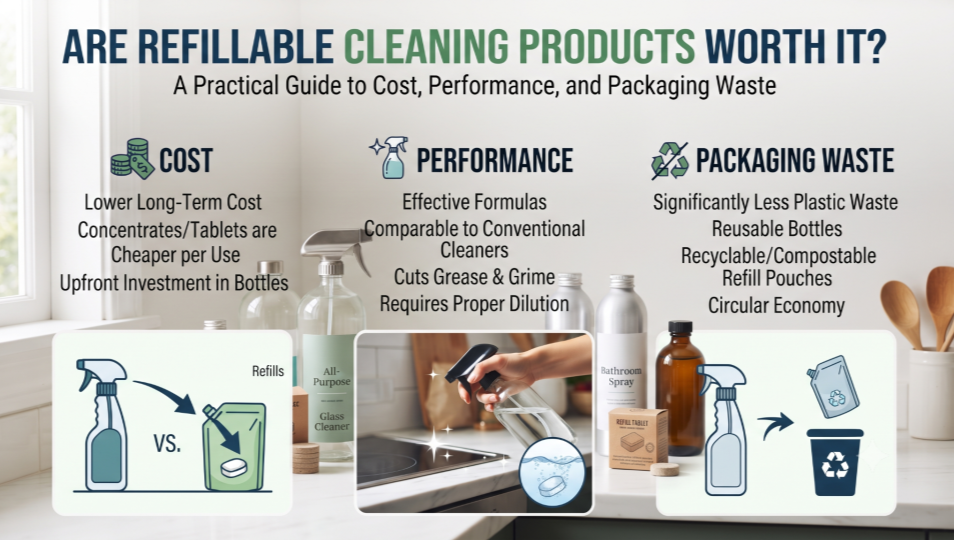
Replacing a disposable cleaning bottle with a refillable one sounds like an easy way to reduce household waste. Buy a durable bottle, add a refill when it runs out, and continue using the same container. Yet choosing a refill system involves more than finding attractive packaging or a small packet of cleaning powder.
Some refills arrive as ready-to-use liquids. Others require you to dilute a concentrate or dissolve a tablet in water. Their purchase prices, preparation instructions, cleaning performance, and packaging can differ considerably. A system that works well for one household may become inconvenient or expensive for another.
The most useful question is whether a particular refill product fits your cleaning needs, budget, and routine. This guide explains how to evaluate refillable cleaning products, calculate their ongoing cost, assess packaging claims, and introduce them into your home without buying more than you need.
The Short Answer
Refillable cleaning products can be worthwhile when they clean effectively, offer reasonably priced refills, and allow you to keep using a suitable bottle over time. Their environmental advantages depend on the complete system—including refill packaging, bottle durability, shipping, and how consistently you reuse it.
Before purchasing, compare the cost per equivalent amount of prepared cleaner, check surface compatibility, and confirm that replacement refills are easy to obtain.
What Are Refillable Cleaning Products, and How Do They Work?
Refillable cleaning products let you replenish a container rather than purchase a new dispensing bottle whenever the cleaner runs out.
The refill may replace the liquid directly or provide ingredients that you combine with water according to the manufacturer’s instructions.
Common formats include:
- Ready-to-use liquid refills.
- Liquid concentrates.
- Dissolvable tablets.
- Powder sachets.
- In-store refill stations.
- Supplier-managed return-and-refill containers.
These formats are purchasing and preparation options. They do not, by themselves, establish cleaning effectiveness, ingredient safety, or an overall environmental benefit.
The U.S. Federal Trade Commission’s Green Guides explain that an unqualified refillable claim should be supported by an actual way to refill the package, such as separately available refill products or a collection-and-refill system. This is U.S. marketing guidance, but the underlying buying question is useful anywhere: can you realistically refill the item after the starter kit is empty?
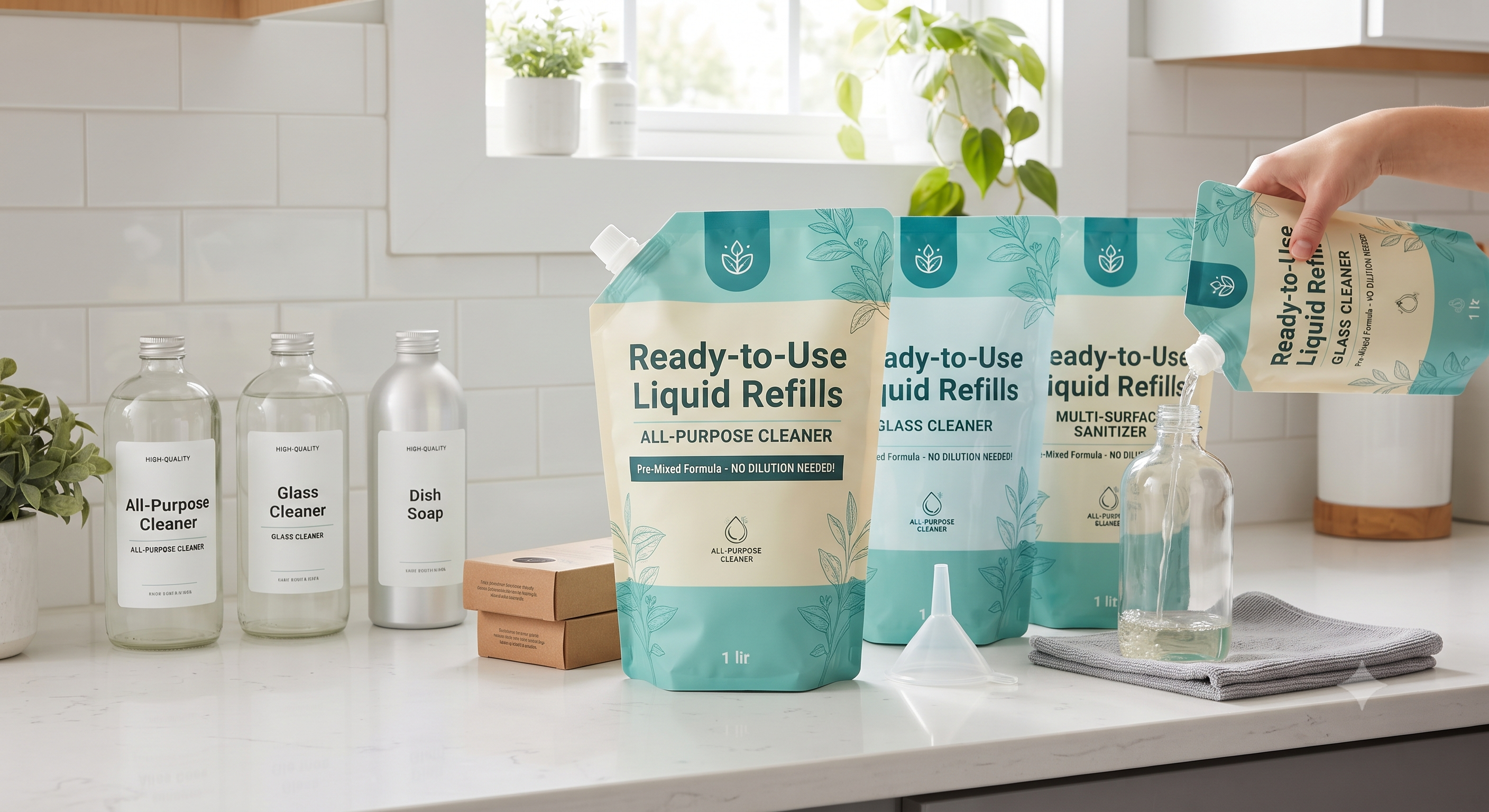
Ready-to-Use Liquid Refills
A ready-to-use refill contains cleaner at its intended use concentration. Where the instructions allow it, you transfer the liquid into the designated dispensing bottle.
This format may suit someone who wants a straightforward routine without measuring or waiting for ingredients to dissolve.
Before buying, check the refill volume and transfer instructions. A large refill container is convenient only if you can store it securely and pour from it without difficulty.
Liquid Concentrates
A concentrate requires preparation at the ratio specified by its manufacturer.
The important figure is the amount of usable cleaner produced after correct dilution. A small concentrate bottle can appear expensive when compared by package size, yet supply several prepared bottles.
Check whether the product includes a measuring cap, a marked bottle, or clear written quantities. A system that is difficult to measure adds unnecessary friction to a repeated household task.
Cleaning Tablets and Powders
Tablets and powders are typically prepared with a specified quantity of water in a suitable container.
Look for instructions covering water temperature, preparation order, dissolution time, and storage after mixing. Do not assume that every tablet works with every bottle size.
These products may appeal to households with limited storage space. Their usefulness still depends on cleaning performance and whether preparing a fresh batch fits your routine.
Refill Stations and Return Systems
A local refill station may let you replenish a suitable container, while a return system collects containers for the supplier to refill.
Ask about container requirements, product labeling, hygiene procedures, and pricing before your first visit. For a return service, check deposits, return deadlines, and collection arrangements.
Also consider the journey. A refill stop that fits an existing shopping trip is easier to maintain than one requiring a separate trip each time.
Do Refillable Cleaners Perform as Well as Conventional Products?
Performance depends on the formulation, intended task, preparation, and application—not simply on whether the product is refillable.
A refill system is useful only if its cleaner does the job you need it to do.
An everyday surface cleaner, a glass cleaner, and a bathroom descaler serve different purposes. Evaluate a refill against an equivalent product used for the same task, rather than expecting one formula to replace every cleaner in your home.
Start With a Specific Cleaning Task
Choose one familiar job for your first trial.
For example, you might evaluate a kitchen surface cleaner on a surface that the label explicitly permits. Use the recommended amount and method, then observe:
- Whether ordinary dirt is removed.
- Whether the product leaves visible residue.
- Whether wiping requires extra effort.
- Whether its fragrance is acceptable.
- Whether the spray mechanism works comfortably.
These observations provide a practical basis for deciding whether to reorder.
Check Surface Compatibility
Read the list of suitable and unsuitable surfaces before purchasing.
Do not infer compatibility from words such as “natural,” “gentle,” or “eco-friendly.” Ask the manufacturer when the guidance does not clearly address a material in your home.
Where the instructions recommend a small-area test, follow that advice before broader use.
Look for Meaningful Performance Evidence
A customer review can reveal usability issues, but stronger product documentation may help you assess the formulation itself.
For example, the U.S. EPA’s Safer Choice program evaluates ingredients and additional criteria, including performance, pH, and packaging. Products carrying the label must meet category-specific performance requirements. The label applies to qualifying products; it does not certify every item sold by the same brand.
Use the EPA’s product directory to check an exact product when a seller claims Safer Choice certification.
Are Cleaning and Disinfecting the Same Thing?
No. Cleaning removes dirt and organic matter, while disinfecting uses an appropriate product to kill specified microorganisms under its labeled conditions.
A refillable surface cleaner should not be assumed to disinfect because it smells strong, contains plant-derived ingredients, or makes a surface look clean.
In the United States, the EPA regulates surface products making sanitizing or disinfecting claims. Its guidance distinguishes these functions and emphasizes following product directions, including the required contact time for disinfectants. Other countries have their own regulatory systems.
When evaluating a product, decide which function you need. A cleaner intended for everyday dirt removal and a disinfectant intended for a specific hygiene task should be assessed against their respective claims.
For household guidance, the CDC explains that cleaning alone is sufficient in many situations, while additional disinfection may be appropriate when someone is sick or has recently visited while ill.
Are Refillable Cleaning Products Cheaper Over Time?
They can be, but you need to compare equivalent amounts of prepared cleaner and include the costs you actually pay.
Comparing a small concentrate with a large ready-to-use bottle by package price alone can be misleading. Comparing starter kits is also different from comparing ongoing refills.
Separate your calculation into two stages:
- The cost of starting the system.
- The recurring cost after the bottle is already owned.
Calculate the Cost per Prepared Bottle
Use this formula:
Cost per prepared bottle = Total refill purchase cost ÷ Number of equivalent bottles produced
Include shipping or other unavoidable charges in the purchase cost.
For illustration, suppose a refill pack costs $12 and prepares six bottles of 500 mL each. Its cost is $2 per prepared bottle before shipping.
If delivery adds $6 and you purchase only that pack, the total becomes $18, or $3 per prepared bottle.
These are hypothetical figures, not current prices for a particular brand.
To compare with a conventional cleaner, use the same prepared volume and a similar cleaning purpose. If one product prepares 500 mL and another contains 750 mL, convert both to a common volume first.
Account for the Starter Kit
A starter kit may include a bottle, spray head, and initial cleaner. Identify how much usable cleaner comes with it before comparing its total cost.
Consider this simplified hypothetical example:
- A starter kit costs $14 and includes one prepared bottle.
- Each subsequent refill costs $2.
- An equivalent conventional bottle costs $4.
- Shipping, tax, and bottle replacement are excluded.
After using the equivalent of (n) bottles, the refill system costs:
[
14 + 2(n-1)
]
The conventional option costs:
[
4n
]
Under these assumptions, both cost $24 after six bottles. The refill system becomes cheaper after that point, provided its bottle continues to work and the recurring price stays the same.
This is a financial comparison only. It does not calculate environmental impact.
Check Subscriptions and Minimum Orders
Before subscribing, review:
- Delivery frequency.
- Minimum purchase quantities.
- Cancellation and pause options.
- Shipping charges.
- Discounts that depend on recurring orders.
Estimate how quickly you finish the product. A lower unit price offers little practical value if deliveries accumulate faster than you use them.
Start with a small order when possible, then adjust purchasing around your actual consumption.
Do Refills Automatically Reduce Environmental Impact?
No. A refill format may reduce a particular packaging burden, but assessing the whole system requires more information.
The EPA identifies packaging and shipping among the considerations relevant to choosing greener cleaning products. It also cautions buyers about vague environmental claims.
For your purchasing decision, examine what changes between the refill system and the product it replaces.
Count All the Packaging
Look beyond the dispensing bottle.
A refill order may include a pouch or sachet, caps, labels, a delivery box, and protective materials. An online photo of a compact refill does not show every part of the shipment.
If a supplier claims a percentage reduction in packaging, ask what was compared:
- Packaging weight or volume?
- Plastic alone or all packaging materials?
- One refill or a year of use?
- Equal quantities of prepared cleaner?
- Shipping packaging included or excluded?
A percentage is useful only when its basis is clear.
Consider Bottle and Spray-Head Durability
Inspect the parts that make repeated use possible.
A durable bottle paired with an unreliable spray head can create inconvenience and replacement costs. Before buying, check whether the supplier offers replacement pumps or triggers and whether they fit your exact bottle.
During use, note leaks, difficult spraying, and worn seals. These details matter when evaluating whether the system deserves a second purchase.
Ask What an Environmental Study Actually Covers
If a brand provides a life-cycle assessment, check its scope before repeating the result.
Look for the compared products, amount of cleaning service delivered, transport assumptions, and expected bottle reuse. A result for one system does not establish the same result for every refill product.
Without that evidence, keep your conclusions specific. You may be able to document how many dispensing bottles you avoided buying, while still lacking enough information to estimate total emissions savings.
Quick Comparison
Ready-to-Use Refills
Best suited to: People who want a simple transfer-and-use routine.
They avoid a dilution step, although the refill container still needs storage space. Compare price by usable volume and check the designated bottle’s refill instructions.
Liquid Concentrates
Best suited to: People comfortable measuring and preparing cleaner.
They can supply multiple batches from a smaller package. Clear ratios, manageable measuring tools, and reliable access to refills are important buying criteria.
Tablets and Powders
Best suited to: Households that value compact storage and can accommodate preparation time.
Check the required bottle size, water instructions, and time needed before use. Evaluate the finished cleaner rather than judging the format alone.
Local Refill Stations
Best suited to: Shoppers with convenient access to a reliable supplier.
Ask about labeling and container requirements. Consider how easily the visit fits your existing errands.
Ready-to-Use Conventional Bottles
Best suited to: Situations where a suitable refill is unavailable or preparation would be impractical.
They offer convenience and may remain a reasonable choice for a specific task. Compare the exact formulation, price, and packaging rather than assuming a refill will always be preferable.
How to Choose
- Start with one product you use regularly. A frequent task gives you a clearer basis for evaluation.
- Choose the correct cleaning function. Distinguish general cleaning from sanitizing or disinfecting.
- Check your surfaces. Confirm compatibility before purchasing.
- Read preparation instructions. Make sure the required measuring and mixing are manageable.
- Compare equivalent prepared quantities. Include delivery costs.
- Inspect the dispensing bottle. Consider grip, stability, capacity, and spray-head replacement.
- Verify exact certifications. Check the product name and listing.
- Investigate refill availability. Look at stock, delivery arrangements, and local access.
- Buy a small trial quantity. Evaluate performance before committing to bulk orders.
- Track actual use. Reorder according to consumption rather than promotional urgency.
How Can You Introduce Refills Without Replacing Everything at Once?
Make the change when a frequently used cleaner is running out, then evaluate one replacement before expanding.
Start by reviewing the products you already have. Identify their purposes and remaining quantities. There is little reason to purchase several replacements before you know whether a new system works for you.
Choose one category, such as an everyday cleaner for a compatible surface. Keep a short note of its price, prepared volume, and refill date.
After using it, answer four questions:
- Did it clean the intended surface adequately?
- Was preparation straightforward?
- Was the dispensing bottle comfortable and reliable?
- Would you purchase the refill again at its normal price?
If the answers support continuing, retain the bottle and reorder as needed. If the product does not fit your routine, use those observations to guide the next choice.
This approach makes the decision manageable and produces more useful experience than buying a complete collection immediately.
Important Safety Considerations
Follow the Exact Dilution Instructions
Prepare concentrates, tablets, and powders according to the manufacturer’s directions.
Do not assume that adding extra concentrate improves performance, or that extra water is acceptable. For disinfectants, the EPA specifically advises against dilution or mixing unless the label directs it.
Do Not Mix Cleaning Products
Do not add another cleaner, disinfectant, fragrance, or household ingredient to a prepared refill.
The CDC advises against mixing products or chemicals and recommends clearly labeling diluted cleaning or disinfectant solutions.
Use a Suitable Container
Use the designated bottle or a container explicitly permitted by the manufacturer. Keep its product identification and preparation instructions available.
Before reusing a bottle from another product, ask whether it is compatible and how it should be prepared. Avoid experimenting with residues from an unknown previous formulation.
Store Products Securely
Follow label instructions for storage, protective equipment, ventilation, and disposal. Keep cleaning products out of children’s reach, including small refill units that may be easy to handle.
Do Not Interpret “Natural” as a Safety Guarantee
The EPA explains that an ingredient’s natural or renewable origin does not, by itself, determine its health or environmental effects. Assess the formulation and use instructions rather than relying on the word “natural.”
For accidental exposure, follow the product’s first-aid instructions and contact an appropriate local poison information service or medical professional.
Frequently Asked Questions
Can I Use Any Old Spray Bottle for a Refill?
Use a bottle allowed by the product’s instructions. If you want to reuse a different container, check compatibility and preparation requirements with the manufacturer before filling it.
Are Cleaning Tablets Better Than Liquid Refills?
Neither format is automatically better. Compare the finished cleaner’s performance, price, preparation requirements, and suitability for your home. Compact storage may favor tablets, while immediate use may favor liquid refills.
How Long Can I Keep a Prepared Cleaning Solution?
Follow the manufacturer’s guidance. Do not invent a storage period based on another cleaner’s instructions. Ask the supplier if the product does not specify how long the prepared solution remains suitable for use.
Are Fragrance-Free Refills Available?
Availability depends on the supplier. Check the exact formulation rather than assuming every product in a range has the same fragrance options.
The EPA offers a separate Safer Choice fragrance-free designation for qualifying products, which can help shoppers researching those options.
Does a Refill Cleaner Kill Germs?
Only rely on sanitizing or disinfecting claims that apply to the exact product and its prescribed use. A general-purpose cleaning claim does not establish disinfection.
Should I Buy a Large Refill Bundle?
Try the product first. Once you know its performance and your consumption rate, assess whether a larger order offers useful savings without creating storage problems or excess stock.
What if the Brand Stops Selling Refills?
Check whether another product is explicitly compatible with the bottle. A reusable container remains useful only when its continued use is supported by appropriate instructions and an available supply.
Are Refill Pouches Recyclable?
Check the exact pouch and your local collection service’s rules. Ask the supplier for the packaging material and disposal instructions; a refill claim does not establish recyclability.
The Bottom Line
Refillable cleaning products are worth considering when they combine effective cleaning, clear preparation instructions, durable dispensing equipment, and affordable, accessible refills.
Start with one product you use often. Evaluate its performance, calculate its real recurring cost, and keep reusing the bottle if the system works for your home.
Editorial Sources
- U.S. EPA — Identifying Greener Cleaning Products
- U.S. EPA — Learn About the Safer Choice Label
- U.S. EPA — Frequently Asked Questions on Safer Choice
- U.S. EPA — Search Products That Meet the Safer Choice Standard
- U.S. EPA — Differences Between Cleaning, Sanitizing, and Disinfecting
- CDC — When and How to Clean and Disinfect Your Home
- Federal Trade Commission — Environmental Claims: Summary of the Green Guides